

Frost Ferns 6349, photo by SNiedzwiecki.
Stacy writes that this (and a few more) are photos of frost on her front storm door on a subzero afternoon.
Frost Ferns 6349, photo by SNiedzwiecki.
Stacy writes that this (and a few more) are photos of frost on her front storm door on a subzero afternoon.

Fly fisherman with Brown Trout, photo by Photos from the Archives of Michigan.
The photo is captioned Unidentified man holding a brown trout caught on a fly. Location is somewhere in northern Michigan, c. 1930. They have several more Michigan fishing photos including one of Gov. George Romney releasing the first Atlantic Salmon into the Great Lakes in the early 1960s.
View more images from the Archives of Michigan on their Flickr page and also at seekingmichigan.org. Learn more about the Archives at archivesofmichigan.org.

Well, this was SUPPOSED to be a photo of the moon in honor of tonight’s total eclipse of the moon.
What can I say? I’m easily distracted.
Mark took this photo in Saline with a Diana camera and it’s just one of many in his outstanding alternative cameras set (slideshow) featuring images from Polaroids, 110 cameras, toy cameras, and Holgas.
Here are some ACTUAL Michigan photos from the lunar eclipse of February 20, 2008!

Saginaw Bay Ice Shanty c.1925, photo by oldog_oltrix.
Larry writes that this photo was taken by his grandfather at his ice shanty on Saginaw Bay (probably near Bay Park) in the mid-1920s. The 6′ bar between the shovel and the axe is a “spud” used with the axe to make the hole in the hole in ice and the pole coming from the top of the shanty is likely a “pickerel spear”. The This is one of the photos in his Oldog’s OLD PHOTOS set, and it also appears in the Michigan Thumb Memories group.
Over on Michigan Sportsman, Capt. Dan Manyen has written a nice little article titled The Fishing History of the Saginaw Bay. In it, he shares a number of old photos and provides a nice overview of the last few centuries of fishing on what I’m going to guess is Michigan’s largest bay. Capt. Manyen writes that walleye was mis-identified by many back then as pickerel and sold in great numbers to both local fish market outlets and buyers from the eastern states. He says that for many in the area, the burgeoning auto industry…
…did not stop or ease the pain of the Great Depression during this time. What did for many though, including my own Grandfather, was the plentiful fishing and hunting resources the Bay area offered. When Grandpa couldn’t get a job unloading the (Bean Boat) as he called it for .50 cents a day, he’d be out hunting or fishing for a meal for his family. Grandpa talked often about spending all winter out on the ice on Saginaw Bay in a (Pickerel Shanty) spearing pickerel.
I’m not sure where you might want to take this, so here’s the Wikipedia entries for Pickerel, Walleye and Saginaw Bay. You might also be interested in the Saginaw Bay Watershed Initiative Network, the Saginaw Bay Fishing Report and a more recent photo of ice fishing on Saginaw Bay.
Also see Saginaw Bay on Absolute Michigan’s Map of Michigan.

thru the woods, photo by litchard.
I’d never heard of the Wing Aero Sleigh – designed & built by Blain Wing in St. Ignace, Michigan in the 1940s – but Milton has a bunch of cool photos of the Aero Sleigh in action (slideshow)
There’s some information about how these were used from the Drummond Island Yacht Haven.
He uploaded the photos pretty large so be sure to click through check them out!
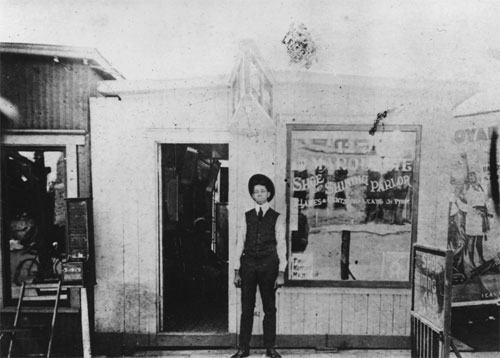
William Leabs, Jr., photo courtesy the Archives of Michigan
The description from the Archives of Michigan begins:
Here, we see William Leabs, Jr., an African American businessman. He’s standing in front of his store, the Marquette Shoe Shining Parlor (view larger). This business is listed in the Lansing City Directories of 1902 and 1904, and the photo presumably dates from about that same time frame.
Lansing’s African American heritage is as old as the city itself. Lansing’s first black resident of record is James Little, a freed slave from New York state. Little came to Lansing in 1847 (the year of the city’s founding) and started a farm.
Lansing’s black population increased slowly during the remainder of the 19th Century. Many black settlers came from other Northern states and from the upper South. Some were Canadians descended from escaped slaves. Others came from elsewhere in Michigan, with the majority of those hailing from Cass County (Freed slave communities had been established there before the Civil War.).
You can read more at the Image of the Month for February 2008 and also in Robert Garrett’s article The Birth and Death of Lansing’s Black Neighborhoods in the Lansing City Pulse.
February is Black History Month in Michigan and you can get a ton more articles from Absolute Michigan’s Black History in Michigan.

Paul Bunyan, photo by I am Jacques Strappe.
The Michigan Historical Museum is planning an exhibit called Michigan’s Roadside Attractions, set to run from January to June of 2009. They are looking for stories, pictures and artifacts of the unique places – open or long shuttered – that folks visit on the way from someplace to someplace else. Michigan Historical Museum System Director Phillip C. Kwiatkowski says:
We want to hear what made you stop at these roadside attractions – places like the Mystery Spot in St. Ignace, Deer Forest in Coloma, Windmill Island in Holland and the multiple locations where Paul Bunyan has been spotted – and to see the photos you took and the souvenirs that you kept. Our biggest need is your treasured mementoes, from miniature Paul Bunyan statues and plastic purses to dinosaurs, seashells and even ceramic doll dish sets.
If you can help, please contact Eve Weipert, curator of collections, at (517) 373-1509 or weiperte@michigan.gov. Most artifacts used in the exhibit will be considered on loan and will be returned after the exhibit ends. The museum has an established review process that is utilized prior to acceptance of loans or permanent donations. Artifacts are needed by April 1, 2008 to allow time to complete the exhibit storyline around the available artifacts.
This photo by Marjorie is part of her Roadside Curiosities set (slideshow) and it’s available “Bunyan-sized” for your desktop wallpaper.
If you’re interested in Michigan’s roadside attractions, here’s some “roadside” photos from the Absolute Michigan pool, Michigan Tourist Traps from WaterWinterWonderland.com, the “roadside” tag on Michigan in Pictures, this Absolute Michigan “Weird Wednesday” featuring Domke’s Dinosaur Gardens and of course, Michigan’s legendary Big Boy Graveyard.
If you have links or memories to share, post them in the comments!

Packard Proving 058 B&W 4×6, photo by Kevin Ridge Photo.
Kevin is one of a large number of very talented photographers who will be presenting work at the Exposure.Detroit January 2008 Photography Exhibit. He took this photo on one of the group’s photo safaris to the Packard Proving Grounds – check out his photos from the outing and/or everyone’s.
What: Exposure.Detroit January 2008 Photography Exhibit
When: 7pm-10pm ~ January 18th, 2008
Where: The Bean & Leaf Cafe, Royal Oak, MI
Who: 30 of Exposure.Detroit’s finest photographers
Coming to you via the coffee coated walls of the Bean & Leaf Cafe (the BLC) is the next round of talented Michigan photographers (in no particular order):
Ledio
LAWRENCEcreative
Ken Jacoby
Amy Palomar
Vanessa Miller
Ryan Southen
Mike Harabedian II
Mark F. O’Brien
One Foot Over The Moon
Detroit Derek
Stephanie Aust
C.J. Peters
Meghan East
David M. Haupt
St. Laurent Photography
Larry Carr
Scott Carey
Kyle Engelhart
James Szewczyk
Keith Burgess
Becky Layton
Ross Sandelius
Kevin Ridge
Rob Terwilliger
Patrick Simpson
David Kohrman
Paul Nichol
Paul K
John Levanen
Alexander J. Hernandez
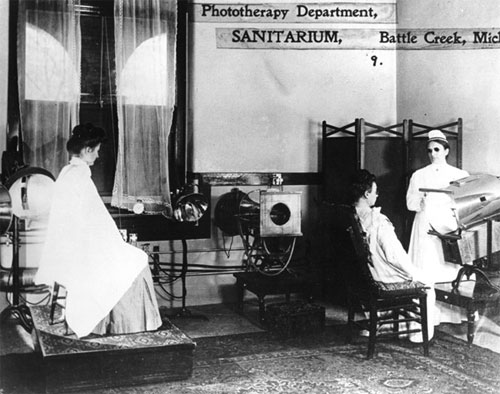
Phototherapy Department at the Battle Creek Sanitarium, courtesy Willard Library
The Willard Library has an amazing collection of photos from the Battle Creek’s history. Prominent among these are of course photos from the Battle Creek Sanitarium. The Battle Creek Sanitarium Years from the Battle Creek Federal Center is a good companion article and explains:
Dr. John Harvey Kellogg (1852-1943) took charge of the Institute for the Seventh-day Adventist Church in 1876 and changed the name to the Battle Creek Sanitarium. He came up with the word “sanitarium” to reflect his idea of a sanitary retreat for health restoration and training (“a place where people learn to stay well”) rather than “sanitorium,” which meant a hospital for invalids or for treatment of tuberculosis. The San, as the place was familiarly known, prospered under Dr. Kellogg’s direction…
Dr. Kellogg’s medical treatment embraced all branches of medicine, including surgery, but with emphasis on fresh air, sunshine, exercise, rest and diet. The SDA dietary practices eliminated meats, condiments, spices, alcohol, chocolate, coffee and tea. Nutritious substitutes were created for “harmful” foods. Dr. Kellogg invented some 80 grain and nut products.
Somewhere amidst all of this, flaked cereal was invented and John’s brother William Keith Kellogg and C.W. Post began a breakfast bowl battle that basically created the breakfast cereal industry. There’s much more at the link above (including some more great photos) and you can also see Wikipedia’s entry on the Battle Creek Sanitarium, the entry on John Harvey Kellogg from the Battle Creek Historical Society and Mr. Breakfast’s Early Days of Breakfast Cereal.

 Michigan in Pictures
