100,000 photos in the Absolute Michigan Pool

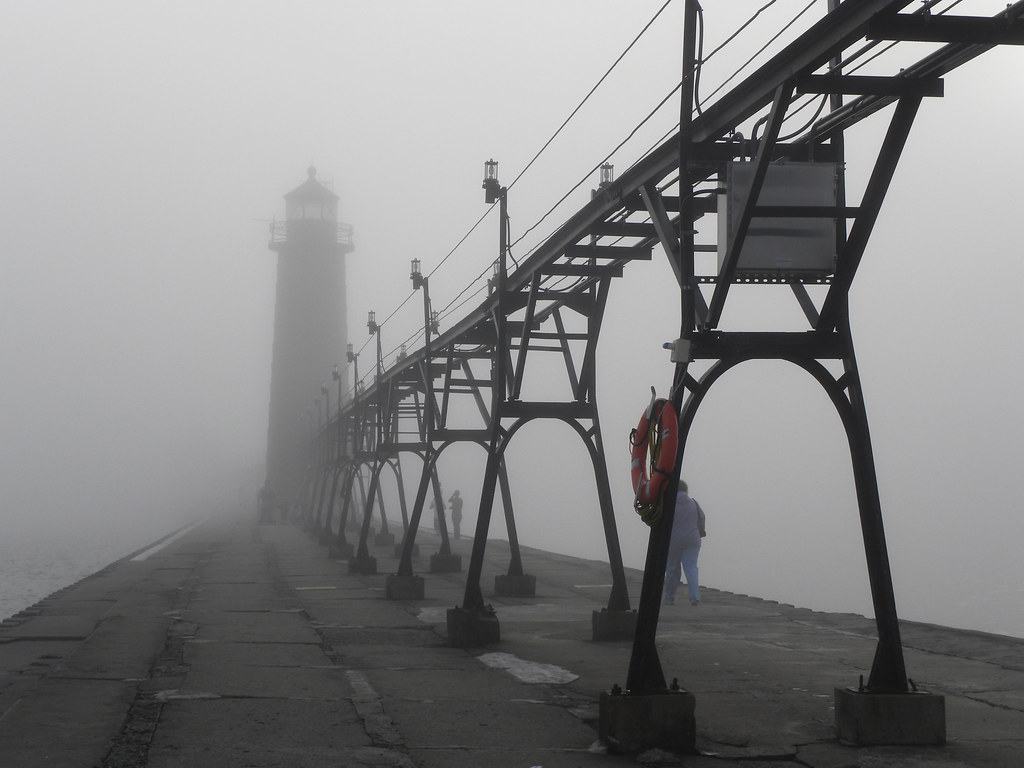
Can You See Me Now...?(.142/365) by Sydney Marie Photography

Can You See Me Now…?(.142/365) by Sydney Marie Photography

Sometime over the weekend, the 100,000th photo was added to the Absolute Michigan pool on Flickr.

One hundred thousand.

What an amazing gift you nearly 2400 photographers have shared with Absolute Michigan and Michigan in Pictures over the last four and a half years. Whether it’s dandelions or Detroit Lions, hill sides or mud slides, if it’s Michigan, chances are there’s a photo of it in the Absolute Michigan photo group!

Check this out bigger and in Sydney’s 365 slideshow.

Support Michigan in Pictures with Patreon

Step back in time at Greenfield Village

Greenfield Village
Greenfield Village, photo by Michael Lavander

“I am collecting the history of our people as written into things their hands made and used…. When we are through, we shall have reproduced American life as lived, and that, I think, is the best way of preserving at least a part of our history and tradition.”
~Henry Ford on his museum

Greenfield Village in Dearborn (satellite map) is part of The Henry Ford, dubbed America’s Greatest History Attraction. If you’ve ever been to either, you know that’s not just a marketing slogan. Greenfield Village has seven historic districts that are jam packed with historical buildings & artifacts from all over:

Entering Greenfield Village is like stepping into an 80-acre time machine. It takes you back to the sights, sounds and sensations of America’s past. There are 83 authentic, historic structures, from Noah Webster’s home, where he wrote the first American dictionary, to Thomas Edison’s Menlo Park laboratory, to the courthouse where Abraham Lincoln practiced law. The buildings and the things to see are only the beginning. There’s the fun stuff, too. In Greenfield Village, you can ride in a genuine Model T or “pull” glass with world-class artisans; you can watch 1867 baseball or ride a train with a 19th-century steam engine. It’s a place where you can choose your lunch from an 1850s menu or spend a quiet moment pondering the home and workshop where the Wright brothers invented the airplane. Greenfield Village is a celebration of people — people whose unbridled optimism came to define modern-day America.

Michael took this photo at the museum’s opening day and you can see it bigger in his Greenfield Village 041510 slideshow.

Need more? Check out the Greenfield Village slideshow from the Absolute Michigan pool and more posts about Greenfield Village on Michigan in Pictures.

Enjoy your weekend and remember that Michigan’s museums need your patronage more than ever!

some dudes, up to no good

some dudes, up to no good

some dudes, up to no good, photo by jenny murray.

Have a great weekend and do your best to be up to some good.

Check this triple (?) exposure shot out bigger and in Jenny’s slideshow.

Speaking of up to some good, Michigan’s Smoke Free Air Law takes effect tomorrow night and bans smoking in all Michigan restaurants, bars and businesses (including hotels and motels).

More photos from jenny murray on Michigan in Pictures.

Laughing Whitefish Falls (and hey brother help a brother from Michigan out!)

Laughing White Fish Falls

Laughing White Fish Falls, photo by John.Dykstra.

I’m goin away, ’cause I gotta busted heart.
I’m leavin’ today, if my TravelAll will start.
And I reckon where I’m headed, I might need me different clothes
way up in Michigan, where the Laughing River flows.
~Greg Brown, Laughing River

Waterfall supersite Go Waterfalling says that Laughing Whitefish Falls looks bigger in person and:

…is in the Laughing Whitefish Scenic Site. This is one of the most impressive of Michigan’s waterfalls. I believe it is the highest waterfall in Michigan that is readily visitable.

The falls can be found off of M-94, about 30 miles from Munising or Marquette, and just outside of Chatham.

…The waterfall is named for the river. The river is so named because the mouth of the river resembled a laughing fish when viewed by the Ojibwe from Lake Superior.

The photo was taken by John Dykstra and John is a high school senior who is near the top of the voting for the Sigma Corporation of America Scholarship. They will award a cash gift & Sigma products for one senior to advance his or her education and goals toward obtaining a career in the photography industry.

John asks you to look at his work as he wants honest support. He writes that he is an:

…aspiring artist with an intense passion for landscape photography, the main point of interest being the innate beauty of the Michigan wilderness. The prize is for $5000 + $1000 in Sigma products, all of which I would be using to get an immense jump start in my fine art photography and nature conservancy career. I would be able to get the equipment I need right now and begin shooting across the state’s forests within weeks of graduating.

You can learn about the contest here and see and vote for John’s entry right here. See this photo bigger in John’s slideshow.

Grand Rapids Founding Day Parade, May 1, 2010

NOTE: This event has been CANCELLED!


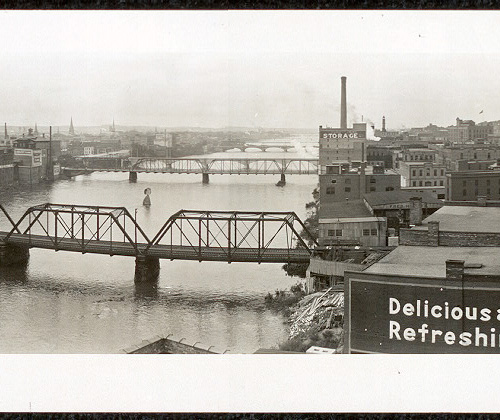
Grand Rapids, 1915, photo by Kenneth Spencer

Grand Rapids cruise director Rob Bliss has launched the latest in a series of events, the Grand Rapids Founding Day Parade (view poster). The first annual of this event happens May 1, 2010 and he writes:

May 1st will be the 160th Anniversary of the Founding of Grand Rapids, and to mark that day I am putting on a large scale parade and celebration. Floats, marching bands, and retro cars will all be involved in making this day great.

$5,000 Float Competition: $5,000 will be given away to the best float, decided by a public vote. Anyone can enter a float and be in the parade and possibly win this prize, and there is no entry fee. All floats must have some connection to the greater Grand Rapids area (includes lowell, caledonia, etc.) but are very open ended. A local band playing local music on a float stage would apply! Dance party on the blue pedestrian bridge as a float would work. Whatever idea you have will most likely work.

…This parade is decided by a public vote, with paper voting taking place at the end of the parade, near the Grand Rapids Library and Veterans Memorial. Mayor Heartwell will be speaking to the crowd following the event.

This exciting new community event works to celebrate and to continue to push our city forward. Very few citizens know when their hometown was founded; come downtown and help celebrate our community.

This photo from the Library of Congress is available as a stunning panorama which I hope you get a chance to see. You may also want to explore the photographic history of Grand Rapids through the photographs from the Grand Rapids Historical Commission’s online archive!

Happy Ernie Harwell Day!

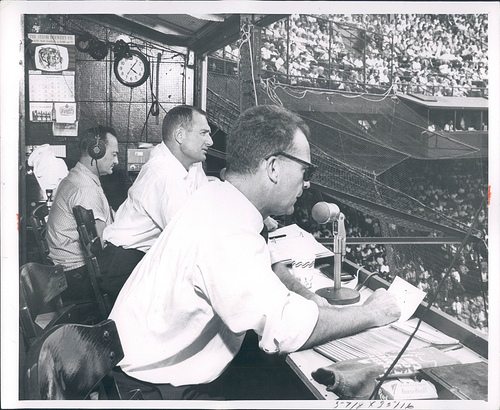
Ernie Harwell & George Kell broadcasting for the Detroit Tigers
George Kell Ernie Harwell 1961, photo by doctor_gogol.

For, lo, the winter is past,
the rain is over and gone;
The flowers appear on the earth;
the time of the singing of birds is come,
and the voice of the turtle is heard in our land
~Ernie Harwell quoting the Song of Solomon (listen)

The Detroit Free Press notes that today is not just the Detroit Tigers home opener against the Cleveland Indians, but also that April 9 is now Ernie Harwell Day by decree of the Michigan Senate.

The Detroit News Rearview Mirror on Ernie Harwell writes that the Baseball Hall of Fame and longtime Detroit Tigers announcer was born on January 25, 1918 in Washington, Georgia, was so tongue-tied as a youngster that kids made fun of him and became the only broadcaster ever traded when the minor league Atlanta Crackers traded him to the Brooklyn Dodgers for farmhand Cliff Draper.

In 1950 Harwell was lured to the rival New York Giants, where one year later he broadcast the debut of Willie Mays. From 1954 to 1959, Harwell was the voice of the Baltimore Orioles.

George Kell was finishing his Hall of Fame career as a player with the Orioles, and one day Ernie invited him into the radio booth. Kell later landed a job with the Detroit Tigers and in 1960 the Detroit club signed Harwell to become Kell’s partner. “It’s the best move I ever made,” Ernie said. “I’ve been very happy in Detroit.”

…Baseball author Bruce Shlain reflects: “Somehow he brings the proper pitch and phrasing to a whole season, with a rhythm and pacing that only a select few have ever commanded. In many ways a Harwell broadcast is profoundly musical, as befits a man who has published 55 songs with composers such as Johnny Mercer. Many an announcer has aspired to sounding as if talking to a friend in his living room, but Harwell effortlessly establishes the same rapport on the air as he does in person.”

Be sure to check out this shot of Ernie & George Kell out bigger and see more in Doctor Gogol’s Stadium Workers set. In honor of Ernie and the home opener, I suggest you settle back and watch the Tiger Briggs Stadium Detroit slideshow.

Check out more Detroit Tiger features on Michigan in Pictures and play ball!

WAFS, WASPs and Nancy Harkness Love

Nancy Love in a B-17, photo courtesy Air Force Historical Research Agency/Wikipedia

Wikipedia says that Nancy Harkness Love was born (appropriately enough) on Valentine’s Day in 1914. Love was interested in aviation from an early age, took her first flight at 16 and earned her pilot’s license within a month. In 1942 her husband Robert Love was called to active duty as the deputy chief of staff of the Ferrying Command, and Nancy convinced Col. William H. Tunner that experienced women pilots could be used to deliver aircraft from factories to airfields. Although Tunner’s original proposal for female pilots to be be commissioned into the WAACs was rejected, he appointed Love to his staff as Executive of Women’s Pilots.

Within a few months, she had recruited 29 experienced female pilots to join the newly created Women’s Auxiliary Ferrying Squadron (WAFS). Nancy Love became their Commander. In September, 1942, the women pilots began flying at New Castle Army Air Field, Wilmington, Delaware, under the 2nd Ferrying Group.

By June, 1943, Nancy Love was commanding four different squadrons of WAFS at Love Field in Texas, New Castle in Delaware, Romulus in Michigan and Long Beach in California. The WAFS’ number had greatly increased because of the addition of graduates of the Women’s Flying Training Detachment (WFTD) at Avenger Field, Sweetwater, Texas, an organization championed and headed by Jacqueline Cochran.

On August 5, 1943, the WAFS merged with the WFTD and became a single entity: the Women Airforce Service Pilots (WASP). Nancy Love was named as the Executive for all WASP ferrying operations. Under her command, female pilots flew almost every type military aircraft then in the Army Air Force’s arsenal, and their record of achievement proved remarkable.

She was the first woman to be certified to fly the North American P-51 Mustang, C-54, B-25 Mitchell, and along with Betty Gillies, the B-17 Flying Fortress. She was certified in 16 military aircraft, including the Douglas C-47 and the A-36.

In 1944, after the WASPs were disbanded, Love continued to work on the Air Transport Command’s Report. She set a record of being the first woman in aviation to make a flight around the world. She flew the plane at least one-half of the time, including crossing over the Himalayas.

You can learn more about Nancy Harkness Love in the Michigan Women’s Hall of Fame. In Wednesday, the roughly 1000 women from the WASP service were awarded the Congressional Gold Medal for their service. Here’s a fantastic feature from NPR titled Female WWII Pilots: The Original Fly Girls.

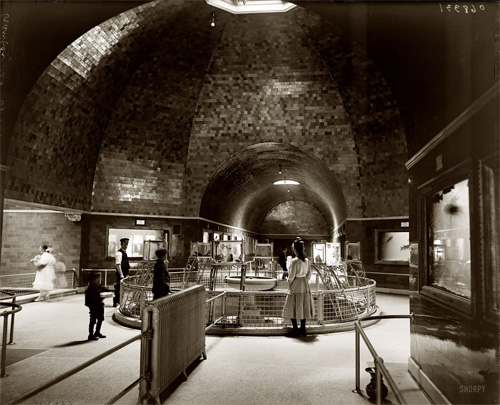
Belle Isle Aquarium – 1905

Fishbowl: 1905, photo via Shorpy Historic Photo Archive

The Friends of Belle Isle Aquarium history page (click through for some great photos & historic postcards) says:

It was August 18, 1904 in Detroit when architect Albert Kahn’s new aquarium would open to the public … The Belle Isle Aquarium, which opened adjacent with the new horticultural building on Belle Isle at a cost of $160,000, would quickly become, “one of the most popular attractions on the Island.”

…The interior of this aquarium were framed cypress tank-lined walls that were filled with fresh and salt water fish. The water contained in many of these tasks were brought direct from the ocean for the aquarium. Under the domed ceiling in the center of the building was a deep pool that was encircled by several small tanks. Later this pool would become the home to a large tank that would sit in the middle.

The most magnificent part of the interior was the grotto ceilings lined with shinny jade green titles, giving visitors a unique feeling of being underwater. Underneath this aquarium was a basement, that would be used by many as a speakeasy during Prohibition.

This photo is one that you absolutely have to check out bigger. You can get more shots from Belle Isle at Shorpy and prints too! and get more view & buy Detroit pics right here!

MacArthur Lock No. 4

MacArthur Lock No. 4

MacArthur Lock No. 4, photo by Ralph Krawczyk Jr.

With apologies to Richard Harris, Donna Summer and pretty much everyone…

The captain took the Spruceglen, through the Soo
Ralph has a Holga, on trips he often takes it
It uses film and doesn’t fake it
Which isn’t always the easiest thing to do

Check it out bigger and in Ralph’s The U.P. – Autumn 2007 set (slideshow).

U.S. National Ski and Snowboard Hall of Fame and Museum in Ishpeming

Iron Mountain MI UP Olympic Ski Jump Slide 1930s RPPC LL Cook C-1693 Unsent

Iron Mountain MI UP Olympic Ski Jump Slide 1930s RPPC LL Cook C-1693 Unsent, photo by UpNorth Memories – Donald (Don) Harrison.

With the Winter Olympics just around the corner, it’s a good time to look back on the history of skiing. I’m guessing many folks aren’t aware of the pivotal role that Michigan has played in the history of skiing.

A great place to start is the U.S. National Ski and Snowboard Hall of Fame and Museum in Ishpeming. It’s the only hall of fame in America dedicated exclusively to skiing and boasts 20,000 square feet that are packed with cross-country, downhill and snowboarding exbibits and memorabilia to take you from the founding of skiing to the latest innovations.

The core of the hall are the 368 inductees who represent some of the great names in skiing history. Included in their ranks are a number of Michiganians from one of the most influential ski resort owners in the nation, Everett Kircher (who developed the double and triple chair and made numerous other innovations at Boyne Mountain) to Lansing native and world class racer Cary Adgate (whose daughter is currently tearing up the slopes in Northern Michigan).

At this point, you may be asking yourself the same question that I did: “Why Ishpeming?”

About a century ago, a group of Ishpeming businessmen and skiing enthusiasts took the first steps to organize the National Skiing Association, now known as the U.S. Ski and Snowboard Association. USSA is the national governing body for Olympic skiing and snowboarding and the entity behind the US Ski Team and US Snowboarding Team. For the story on why that happened in Ishpeming, we have to turn to the International Skiing History Association who explain that:

…The first actual recorded tournament in the Midwest took place in St. Paul, Minnesota, January 25, 1887. Starting from a tower all of twenty feet high, the Norwegian champion Mikkel Hemmestveit went 60 feet in the air to win. Then Hemmestvedt and his brother Torjus took the sport west to Red Wing, Minnesota with an exhibition tourney on February 8, 1887, sponsored by the year-old Aurora Ski Club of Red Wing. That very year, the idea of jumping spread to the Upper Peninsula and Ishpeming soon became a particular hotbed of jumping culture. In the Upper Peninsula after 1900, any town aiming to rank as a place worth living in had at least one big jump trestle. It became a matter of civic pride. The movement was supported by generous donations from the Upper Peninsula mining companies. Along the entire peninsula, ski clubs were founded, copying the organization of earlier Norwegian ski clubs the immigrants had known in their homeland. In Ishpeming, dozens of small backyard jumps were fashioned out of the plentiful snow and a few larger ones were built from trusses of native iron.

The Ishpeming Ski Club was organized in 1887 as the Norden Ski Club. A year later, it changed its name to Den Nordiske Ski Club (the Nordic Ski Club) to reflect its ethnic makeup. Business during club meetings was mostly transacted in Norwegian. Then diversity set in. With the arrival of Finns, the name was changed in 1901 to the Ishpeming Ski Club and meetings were thenceforth conducted in English. From that came a gradual growth toward the birth of organized skiing and, eventually, the founding of the U.S. National Ski Hall of Fame.

Definitely click through to their homepage – there’s an awesome ski history video there – and if you want to know more about ski jumping in Michigan, the Detroit News Rearview Mirror has a cool feature on Michigan’s long history of ski jumping with some great old photos!

The photo above from Pine Mountain is one of countless postcards featuring Michigan’s rich history available from Don Harrison. Be sure to check it out bigger or in his ski slideshow (which leads off with a postcard of the jump they had in Ishpeming).