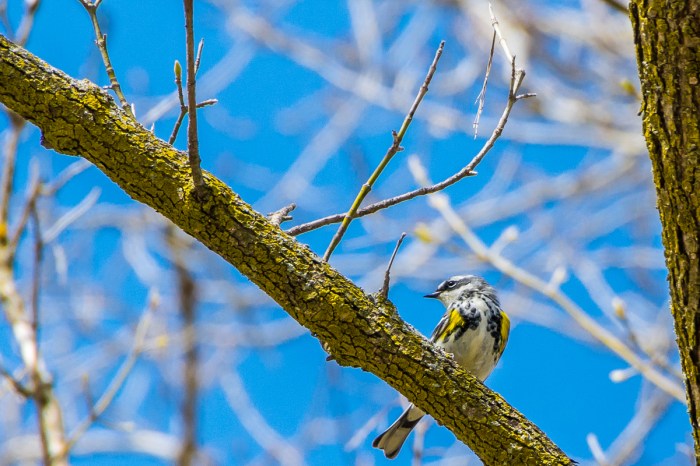
Yellow Rumped Warbler

Yellow Rumped Warbler, photo by Jeff Dehmel

Jeff’s back with another bird everyone! I couldn’t resist – the colors on this are so perfectly April!! Here’s a couple of facts on the Yellow-rumped Warbler from All About Birds:

Yellow-rumped Warblers are impressive in the sheer numbers with which they flood the continent each fall. Shrubs and trees fill with the streaky brown-and-yellow birds and their distinctive, sharp chips. Though the color palette is subdued all winter, you owe it to yourself to seek these birds out on their spring migration or on their breeding grounds. Spring molt brings a transformation, leaving them a dazzling mix of bright yellow, charcoal gray and black, and bold white.

The Yellow-rumped Warbler is the only warbler able to digest the waxes found in bayberries and wax myrtles. Its ability to use these fruits allows it to winter farther north than other warblers, sometimes as far north as Newfoundland.

They’re the warbler you’re most likely to see fluttering out from a tree to catch a flying insect, and they’re also quick to switch over to eating berries in fall. Other places Yellow-rumped Warblers have been spotted foraging include picking at insects on washed-up seaweed at the beach, skimming insects from the surface of rivers and the ocean, picking them out of spiderwebs, and grabbing them off piles of manure.

The oldest recorded Yellow-rumped Warbler was at least 7 years old.

View the photo background big and see more in Jeff’s Holloway Reservoir slideshow (where you’ll see his photo of a bald eagle from not long ago).

More spring wallpaper and more birds on Michigan in Pictures.
Pheasant Friday: Ring-necked Pheasant Breeding Habits

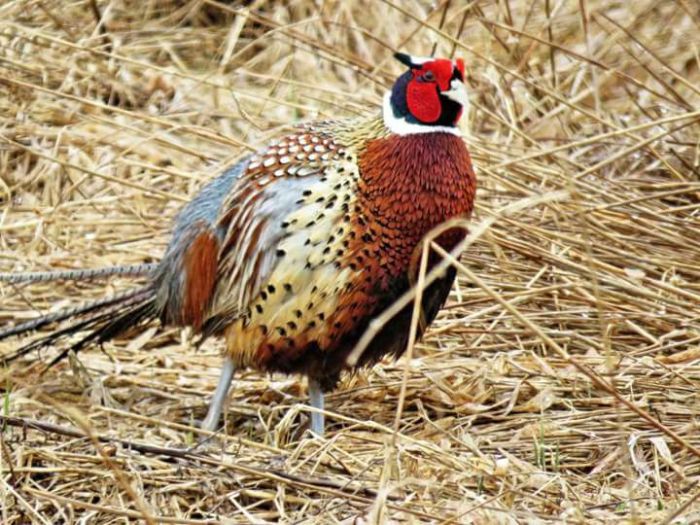
Ringnecked Pheasant, photo by Tim Carter

This pheasant is ready for the weekend, Ladies! All About Birds has all the details on the very colorful Ring-necked Pheasant including information about their breeding season which is going on right now:

Male Ring-necked Pheasants establish breeding territories in early spring. A male maintains sovereignty over his acreage by crowing and calling; he approaches intruders with head and tail erect, and may tear up grass that he then tosses. Competitors sometimes resort to physical combat. After a series of escalating threat displays, fighting cocks flutter upward, breast to breast, and bite at each other’s wattles. They may take turns leaping at each other with bill, claws, and spurs deployed. Usually the challenger runs away before long, and these fights are rarely fatal. Females assemble in breeding groups focused on a single male and his territory.

The cock courts the hen with a variety of displays—strutting or running; spreading his tail and the wing closest to her while erecting the red wattles around his eyes and the feather-tufts behind his ears. He also “tidbits”—poses with head low while calling her to a morsel of food. A female may flee at first, leading the male on a chase punctuated by courtship displays. Males guard their groups of females from the advances of other males.

Like many birds, Ring-necked Pheasants take frequent dust baths, raking their bills and scratching at the ground, shaking their wings to sweep dust and sand into their feathers, lying on their sides and rubbing their heads. Dust-bathing probably removes oil, dirt, parasites, dead skin cells, old feathers, and the sheaths of new feathers.

View the photo from near Attica, Michigan bigger on Facebook.

More birds on Michigan in Pictures.
Brunching with Bald Eagles

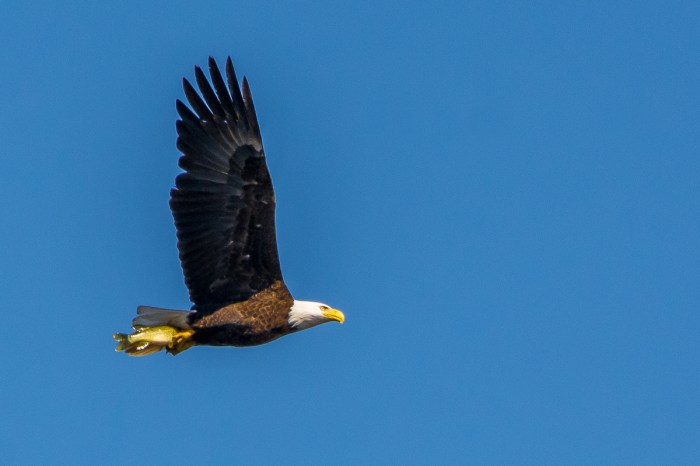
Bald Eagle with Cargo, photo by Jeff Dehmel

Jeff took this shot last weekend in Milford’s Kensington Metropark.

If you’re looking for an alternative to Saturday morning cartoons for kids & adults alike, the CarbonTV Eagle Cam at the Platte River Fish Hatchery in Benzie County has returned for 2017. While it’s a lot of sitting on eggs right now, before too long there will be all kinds of fun as the eaglets hatch and grow!

View the photo background bigilicious and see more in Jeff’s Kensington Metropark 4.1.17 slideshow.

More bald eagles on Michigan in Pictures.

Eight Hooter, Rain Owl, Wood Owl, Striped Owl, Barred Owl

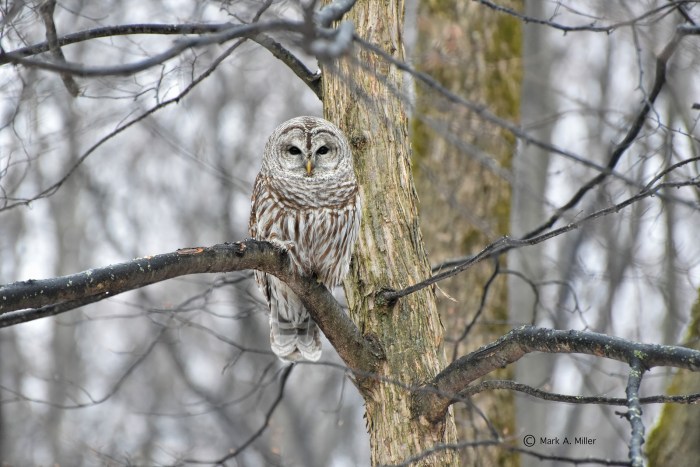
Barred Owl, photo by Mark Miller

Those cool names are from the Wikipedia for the Barred Owl (Strix varia). The All About Birds page on Bard Owls says in part:

The Barred Owl’s hooting call, “Who cooks for you? Who cooks for you-all?” (see video below) is a classic sound of old forests and treed swamps. But this attractive owl, with soulful brown eyes and brown-and-white-striped plumage, can also pass completely unnoticed as it flies noiselessly through the dense canopy or snoozes on a tree limb. Originally a bird of the east, during the twentieth century it spread through the Pacific Northwest and southward into California.

Barred Owls live year-round in mixed forests of large trees, often near water. They tend to occur in large, unfragmented blocks of mature forest, possibly because old woodlands support a higher diversity of prey and are more likely to have large cavities suitable for nesting. Their preferred habitats range from swamps to streamsides to uplands, and may contain hemlock, maple, oak, hickory, beech, aspen, white spruce, quaking aspen, balsam poplar, Douglas-fir, lodgepole pine, or western larch.

Barred Owls don’t migrate, and they don’t even move around very much. Of 158 birds that were banded and then found later, none had moved farther than 6 miles away. (In Michigan, the average range is about a mile)

 
View Mark’s photo bigger and see more in his In My Backyard slideshow.

More owls on Michigan in Pictures.

Alley Adventures, Grand Rapids Edition

alley-adventures-jerry-james

Alley Adventures, photo by Jerry James

Jerry writes Tonight’s image is brought to you by the darker side of reality. Things are not always sunsets and rainbows. Shot taken with the Olympus EM5 Mark II and the Rokinon 7.5mm fisheye in grand rapids, Michigan

View his photo bigger, view work and read his thoughts on his website, and definitely check out Jerry’s slideshow for more!

Year of the Rooster, 2017

fonzi-the-year-of-the-rooster

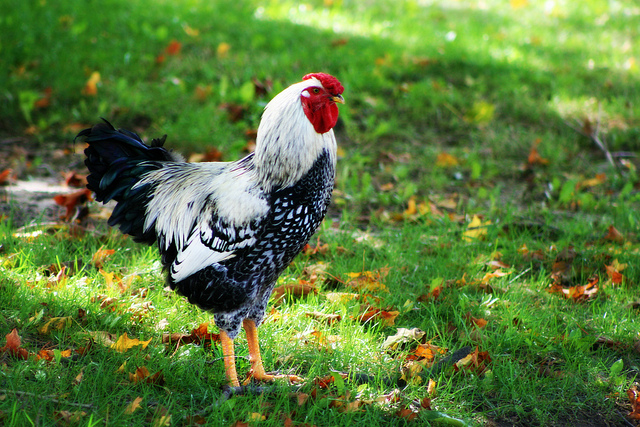
fonzi | by PepOmint

2017 is the Year of the Rooster in the Chinese Zodiac, and the Happy Lantern Festival travel guide explains that:

Rooster is the tenth in the 12-year cycle of Chinese zodiac sign. The Years of the Rooster include 1921, 1933, 1945, 1957, 1969, 1981, 1993, 2005, 2017, 2029

Rooster is almost the epitome of fidelity and punctuality. For ancestors who had no alarm clocks, the crowing was significant, as it could awaken people to get up and start to work. In Chinese culture, another symbolic meaning of chicken carries is exorcising evil spirits.

People born in the Year of Rooster according to Chinese zodiac have many excellent characteristics, such as being honest, bright, communicative and ambitious. Most of them are born pretty or handsome, and prefer to dress up. In daily life, they seldom rely on others. However, they might be enthusiastic about something quickly, but soon be impassive. Thus, they need to have enough faiths and patience to insist on one thing.

PepOmint shares:

Our baby rooster, Fonzi (you know…”chicks dig him”- lol) out and about in the yard earlier…he’s grown quite tall and loves the ladies…he’s also quite the runner and can chase them down with no issue. At the moment though, he seems to have found his voice and has been in a crowing contest with our old rooster Normie for a good week though..

He is such a pretty boy :)

View the photo bigger and see more in her slideshow.

Bonaparte’s Gull

bonapartes-gull

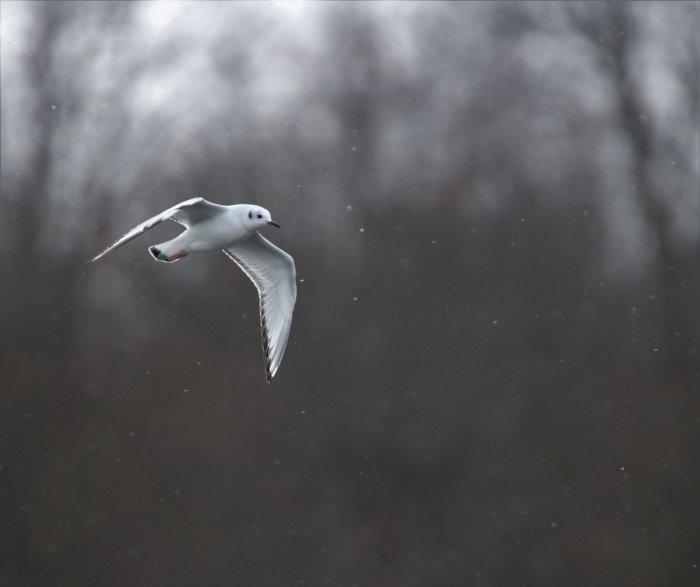
Bonaparte’s Gull, photo by Zach Frieben

All About Birds has this to say about Bonaparte’s Gull:

A small, graceful gull with bright white patches in its wings, the Bonaparte’s Gull winters near people, but breeds in the isolated taiga and boreal forest (north of us in Canada)

The Bonaparte’s Gull is the only gull that regularly nests in trees.

The English name of the Bonaparte’s Gull honors Charles Lucien Bonaparte, who made important contributions to American ornithology while an active member of the Academy of Natural Sciences of Philadelphia during the 1820s. The scientific name philadelphia was given in 1815 by the describer of the species, George Ord of Philadelphia, presumably because he collected his specimen there.

View Zach’s photo from Noah Lake in Three Rivers background big and see more in his Migrating MI Birds slideshow.

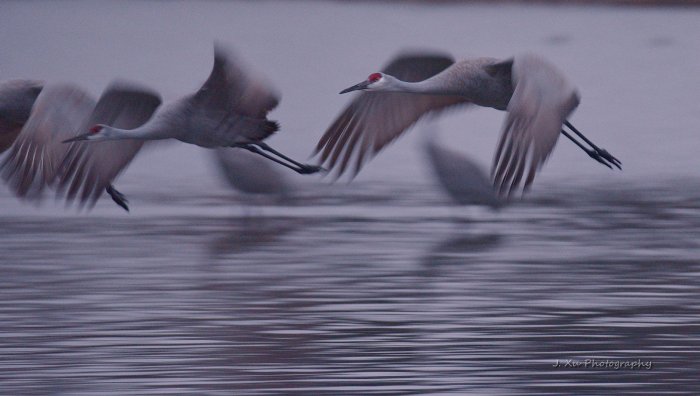
Good Morning: Sandhill Crane Edition

good-morning-by-jiafan-john-xu

Good morning!, photo by Jiafan (John) Xu

View Jiafan’s photo bigger and see more in his sideshow.

More about Sandhill cranes on Michigan in Pictures.

Life in 2016: Tree Swallow Edition

Life in 2016 Tree Swallow Edition

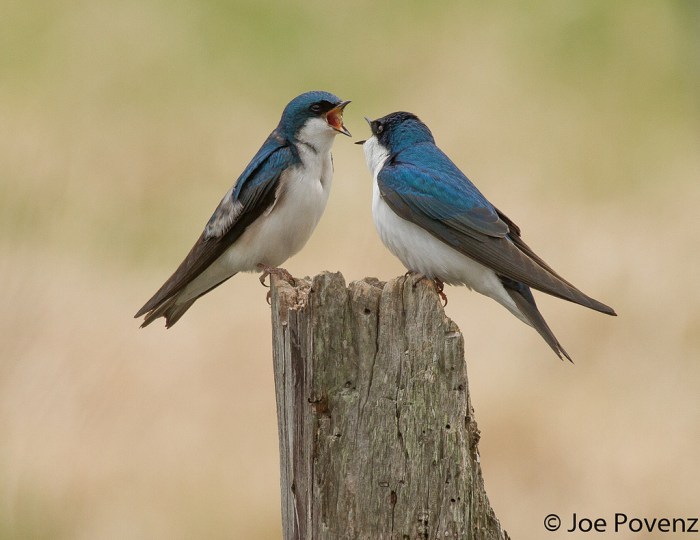
Tree Swallows, photo by Joe Povenz

Some days I feel that this photo sums up the modern world. Try to listen every so often … you might learn something.

The All About Birds page on Tree Swallows (Tachycineta bicolor) says they are:

Handsome aerialists with deep-blue iridescent backs and clean white fronts, Tree Swallows are a familiar sight in summer fields and wetlands across northern North America. They chase after flying insects with acrobatic twists and turns, their steely blue-green feathers flashing in the sunlight. Tree Swallows nest in tree cavities; they also readily take up residence in nest boxes. This habit has allowed scientists to study their breeding biology in detail, and makes them a great addition to many a homeowner’s yard or field.

…Tree Swallows feed on small, aerial insects that they catch in their mouths during acrobatic flight. After breeding, Tree Swallows gather in large flocks to molt and migrate. In the nonbreeding season, they form huge communal roosts.

Read on for more, and if you have a little time, this article on Tree swallow farmer David Winkler is worth a read.

View Joe’s photo bigger and see more in his Songbirds slideshow.

More birds on Michigan in Pictures.
Dinner with the Ospreys

Dinner with the Ospreys

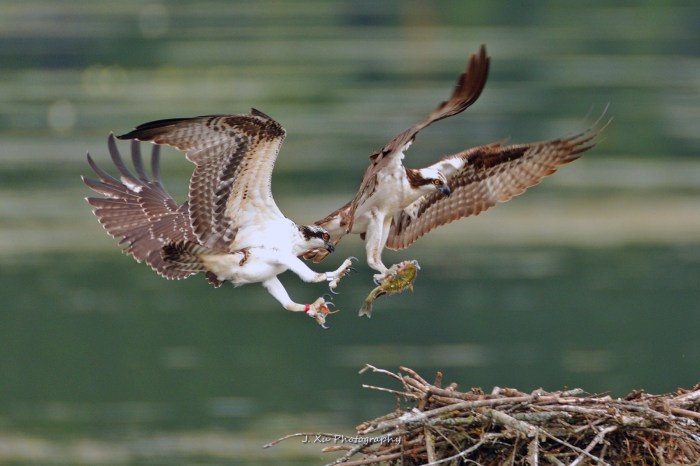
Can’t Wait, photo by Jiafan(John) Xu

Osprey Watch of Southeast Michigan shares some information about Michigan Osprey:

An Osprey is a large bird with a length of 22-25 inches, a wingspan of 4.5-6 feet, and a weight of approximately four pounds. The Osprey has a dark brown back and a white belly, as well as a white head, which features a dark stripe running from its yellow eyes to the back of its head. Female Ospreys are slightly larger than males and may sport a dark speckled necklace

..The Osprey dines almost exclusively on live fish, often catching its meals by hovering over the water at an altitude of 50 to 200 feet, then diving feet first into the water to catch its prey. The Osprey’s feet are uniquely adapted to “air fishing.” Each Osprey foot has a reversible front toe, as well as barbs, called spicules, which help it hold onto a slippery fish in flight. Normally, an Osprey will aerodynamically position a fish headfirst in its talons before it returns to the nest.

These talons definitely look like fish hooks – read on for more!

View Jiafan’s photo bigger and see more in his slideshow where you can also see shots from a trip out west.

More Michigan birds on Michigan in Pictures.