Is this a Paddle, Raft, Plump, Team, Brace or Dopping of Ducks?

Swarm!

Swarm!, photo by OtisDude.

OtisDude writes:

I was shooting some duck pictures today when all the sudden something startled all the ducks. Calm to chaos in less than a second. I managed to snap off 4-5 pics before I got a little panicked and got out of the way.

We’ve all heard of the many Inuit names for snow. In case anyone was wondering, ducks are pretty much the same. There’s quite a collection of names for a group of ducks including a paddling of ducks or a raft of ducks (when floating along), a plump or team of ducks (in flight overhead), a brace of ducks (post hunting I believe) or a dopping of ducks (when diving). More ducks on Michigan in Pictures.

None of these seemed quite right but fortunately there’s also a flush of ducks, which I’m going to assume covers exactly this scenario.

Trumpeter Swan and the Birds of Michigan

trumpeter swan

trumpeter swan, photo by tobibritsch.

On the Michigan DNR’s page on the trumpeter swan, says that at 25-35 pounds when fully grown, the trumpeter swan is the world’s largest waterfowl with a wingspan of nearly 8′ and that:

Historically, trumpeter swans were most likely abundant throughout the Great Lakes region, even in the southern Michigan marshlands. On his travels along the Detroit River in 1701, Cadillac compared the abundance of swans to lilies among the rushes. However, with the settlement of America, the populations of trumpeters plummeted. Beginning in the late 1800s, European settlers cleared the land, draining and filling important marsh habitat, and market hunters took swans for their fine down and quills. By 1933, only 66 trumpeter swans remained in the continental United States, mainly in remote parts of the Rocky Mountains and Alaska. Nearly 100 years passed before trumpeter swans were seen again in the Michigan wilds.

In the 1980s Michigan began a swan reintroduction program as part of the North American Restoration Plan. While the program has been a success and dramatically increased the number of nesting pairs, there are some who question whether these birds did in fact historically nest in Michigan. Nuthatch at the excellent Michigan blog bootstrap analysis presents the case in with great links in swans, take 2. It’s something that merits consideration as swans are pretty rough on aquatic habitats!

For more on these birds, check out The Trumpeter Swan Society. Also, the UM Animal Diversity Web Cygnus buccinator (trumpeter swan) listing has some photos but unfortunately no sounds. Wikipedia’s Trumpeter Swan entry also includes creative commons photos of trumpeter swans for use and download.

The photographer has a cool set of waterbird photos (slideshow) and this photo is in the Birds of Michigan group on Flickr. It’s for sharing photos of birds found anywhere in the State of Michigan and they say that if you cannot identify the bird, post it to the group and likely someone there can!

Dream

Dream

Dream, photo by rckrawczykjr.

Ralph writes: 59°F + Sunny + Mid-November = Photo Safari.

Foggy river

Foggy river

Foggy river, photo by kthschsslr.

kthschisser writes that he took this photo of a heron on the Flint River near Flushing while rushing to the airport.

Always good to have eyes open and camera handy…

A Herd of Turkeys

A Herd of Turkeys

A Herd of Turkeys, photo by curlyson.

The thought of two guys in the woods chasing turkeys around for a photo is pretty funny.

You can learn more about Michigan turkeys (both wild & plattered) at Absolute Michigan.

Happy Thanksgiving folks.

Michigan Breeding Bird Atlas II

some cute chicks

some cute chicks, photo by paulhitz.

As is usually the case, I came upon today’s picture in a roundabout way. Stylurus (who seems to know a thing or two about birds) noted that Paul could submit this to the Michigan Breeding Bird Atlas II. The Michigan DNR’s page on MBB II explains:

In the 1980s, volunteers surveyed the entire state in a massive effort to record and map in an atlas the birds which breed in Michigan. This information has proved invaluable to scientists and natural resource managers, but there are indications that bird distribution and abundance has changed since this atlas was created.

Starting in 2002, the Kalamazoo Nature Center was contracted to coordinate the creation of a second Michigan Breeding Bird Atlas. The data collection portion of this process is scheduled to be completed in 2008, and its success depends again on the dedication of a corps of volunteers: backyard birdfeeders, hunters, amateur birdwatchers, and professionals.

You can get all the details on this project at the links above and go to the main MichiganBirds.org page for a flock of links to Michigan birding sites.

Kayak on the Pine River Channel

Kayaking through the Channel

Kayaking through the Channel, photo by smiles7.

The lighthouse is the Charlevoix South Pier Light, and it marks the mouth of the Pine River channel that extends from Lake Charlevoix to Lake Michigan. Terry Pepper’s Seeing the Light explains:

The Pine River Channel is believed to be unique in the entire world inasmuch as it has a two-way current. After severe westerly windstorms, waters pushed high into Lake Charlevoix will swiftly flow back out to meet other inbound currents. Small whirlpools and eddies at the harbor mouth are not uncommon, and whitecaps can frequently be observed within the channel on the calmest days.

You can get a lot more information about the history of Charlevoix’s Pier Lights from Terry Pepper and see historical photos including a cool postcard of the Charlevoix North Pier Light in 1909. If you want to visit Charlevoix, the Charlevoix Area Convention and Visitors Bureau is a good place to start.

Happy Valentines Day, Michigan!

Duckie Love

Duckie Love, photo by suesue2.

This was the first picture that I saw this morning. Then I went wandering around for an hour or so looking for a picture that would somehow capture the essence of Valentines Day as it relates to Michigan.

Then I looked again and realized that all it is really about is having and showing a little more love, whenever and wherever possible.

Happy Valentines Day, Michigan!

Mallard, The Get Away

Mallard, The Get Away

Mallard, The Get Away, photo by Tut99.

Roger says that this photo (taken at River Bends Park) is Best viewed large On Black.

Nice to see the birds all dressed up for spring…

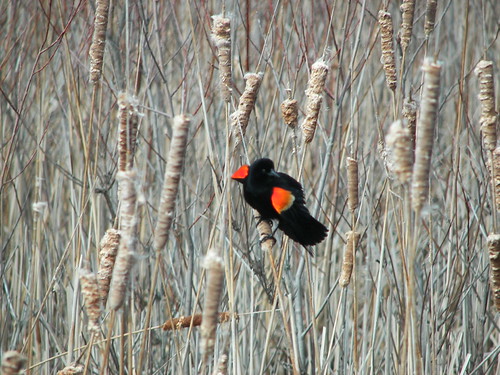
Redwing Blackbird

Redwing Blackbird

Redwing Blackbird, originally uploaded by curlyson.

A redwing blackbird in courting display.

From the Google Institute of Artificial Smartness comes this link to the University of Michigan Museum of Zoology’s Animal Diversity Web listing for Agelaius phoeniceus (red-winged blackbird) that tells us:

Red-winged blackbirds roost and breed in a variety of habitats, but tend to prefer wetlands. They have been known to live in fresh and saltwater marshes. On drier ground, red-winged blackbirds gravitate towards open fields (often in agricultural areas) and lightly wooded deciduous forests. In winter red-winged blackbirds are most often found in open fields and croplands.

In addition to spot-on information like the above passage, this great web resource includes many more photos and blackbird calls. Go there!