Auto trail coming to Shiawassee National Wildlife Refuge

Shiawassee National Wildlife Refuge

Shiawassee National Wildlife Refuge, photo by Wigwam Jones.

The Great Lakes Echo has a feature by Emma Ogutu about a 7.5-mile auto trail through Saginaw County’s Shiawassee National Wildlife Refuge that opens in May (assuming the eagles cooperate).

“Everything will depend on a pair of eagles which built a nest just 50 feet off the road. It all depends if they start nesting early or late– it’s critical that we do not disturb them,” DeVries said (Ed DeVries, assistant manager of the refuge).

The gravel trail, which was completed in November, will be the second of its kind in the state, after one in the Upper Peninsula’s Seney National Wildlife Refuge.

Along the trail are two new observation decks with spotting scopes to assist visitors in viewing more birds, DeVries said. The refuge has also constructed a parking area to accommodate the anticipated larger amount of traffic and a new fishing and canoe access site along the Spaulding Drain.

“Previously we had only one day in September where tourists were allowed to drive in the refuge,” DeVries said. “With the new trail, it’s going to be possible for more people to view a wider variety of birds and other wildlife throughout spring and summer seasons.”

The Shiawassee refuge was established in 1953 to protect and increase the breeding of migratory birds and other wildlife. The refuge includes marsh areas, swamps, bogs, grasslands and forests and has one of largest and most productive wetland ecosystems in the state, according to the service.

Learn more about the Shiawassee National Wildlife Refuge.

Check Wigwam Jones’ photo out background big and in his Shiawassee National Wildlife Refuge slideshow.

New Year’s Resolution Case Study #77: The Tufted Titmouse

Im not Fat, Im Fluffy!

Im not Fat, Im Fluffy!, photo by Spring Noel.

All About Birds says that the Tufted Titmouse is common in eastern deciduous forests and a frequent visitor to feeders. They eat mostly insects in the summer but aren’t above seeds, nuts, and berries and (in the case of this fellow) cheesecake and jelly donuts. Fun facts:


  • Experiments with Tufted Titmice indicate they always choose the largest seeds they can when foraging. (see above)
  • Tufted Titmice hoard food in fall and winter, a behavior they share with many of their relatives, including the chickadees and tits. Titmice take advantage of a bird feeder’s bounty by storing many of the seeds they get. Usually, the storage sites are within 130 feet of the feeder. The birds take only one seed per trip and usually shell the seeds before hiding them.
  • Tufted Titmice nest in tree holes (and nest boxes), but they can’t excavate their own nest cavities. Instead, they use natural holes and cavities left by woodpeckers.
  • Tufted Titmice often line the inner cup of their nest with hair, sometimes plucked directly from living animals. The list of hair types identified from old nests includes raccoons, opossums, mice, woodchucks, squirrels, rabbits, livestock, pets, and even humans.
  • The oldest known wild Tufted Titmouse lived to be 13 years 3 months old.
  •  

Check out Birding in Michigan’s Ode to the Tufted Titmouse and see more birds on Michigan in Pictures.

See this bigger in Spring’s Birds slideshow.

Short Eared Owl

P1090935

P1090935, photo by Sherri & Dan.

The Short-eared Owl – Asio flammeus entry at Owl Pages says:

A Danish bishop and amateur naturalist, Erich Ludvigsen Pontoppidan, published the first description of this Owl in 1763. In Latin, the word “flammeus” means fiery, flaming, or the colour of fire. Local names for the Short-eared Owl include the Evening Owl, Marsh Owl Bog or Swamp Owl, Grass Owl, Meadow Owl, Mouse-hawk, and Flat-faced Owl.

The Short-eared Owl is a medium-sized Owl. The plumage is buffy brown with dark streaks on the chest, belly, and back. Males tend to be lighter in colour than females. This colouring provides good camouflage, but if this fails, a Short-eared Owl will feign death to avoid detection. The wings and tail are strongly barred. The yellow eyes are circled with black and set in whitish or buffy-white facial disks, which are suffused with a ring of brown. The bill is black. The head appears round without ear tufts, but at very close range small ear tufts are visible. In flight, the dark “wrist” on the underwing is the key field mark.

Check it out background big and in see more great shots of this bird in Sherri & Dan’s Animals slideshow.

The Bird Girl

The Bird Girl Angie

The Bird Girl Angie, photo by sharona 315 사론아.

Michigan in Pictures has a lot of Michigan birds but nothing quite like Angie!!

Check this out bigger in Sharon’s Winter slideshow.

Rough-legged Hawk (Light Morph)

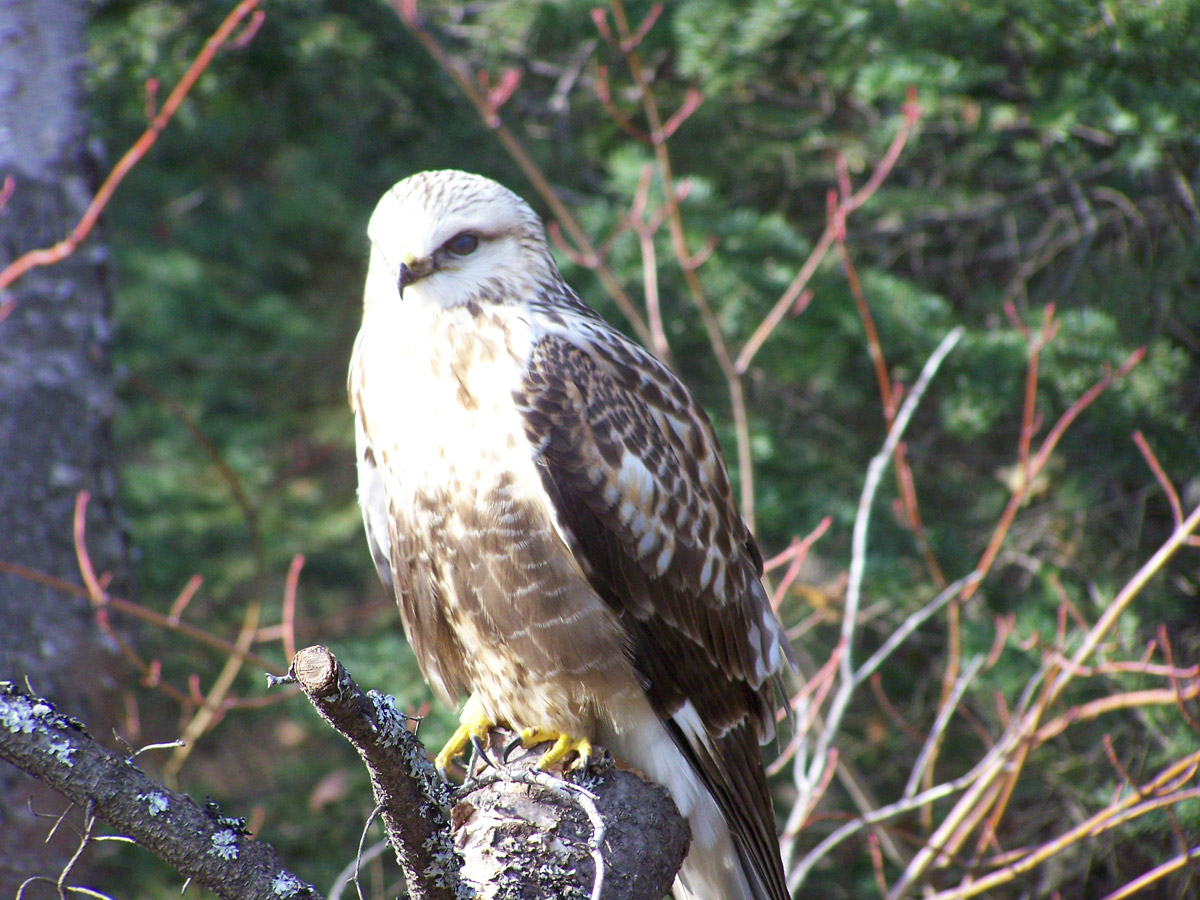
rough-legged hawk light morph

rough-legged hawk light morph, photo by Sherri & Dan.

Bird Web’s entry on Rough-legged Hawks (Buteo lagopus) says these birds:

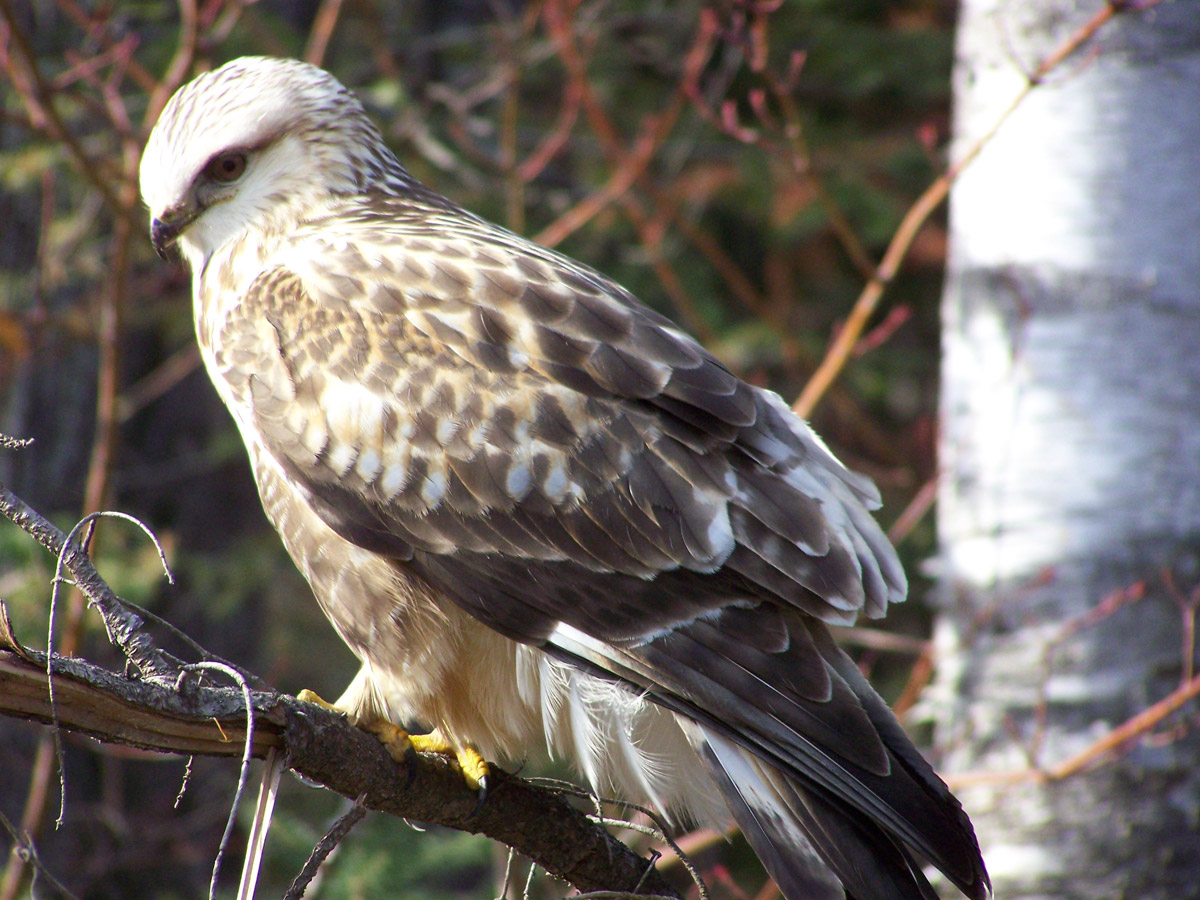
…are variable in plumage, with light and dark color phases and variations in between. Dark phases account for only ten percent of western Rough-legged Hawks. Adults are generally mottled light-and-dark underneath, with dark patches at the wrists. Seen from below, the tails of both phases appear light with a dark terminal band. Seen from above, both phases appear mostly dark, but the light phase shows a light tail with a dark terminal band, and the tail of the dark phase appears dark all over. The adult male can have several dark bands at the tip of its tail as compared to the female, which only has one band. The light phase has a distinctive light-colored head, in contrast to its dark upperside. The Rough-legged Hawk’s bill and feet are relatively small.

Read more about these hawks at Rough-legged Hawk (Dark Morph) on Michigan in Pictures.

Check this out background big and in Sherri & Dan’s Animals slideshow.

Many more Michigan birds on Michigan in Pictures!

foggy flight

foggy flight

foggy flight, photo by suesue2.

metro beach marina, harrison township.

Check it out in Sue’s Awesome Autumn slideshow or get down with more parks in the Michigan Parks slideshow!

Sandhill Cranes in Flight

Sandhill Cranes in Flight, near Merritt, MI
Sandhill Cranes in Flight, near Merritt, MI, photo by arrdubyazee

Check it out bigger in his sandhill cranes slideshow!

Crane Fest: Sandhill Cranes at Baker Sanctuary

Crane Fest

Crane Fest, photo by .jowo..

Joel says that last weekend the Michigan Audubon Society and Battle Creek Kiwanis hosted Crane Fest at Baker Sanctuary, near Bellevue. The event celebrates the annual fall migration of the Sandhill Crane. While we’ve missed that, he writes:

Thousands of Sandhill Cranes gather at Big Marsh Lake every evening in October. Well worth your evening.

What my camera cannot capture is the glorious racket these large birds make. Absolutely incredible.

Shot from the Kiwanis Youth Area, which will be open from 4 to 7 every Saturday and Sunday in October. If you can’t make the festival, you can still see the spectacle. Go. You’ll enjoy!

Check this out background boomtacular and in his Baker Sanctuary slideshow.

Michigan Birds: The Belted Kingfisher

Kingfisher... again

Kingfisher… again, photo by palofmine2.

All about Birds says that the Belted Kingfisher is:

A common waterside resident throughout North America, the Belted Kingfisher is often seen hovering before it plunges headfirst into water to catch a fish. It frequently announces its presence by its loud rattling cry.

It breeds along streams, rivers, lakes, and estuaries with banks for nest holes. The breeding distribution of the Belted Kingfisher is limited in some areas by the availability of suitable nesting sites. Human activity, such as road building and digging gravel pits, has created banks where kingfishers can nest and allowed the expansion of the breeding range.

Check this out bigger in Renee’s Birds slideshow and also check out more of her Kingfisher photos.

More Michigan Birds from Michigan in Pictures.

(not) A Gyrfalcon in Michigan

NOTE: Apparently this isn’t a gyrfalcon but a rough-legged hawk. See the comments below.


photo by Angela Merz

I was showing a friend the recent post about osprey in Michigan and he said “well guess what my wife got a photo of the other day?” What Angela got was a rare (for Michigan) photo of a gyrfalcon taken at Fayette State Park.

The Rouge River Bird Observatory has a report on a sighting in Dearborn in 2005 that caused quite a stir:

The Gyrfalcon (Falco rusticolus) is the world’s largest falcon, nearly the size of a Red-tailed Hawk. This Arctic-nesting bird is rarely seen in the United States. When populations of ptarmigan, chicken-like tundra birds that are a main prey item of Gyrfalcons, fall below certain levels, some Gyrfalcons move into southern Canada and the United States in the winter. When one is found, many birders will rush to see it.

In Michigan, the most reliable place to see a Gyrfalcon is at Sault Ste. Marie (click here for a more thorough report on the occurrence of this species in the state). They are very rare in the Lower Peninsula.

Thus it was sensational when Kim Hall, Julie Craves, and Darrin O’Brien located a subadult (first year) Gyrfalcon at a Dearborn office complex while participating in the annual Detroit River Christmas Bird Count.

Get more information about Gyrfalcon (Falco rusticolus) from the UM Animal Diversity Web and click the photo to the left for another view of this rare Michigan sighting!