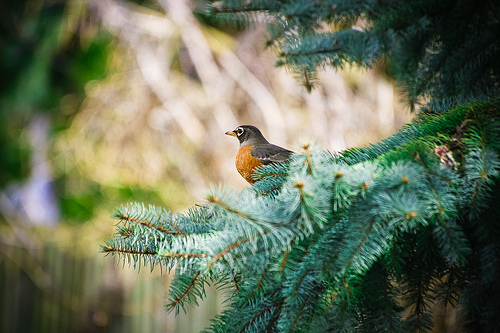
Michigan’s State Bird: The American Robin

1IMG_6158

1IMG_6158, photo by ShannenOMalley

“WHEREAS, A widely and generally conducted contest to choose a State bird, carried on by the Michigan Audubon Society, resulted in nearly 200,000 votes being cast, of which Robin Red Breast received many more votes than any other bird as the most popular bird in Michigan; and WHEREAS, The robin is the best known and best loved of all the birds in the State of Michigan; therefore BE IT RESOLVED BY THE HOUSE OF REPRESENTATIVES (THE SENATE CONCURRING), That the robin be and the same is hereby designated and adopted as the official State bird of the State of Michigan.”
~Michigan House & Concurrent Resolution, April 8, 1931

A sign of spring in Michigan is the sighting of your first robin. Like daffodils, they’ve showed up early this year. American Robin (Turdus migratorius) at All About Birds has some great facts and photos about our state bird:

The quintessential early bird, American Robins are common sights on lawns across North America, where you often see them tugging earthworms out of the ground. Robins are popular birds for their warm orange breast, cheery song, and early appearance at the end of winter…

  • An American Robin can produce three successful broods in one year. On average, though, only 40 percent of nests successfully produce young. Only 25 percent of those fledged young survive to November. From that point on, about half of the robins alive in any year will make it to the next. Despite the fact that a lucky robin can live to be 14 years old, the entire population turns over on average every six years.
  • Although robins are considered harbingers of spring, many American Robins spend the whole winter in their breeding range. But because they spend more time roosting in trees and less time in your yard, you’re much less likely to see them. The number of robins present in the northern parts of the range varies each year with the local conditions.
  • Robins eat a lot of fruit in fall and winter. When they eat honeysuckle berries exclusively, they sometimes become intoxicated.
  • Robin roosts can be huge, sometimes including a quarter-million birds during winter. In summer, females sleep at their nests and males gather at roosts. As young robins become independent, they join the males. Female adults go to the roosts only after they have finished nesting.
  • Robins eat different types of food depending on the time of day: more earthworms in the morning and more fruit later in the day. Because the robin forages largely on lawns, it is vulnerable to pesticide poisoning and can be an important indicator of chemical pollution.
  • The oldest recorded American Robin was 13 years and 11 months old.

Read on for more including the various songs of the robin and some video. More photos and info from Turdus migratorius (American robin) at UM Animal Diversity Web and at American Robin on Wikipedia. Also don’t miss A blue like no other: Robin’s Egg Blue on Michigan in Pictures.

Check this photo out on black and in Shannen’s slideshow.
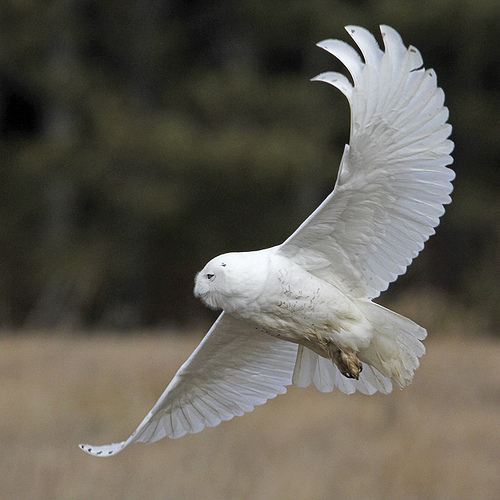
Snowy Owl Irruption in Michigan

Snowy Owl (Bubo scandiacus)_0314_1

Snowy Owl (Bubo scandiacus)_0314_1, photo by johndykstraphotography.

We’ve been seeing a lot of snowy owls this winter in the Absolute Michigan pool on Flickr. These 2′ birds are native to the Arctic tundra, but they’ve been sighted in large numbers in Michigan this winter. Snowy owls flock to Mich. in unusual numbers in USA Today explains:

Scientists say the likely reason for the explosion is that the owls’ chief food source, small animals called lemmings, was abundant last summer, allowing the adults to raise more young. Now, in search of food, young owls are heading farther south.

Although there are a few snowy owls spotted in Michigan every year, “I can tell you this winter is highly unusual,” said Karen Cleveland, bird biologist with the Michigan Department of Natural Resources.

…The phenomenon is called an irruption, an invasion of birds in unusual places or in high numbers. It usually occurs because of a lack of food in the birds’ home territory.

They even talk with photographer Stacy Niedzwiecki about her snowy owl photos, which we featured on Michigan in Pictures a few months ago!

The Snowy Owl page at All About Birds notes that they are the northernmost, heaviest, and most distinctively marked owl of North America, and that an individual adult Snowy Owl may eat three to five lemmings per day, or up to 1,600 per year! While this irruption means that there are many more owls than usual in Michigan, they are a common wintertime visitor.

John captured this owl in Muskegon County earlier this month. See it bigger and see more in his Snowy Owl slideshow.

More Michigan birds on Michigan in Pictures!

Help the National Audubon Society with their Christmas Bird Count

Out On A Limb

Out On A Limb, photo by Beth Crawford 65.

The Great Lakes Echo tipped us off to the National Audubon Society Christmas Bird Count. :

Each of the citizen scientists who annually braves snow, wind, or rain, to take part in the Christmas Bird Count makes an enormous contribution to conservation. Audubon and other organizations use data collected in this longest-running wildlife census to assess the health of bird populations – and to help guide conservation action.

From feeder-watchers and field observers to count compilers and regional editors, everyone who takes part in the Christmas Bird Count does it for love of birds and the excitement of friendly competition — and with the knowledge that their efforts are making a difference for science and bird conservation.

In years past, the Christmas Bird Count has helped the Society document species health and develop plans. Click to learn how to get involved!

See Beth’s photo of a pine siskin, a common finch, bigger and in her beautiful winter slideshow.

Many more Michigan birds on Michigan in Pictures.

Under the Gaze of an Owl

Gaze 3903-11

Gaze 3903-11, photo by StacyN – MichiganMoments

This month has been pretty owl heavy. More about the Snowy Owl from November 2008 on Michigan in Pictures.

Stacy says that this was her first wild snowy owl sighting. She spent all afternoon watching it and is in LOVE. See it bigger and see all her shots from this encounter in her The Visitor slideshow.

Owls in the Attic

Attic, Clare Michigan.

Attic, Clare Michigan. , photo by matthew_michalek.

I posted this photo to the Michigan in Pictures Facebook yesterday with the comment “It’s not all sunsets and lighthouses. ;)” A reader thought it a little strange and wondered “why not show a live one?”

That’s a good question for which I have a few answers.

One is that Michigan in Pictures has a number of posts about owls including a snowy owl on the roof, Northern Saw Whet Owl (and an owl house you can build for one), the Evening Owl, Marsh Owl, Short-eared owl and a live version of this owl, the Great Horned Owl (Bubo virginianus) aka tiger owl or cat owl.

A second reason is that while I am a huge fan of Pure Michigan and the gorgeous photography they share, I’m also a big fan of the strange and wonderful bits of history you can find all over the state in our quirky little museums, second hand stores, attics, basements and (of course) garage sales. When I see a photo like this I wonder how the owl got there. Was it purchased at the Call of the Wild museum in Gaylord or did it simply die of old age?

The final reason is that the experience of Michigan and Michigan in Pictures is (for me at least) one of discovery. I delight in odd finds like the Big Boy Graveyard, old slumpy in Detroit, Lake Michigan’s “Stonehenge” and the crazy things that I find in the Library of Congress and that people like the folks at FOUND magazine in Ann Arbor and daveraoul find in the corners of reality that we often miss.

What do you think? Let me know in the comments…

Check this out on black and in Matt’s slideshow.

Jonathan Livingston Seagull Returns

Jonathan Livingston Seagull Returns

Jonathan Livingston Seagull Returns, photo by LadyDragonflyCC – Flowers, WE NEED Rain!.

Christine writes:

Jonathan Livingston Seagull is concerned with a young seagull’s efforts to rise above the ordinary. In a flock where individuality is frowned upon, Jonathan finds himself a loner and an outcast. After performing feats of tremendous courage and skill, Jonathan is expelled from the flock. This gives him the freedom to develop his skills, and in so doing he reaches a higher plane of achievement, a heaven of sorts. The lessons that Jonathan learns in his travels reflect both a greater peace of mind and a freedom to be himself. Jonathan continues the cycle, by returning to the flock…

She also linked to a video from the movie. The movie is based on the book of the same name, and what Christine may not know is that the author, Richard Bach spent a fair amount of time on Michigan’s Leelanau Peninsula. No idea if our Michigan gulls influenced the tale.

You can read the complete Jonathan Livingston Seagull online.

Check it out big as the sky and in Christine’s slideshow.

Fly high.

You can build a home for little raptors like the Northern Saw Whet Owl!

saw whet owl

saw whet owl, photo by Sherri & Dan.

My friend Michael told me about Ned the Saw Whet Owl, an avian ambassador that Rebecca Lessard of the nonprofit Wings of Wonder is using to tell folks about nest boxes that you can build for small raptors (pdf). Ned is just 7″ tall and belongs to the smallest species of owl native to Michigan. Click Ned’s link above to see just how tiny he is!

This home will also house a screech owl and another bird recently featured – the American Kestrel (Michigan’s smallest raptor).

The Owl Pages have this to say about the Northern Saw-whet Owl – Aegolius acadicus:

European explorers first discovered this Owl in a North American colony called Acadia (now Nova Scotia). The Latinised word “acadius” refers to this territory. The common name “Saw-whet” comes from these Owls unique calls described below. The Saw-whet Owl is also called Acadian Owl, blind Owl, Kirkland’s Owl, the saw-filer, the sawyer, sparrow Owl, white-fronted Owl, Farmland Owl, Little Nightbird, Queen Charlotte Owl, and even the Whet-saw Owl.

The Northern Saw-whet Owl is a very small, short-bodied, Owl with a relatively short tail. The overly large head has no ear tufts and may appear distorted due to an asymmetrical skull. They look small when perched and tend to shuffle their feet, but in flight appear larger because of their broad wings.

…Northern Saw-whet Owls are strictly Nocturnal, with activity beginning at late dusk. During the day, they depend on plumage for camouflage when roosting in foliage, usually close to the ground.

You can hear their call at the link above and learn more at Wikipedia and All About Birds who explain that their defense upon discovery is to sit still and not fly, leading people to perceive them as “tame.”

Check this out way bigger than a saw whet owl and in Sherri & Dan’s slideshow. They took the shot at Whitefish Point Bird Observatory – read more at that link!

Many more Michigan birds on Michigan in Pictures.

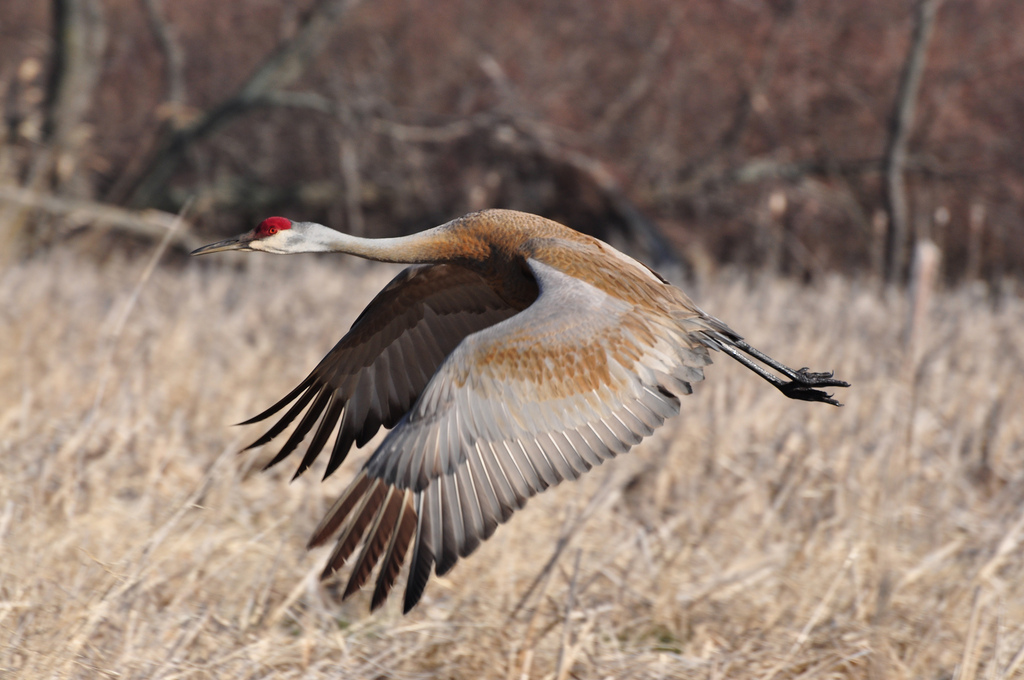
Michigan Birds: Sandhill Crane

Michigan Sandhill Crane in Flight

Flying Crain by Mark Miller

The Baker Sanctuary in northwest Calhoun County is a Michigan Audubon sanctuary that hosts thousands of cranes. It was established in 1947 and was the first crane sanctuary in America. They have fantastic information about sandhill cranes in Michigan. They write that the Sandhill Crane (Grus canadensis) is one of only 15 species of cranes in the world and is one of just two crane species native to North America.

While the Whooping Crane, our other native crane, is highly endangered and restricted to only a few areas of the West, the Sandhill is more widespread and in most areas is more abundant. Once nearly eliminated from Michigan, Sandhill Cranes have made a comeback and now are becoming one of the state’s most popular watchable wildlife species.

Cranes are tall, stately birds with a heavy body, long neck and long legs. Standing four to five feet high and possessing a wing span of six to seven feet, Sandhill Cranes are Michigan’s largest bird. Long, skinny legs and neck give a false impression of size; the males weigh an average of about 12 pounds and the females around 9-1/2 pounds. Except for this size difference, both sexes look alike.

…Sandhill Cranes have a variety of vocalizations, the most common of which is generally described as a repeated series of trumpeting “garoo-a-a-a” calls that can be heard for over a mile. One of the reasons for this remarkably loud and penetrating call is an unusual windpipe. In most birds the trachea passes directly from the throat to the lungs, but in Sandhills it is elongated by forming a single loop which fills a cavity in the sternum. It is not surprising that the louder and more harmonic Whooping Crane has a longer trachea with a double loop.

You can hear these crane calls including the unison call at that link. Don’t miss the Michigan Audubon Crane Fest they hold every October too! Also see Sandhill Crane on All About Birds has more information and some crane calls and on Wikipedia

Mark says that sandhill cranes are quickly becoming his favorite birds. Check this out bigger and see a couple more views in his slideshow.

The Absolute Michigan pool on Flickr has a cool Sandhill Crane slideshow.

The Red-Bellied Woodpecker sings Happy Birthday, John James Audubon

Bobby Dazzler

Bobby Dazzler, photo by Spring Noel.

I never for a day gave up listening to the songs of our birds, or watching their peculiar habits, or delineating them in the best way I could.
~John James Audubon

Today is the birthday of John James Audubon. That entry on Wikipedia relates that he was born Jean-Jacques Fougère Audubon. In 1803 at age 18, he immigrated to the United States and anglicized his name to John James Audubon. Learn more about him and the society that bears his name at audubon.org.

I didn’t really think that there would be a Michigan tie-in, but it turns out that the single most valuable book in the University of Michigan is (you guessed it) Audubon’s Birds of America:

In 1838, the Regents of the University of Michigan authorized the purchase of John James Audubon’s Birds of America. Held in the Special Collections Library, the eight-volume, double-elephant-folio edition is the single most valuable printed book in the MLibrary collections.

Here’s the beginning of the Family XVI. PICINAE. WOODPECKERS. GENUS I. PICUS, Linn. WOODPECKER. entry from that book:

Much of what I have said respecting the habits of several of our Spotted Woodpeckers applies to the present species, which differs, however, in the greater extent of its migration in the spring and summer months, when the greater number of those which return from the south to our Middle and Eastern Districts proceed considerably farther northward than the Hairy Woodpecker, although not so far as the Canadian. In winter I have found the Red-bellied Woodpecker the most abundant of all in the pine barrens of the Floridas, and especially on the plantations bordering the St. John’s river, where on any day it would have been easy to procure half a hundred. Indeed, on this account, and from its well-known notes, the officers and men of the United States’ schooner Spark, as well as my assistants, always spoke of it by the name of chaw-chaw. Perhaps it partly obtained this name from the numbers of it cooked by the crew in the same manner as the dish known to sailors by the same name.

It is, however, less common in the United States than the Hairy Woodpecker; but its range is as extensive, for I have found it from the Texas to the extremities of the British provinces of Nova Scotia, and as far inland as I have travelled. It appears, however, that it does not inhabit the Fur Countries, as no mention is made of it by Dr. RICHARDSON, in the Fauna Boreali-Americana. It is generally more confined to the interior of the forests, especially during the time of its breeding, than the Hairy Woodpecker, although in winter I have found it quite as easily approached. In autumn it frequently occurs in the corn-fields, where it takes its share of the grain, in common with the Hairy, the Downy, and other Woodpeckers. It is a lively and active bird, fond of rolling its tappings against the decayed top-branches of trees, often launching forth after passing insects, and feeding during winter on all such berries as it can procure. Its flight is strong and better sustained than that of the Yellow-bellied or Hairy Woodpeckers, and, like the Golden-winged species, it not unfrequently alights across the smaller branches of the trees, a habit which, I assure you, is oftener exhibited than has been supposed, by all our species of this interesting tribe of birds.

More at Red-bellied Woodpecker on All About Birds including their calls & drums.

Spring writes that you can see why they’re called Red Bellied Woopeckers when you see one the red belly exposed. Check it out bigger and in her Birds slideshow.

Many (many) more birds on Michigan in Pictures.

Fly Fishing: Eagles in Grand Haven

Fly Fishing

Fly Fishing, photo by KevJams.

I think Kevin shot this near Grand Haven. He has so many eagles in the first shot of his Birds of a Feather slideshow that it looks like Alaska. I rolled back through “Eagle” on Michigan in Pictures and found this photo of eagles over the Grand River in Grand Haven, so I guess it’s a regular happening.

View it bigger.