Bald Eagle in Michigan

Eagle turning

Eagle turning, photo by Deirdre Honner

I think this is one of the best bald eagle photos I’ve ever seen. The Michigan DNR’s bald eagle page explains that before European settlement, bald eagles probably nested in all regions of Michigan.

In the early 1900s they were described as being “generally distributed,” but “nowhere abundant.” A decline through the early and mid-1900s was probably related to slow but consistent loss of suitable habitat and available food, and predator control by humans. These eagles are so disturbed by the presence of humans near their nest that they may be induced to abandon the nest, or even chicks that have already hatched. By 1959, the species was considered, “largely restricted to the northern half of the state.”

…Nests are usually constructed near seacoasts, lakes or large rivers to be near their most common food supply: fish. Although they are quite capable of catching their own, sometimes even wading in shallow water to stalk fish like herons, they have often been seen stealing fish from other birds such as osprey. When fish are not available, such as in winter, eagles will also feed on waterfowl, small mammals (up to rabbit-size) and carrion (even road-kill).

During Michigan winters, bald eagles are seen throughout the state (almost all counties), while they nest mainly in the Upper Peninsula (especially the western portion) and the northern portion of the Lower Peninsula. These eagles don’t really migrate, they just move south enough to stay ahead of the ice and congregate near open water. Immature birds may move further south.

Lots more about bald eagles at All About Birds and you can also view recent Michigan bald eagle sightings.

Check this out background big and see more including a shot of the eagle in flight  in Deirdre’s slideshow.

More Michigan birds on Michigan in Pictures.
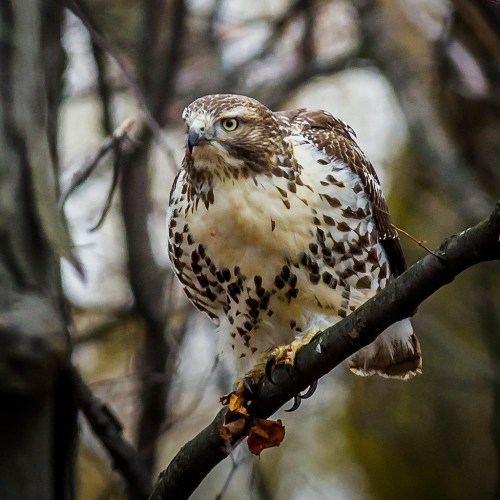
Know Your Michigan Birds: Cooper’s Hawk

10 January ~ Breakfast (with an Attitude)

10 January ~ Breakfast (with an Attitude), photo by MichaelinA2

All About Birds says that Cooper’s Hawks (known as the Chicken Hawk in England) are among the bird world’s most skillful fliers, tearing through tree canopies in high speed pursuit of other birds. They have more information and hawk calls and offer some fun facts:

  • Dashing through vegetation to catch birds is a dangerous lifestyle. In a study of more than 300 Cooper’s Hawk skeletons, 23 percent showed old, healed-over fractures in the bones of the chest.
  • Once thought averse to towns and cities, Cooper’s Hawks are now fairly common urban and suburban birds.
  • Life is tricky for male Cooper’s Hawks. As in most hawks, males are significantly smaller than their mates. The danger is that female Cooper’s Hawks specialize in eating medium-sized birds. Males tend to be submissive to females and to listen out for reassuring call notes the females make when they’re willing to be approached. Males build the nest, then provide nearly all the food to females and young over the next 90 days before the young fledge.
  • The oldest known Cooper’s Hawk was 20 years, 4 months old. (and apparently good at either providing food or flying fast!)

See Michael’s photo on black and see more in his Top 99 Most Popular Photographs slideshow.

Many more Michigan birds on Michigan in Pictures!

New Destination

New destination

New destination, photo by Moobyluvsme

Gorgeous photo from last month. Check it out big as the sky, download it as a background and see more in Mike’s slideshow.

Safe travels this weekend everyone!

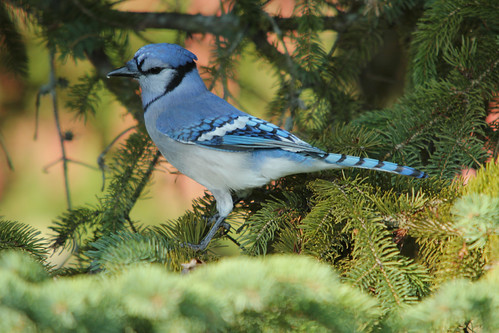
Things you may not know about Blue Jays

Back yard Blue Jay

Back yard Blue Jay, photo by kmenne

The All About Birds entry for Blue Jay (Cyanocitta cristata) says that these birds are known for their intelligence and complex social systems. Here’s a few facts – click above for more:

  • Thousands of Blue Jays migrate in flocks along the Great Lakes and Atlantic coasts, but much about their migration remains a mystery. Some are present throughout winter in all parts of their range. Young jays may be more likely to migrate than adults, but many adults also migrate. Some individual jays migrate south one year, stay north the next winter, and then migrate south again the next year. No one has worked out why they migrate when they do.
  • Their fondness for acorns is credited with helping spread oak trees after the last glacial period.
  • Blue Jays are known to take and eat eggs and nestlings of other birds, but we don’t know how common this is. In an extensive study of Blue Jay feeding habits, only 1% of jays had evidence of eggs or birds in their stomachs. Most of their diet was composed of insects and nuts.
  • The Blue Jay frequently mimics the calls of hawks, especially the Red-shouldered Hawk. These calls may provide information to other jays that a hawk is around, or may be used to deceive other species into believing a hawk is present.
  • Tool use has never been reported for wild Blue Jays, but captive Blue Jays used strips of newspaper to rake in food pellets from outside their cages.

They add that the oldest known wild, banded Blue Jay lived to be at least 17 years 6 months old, and the UM Animal Diversity Web adds that one captive female lived for 26 years and 3 months. If you’re wondering where that ranks in the avian actuarial tables, it’s longer than a cardinal and shorter than a crane – click that link for the details.

Check this photo out bigger than a Blue Jay or in Keith’s nature slideshow.

More Michigan birds on Michigan in Pictures.

Purple Martins (and Mosquitos)

Decoy Upside down

Decoy Upside down, photo by F. D. Richards

Putting up a Purple Martin house is like installing a miniature neighborhood in your backyard. In the East, dark, glossy-blue males and brown females will peer from the entrances and chirp from the rooftops all summer … Our largest swallows, Purple Martins perform aerial acrobatics to snap up flying insects.
~ All About Birds

The Purple Martin Conservation Association says that Purple Martins (Progne subis) are the largest member of the swallow family in North America, measuring 7 1/2 inches (19 cm) long and weighing 1.9 ounces (55 grams). Of the three races (subspecies), the ones we see in Michigan are Progne subis subis. The PMCA page on Attracting & Managing Purple Martins says:

Purple Martins spend the non-breeding season in Brazil then migrate to North America to nest. East of the Rockies they are totally dependent on human-supplied housing. West of the Rockies and in the deserts they largely nest in their ancestral ways, in abandoned woodpecker nest cavities. In the Pacific northwest, Martins are beginning to use gourds and clusters of single-unit boxes for nesting.

The pair-bond of the Purple Martin is monogamous. The male and female cooperate equally in building the nest out of mud, grass and twigs. The female lays two to seven pure-white eggs at a rate of one egg per day. The female incubates the clutch for approximately fifteen days, then the young hatch. The parents both feed the young continuously for a period of 26-32 days until the young fledge. The young continue to be dependent on their parents for food and training for an additional one to two weeks after fledging. It’s not uncommon for the fledglings to return to their human-supplied housing at night to sleep during this period. (Click to see an animation of the growth of a nestling purple martin.)

Martins, like all swallows, are aerial insectivores. They eat only flying insects, which they catch in flight. Their diet is diverse, including dragonflies, damselflies, flies, midges, mayflies, stinkbugs, leafhoppers, Japanese beetles, June bugs, butterflies, moths, grasshoppers, cicadas, bees, wasps, flying ants, and ballooning spiders. Martins are not, however, prodigious consumers of mosquitoes as is so often claimed by companies that manufacture martin housing. An intensive 7-year diet study conducted at PMCA headquarters in Edinboro, PA, failed to find a single mosquito among the 500 diet samples collected from parent martins bringing beakfuls of insects to their young. The samples were collected from martins during all hours of the day, all season long, and in numerous habitats, including mosquito-infested ones. Purple Martins and freshwater mosquitoes rarely ever cross paths. Martins are daytime feeders, and feed high in the sky; mosquitoes, on the other hand, stay low in damp places during daylight hours, or only come out at night.

While it sounds like purple martins aren’t the mosquito machine that they’re sometimes billed as, it does sound like they’d make a great addition to your yard!  Read on to learn about all kinds of things you can do to make your martin house a home. Also check out their songs page and get a lot more info and photos from the All About Birds Purple Martin page.

Check this photo out background big and in F.D.’s Birds slideshow.

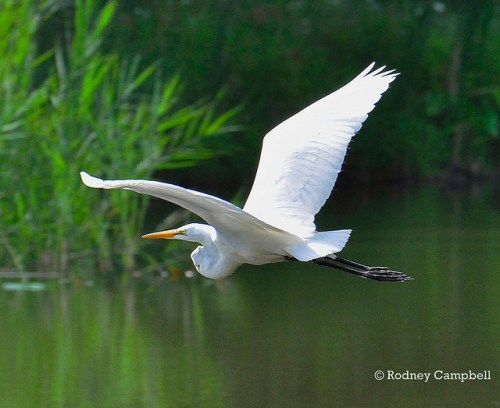
Great Egret (Ardea alba) in Flight

Great Egret (Ardea alba) in Flight

Great Egret (Ardea alba) in Flight, photo by AcrylicArtist

The Michigan Bird Atlas has a nice document on the Great Egret in Michigan that says (in part):

Today, the Great Egret is a powerful symbol of early conservation efforts mounted to safeguard it and other species from overhunting for their feathers in the 1800s. Protection in the early 1900s is credited with population recovery and establishment of the Great Egret as a breeding species in Michigan approximately 50 years ago.

…Great Egrets reach the northern edge of their U.S. distribution in Michigan. Historically, there is no evidence that this species nested in Michigan until the 1950s. For example, Barrows (1912) and Wood (1951) did not report Great Egrets as breeders in Michigan at the time of their studies, but Kelley et al. (1963) confirmed nesting in 1954 by nine pairs on Stoney Island (Detroit River) and seven on Dickinson Island (Lake St. Clair). These colonies appear to have persisted into the mid-1970s when W. Scharf et al. (1978) documented egrets at these sites in 1976. Although these colonies were no longer active at the time of the 1989-91 Great Lakes Colonial Waterbird Census, Sharf and Shugart (1998) reported new colonies in Saginaw Bay and at Pte. Mouillee State Game Area, Monroe Co.

The UM Animal Diversity Web has some information, calls and photos for Ardea alba, and also Great Egret (Ardea alba) on Michigan in Pictures.

Check this photo out background big and see more in Rodney’s Animals slideshow.

More Michigan birds on Michigan in Pictures.
Spread your wings

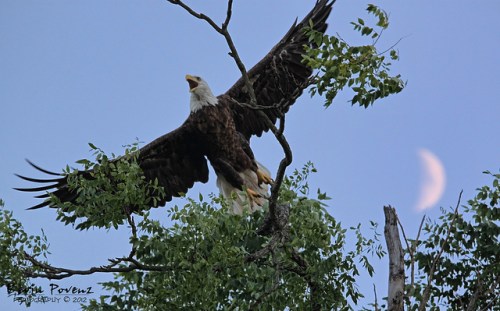
Bald Eagle

Bald Eagle, photo by Kevin Povenz

This feels like the perfect photo to feature one week from the Fourth of July!

Kevin, his son Aaron and his dog Charlie took a walk in the North Ravines on Grand River to see if they could see the eagles. As you can see, they were not disappointed! Check it out bigger and in Kevin’s awesome Birds of Prey slideshow.

More about the Bald Eagle in Michigan on Michigan in Pictures.

How swallows bring home the bacon…

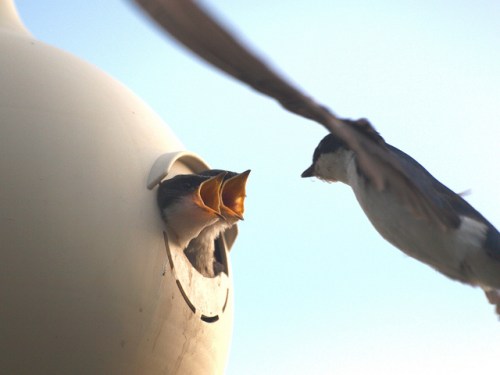
How swallows bring home the bacon . . .

How swallows bring home the bacon…, photo by Dr. Farnsworth

Somebody’s got a couple mouths to feed. Dale writes: These two young swallows kept both parents very busy tonight! About every minute one of the parents would fly up to the gourd and insert a bug or small insect into the wide open mouth of the babies!

Check it out background bigtastic and in his Best of West Lake slideshow.

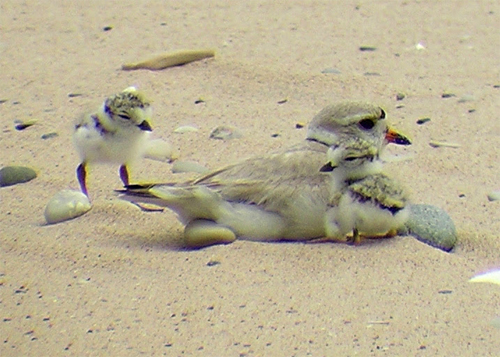
Piping Plover (Charadrius melodus)

Adult Piping Plover caring for her chicks, photo courtesy National Park Service

The Sleeping Bear Dunes National Lakeshore page on piping plovers begins:

The Piping Plover (Charadrius melodus) is an endangered shorebird. They are sand-colored on the back and white below. During the breeding season adults have a black forehead band between the eyes and a single black band around the neck. (Its larger relative the Killdeer is commonly seen at parks, playgrounds, and golf courses, and has two dark bands around the neck.) Piping Plovers nest only on beaches and prefer beaches with cobble. There are three small populations: one in the Great Plains, one on the Atlantic Coast, and the one here in the Great Lakes. They winter together on the Gulf Coast but travel to the separate areas during the breeding season. It is a special opportunity to be able observe Piping Plovers since there are only between 50 and 60 nesting pairs in the entire Great Lakes area and less than 5000 individuals worldwide.

You can read more about piping plovers at All About Birds where they also have some photos, a plover call and a video. You can also check out a video of a piping plover feeding from the other side of the state on Saginaw Bay.

The Sleeping Bear Dunes National Lakeshore reports that four pairs of this federally endangered shorebird have made the Glen Haven beach their home for the summer. It’s an easily accessible location that provides visitors an excellent opportunity to view a rare bird in its natural habitat. While the entire shoreline will be open for walking, certain areas of the beach will be temporarily closed to all entry.

More photos of piping plovers from Alice van Zoeren and the Sleeping Bear Dunes National Lakeshore.

Before we were owls

10

10, photo by Sherri & Dan

The Great Horned Owl article on Michigan in Pictures is stocked with all kinds of information about what this little guy will grow up to be (Sherri & Dan also took that photo). Also see Bubo virginianus (great horned owl) on the University of Michigan Animal Diversity Web and check out this video of three little horned owlets.

See this photo background big and and follow this owl’s growth in  Sherri & Dan’s owls slideshow.