The Turn of the Tern

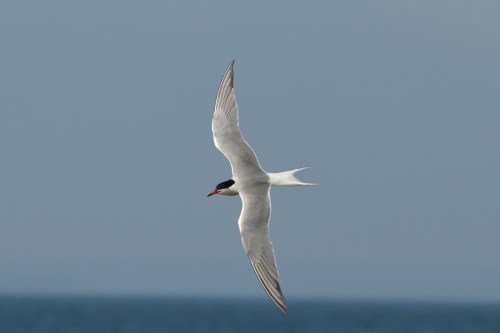
Turn of the tern

Turn of the tern, photo by MI photographer

The Michigan DNR says that the common tern (Sterna hirundo) is a small colonial waterbird and one of four breeding species of terns in Michigan (Caspian, black, common, and Forster’s terns):

Common terns are white with a black cap, and pale gray back and wings. Their bill is red orange with a black tip. The tail is deeply forked and dark along the outer edges. Immature common terns and adults in their winter plumage have only a partial black cap. It can be distinguished from its close relative the gull by a smaller body size and longer wings. The common tern’s call is a rolling ter-arr and rapid kip-kip-kip.

Common terns are frequently seen hovering in the air over a school of fish. With a sudden plunge downward into the water, they seize fish with their bills. Sometimes they will dive entirely below the surface of the water. Terns eat small fish such as shiners, chubs, and other minnows. They will also eat crustaceans and occasionally, insects such as dragonfly nymphs.

Their winter migration takes these birds to the Atlantic coastal areas in Florida, the Caribbean, and South America. They return to their nesting sites in early spring.

Arriving on their breeding grounds in May, common terns nest in colonies of 10 to 1,000 breeding pairs. They prefer sandy, well drained areas away from mammalian predators and human disturbances. Currently, common terns are using natural and human made islands in the Great Lakes with a few nesting on inland lakes. Common terns construct their nests by creating a depression in the sand with their feet, smoothing and shaping it by sifting in it and turning their bodies. Egg laying and incubation lasts until late June or early July. Both adults take turns sitting on the nest. The adults defend the eggs and young fiercely, diving at intruders, and even striking them with their bills.

Once numbering over 6,000 breeding pairs in Michigan, common terns were found on every Great Lakes shore. Data from 1992 suggest that the population has decreased to an estimated 1,400 breeding pairs. Several factors have contributed to this decline including loss of habitat, competition with gulls, predation, and effects of contaminants. As a result of these factors, the common tern was officially listed in Michigan as a “threatened species in 1978 and has recently undergone a status assessment by the US Fish and Wildlife Service in the Great Lakes for possible listing as Federally endangered.

You can read on for more including information about the huge breeding colony on Lime Island. Also see the Common Tern Sterna hirundo from the Audobon Society andCommon Tern at All About Birds.

William caught this photo off the coast of Mackinac Island in Lake Huron. Check it out bigger and see more shots of this beautiful bird his Mackinac Island slideshow.

Many more Michigan birds on Michigan in Pictures.
Pond Boss: The Red-winged Blackbird

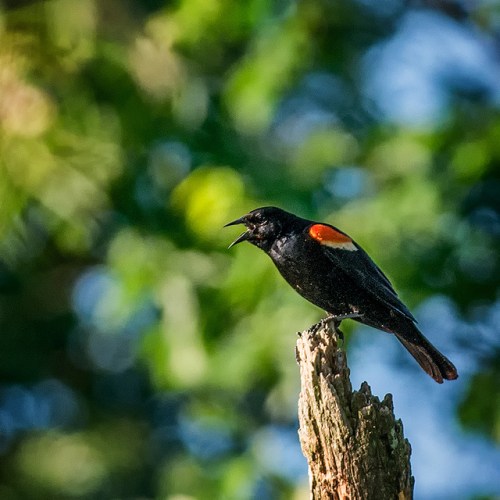
Pond Boss

Pond Boss, photo by MichaelinA2

I grew up by a marsh that was filled with Red-winged Blackbirds, and their song has always felt like lazy summer days to me. All About Birds entry for Red-winged Blackbird Agelaius phoeniceus says:

One of the most abundant birds across North America, and one of the most boldly colored, the Red-winged Blackbird is a familiar sight atop cattails, along soggy roadsides, and on telephone wires. Glossy-black males have scarlet-and-yellow shoulder patches they can puff up or hide depending on how confident they feel. Females are a subdued, streaky brown, almost like a large, dark sparrow. In the North, their early arrival and tumbling song are happy indications of the return of spring.

Male Red-winged Blackbirds do everything they can to get noticed, sitting on high perches and belting out their conk-la-ree! song all day long. Females stay lower, skulking through vegetation for food and quietly weaving together their remarkable nests.

Read on for more including video and blackbird calls. The Red-winged blackbird entry on Wikipedia has more, including a photo of the aforementioned red wing blackbird nest which I have to admit looks very cool!

Check this out bigger and see more in Michael’s 2013 birds slideshow.

More birds on Michigan in Pictures!

American Woodcock (Scolopax minor)

Woodcock

Woodcock, photo by lomeranger

This weekend while morel hunting I stumbled upon a woodcock. Yesterday while riding my bike home from work, I stumbled upon my friend Jason. On a whim, I checked his photos and found this picture. All About Birds entry for American Woodcock Scolopax minor says that this superbly camouflaged bird is difficult to discover on the forest floor where it probes for earthworms. Some facts:

  • The flexible tip of the American Woodcock’s bill is specialized for catching earthworms. The bird probably feels worms as it probes in the ground. A woodcock may rock its body back and forth without moving its head as it slowly walks around, stepping heavily with its front foot. This action may make worms move around in the soil, increasing their detectablity.
  • The American Woodcock is one of the few shorebirds that is regularly hunted for sport.
  • The male American Woodcock has an elaborate display to attract females. He gives repeated “peents” on the ground, often on remaining patches of snow in the early spring. After a time he flies upward in a wide spiral. As he gets higher, his wings start to twitter. After reaching a height of 70-100 m (230-328 ft) the twittering becomes intermittent, and the bird starts chirping as he starts to descend. He comes down in a zig-zag, diving fashion, chirping as he goes. As he comes near the ground he silently lands, near a female if she is present. Then he starts peenting again.
  • The male American Woodcock gives no parental care, but continues to display long after most females have laid eggs. Some males display at several, widely separated singing grounds and will mate with several females. A female may visit four or more singing grounds before nesting, and she may keep visiting even when she is caring for her young.
  • Unlike many birds that leave their nests at hatching, newly hatched woodcocks cannot feed themselves. They are dependent on the mother for food for the first week. The chicks start to probe in dirt at three or four days after hatching.

See Jason’s photo bigger and view more in his Beaver Island slideshow.

Many (many) more Michigan birds on Michigan in Pictures!

Great Blue Heron Rookeries

Great Blue Heons adding sticks to their nest

Great Blue Herons adding sticks to their nest, photo by ellenm1

The Michigan Natural Features Inventory entry for Great Blue Heron Rookeries explains:

The great blue herons in Michigan are largely migratory, with almost all leaving the state during the winter months. Most leave by end of October and return in early to mid-March.

The great blue heron is mostly a colonial nester, occasionally they nest in single pairs. Colonies are typically found in lowland swamps, islands, upland hardwoods and forests adjacent to lakes, ponds and rivers. Nests are usually in trees and may be as high as 98 ft. (30 m) or more from the ground. The platform like nests are constructed out of medium-sized sticks and materials may be added throughout the nesting cycle. Nests are usually lined with finer twigs, leaves, grass, pine needles, moss, reeds, or dry gras. The same nests are refurbished and used year after year. Nest size varies; newer nests may be 1.5 ft. (0.5 m) in diameter with older nests reaching up to 4 ft (1.2 m) in diameter (Andrle 1988). Nests can also be used by Canada geese (Branta canadensis), house sparrows (Passer domesticus), and great-horned owls (Bubo virginianus)…

Most great blue herons return to southern Michigan heronries in mid-March although a few may remain through the winter if there are areas of open water. Courtship and nest building commences from early April in southern Michigan to early May in the extreme northern portions of the state. Both sexes are involved in the nest building process with males primarily gathering sticks from the ground, nearby trees, or ungarded nearby nests. Males pass sticks to females who then place them on the nests. Between 3 and 7 (usually 4) greenish blue eggs are laid in April and May in Michigan. Both sexes take a turn at incubation with females incubating mostly at night and males during the day. The incubation period lasts from 25-29 days. In Michigan hatching occurs in the first week of May in the south while parents are still incubating nests in the far northern part of the state. For the first 3-4 weeks post hatching, one parent remains on the nest with the young.

Check this photo out big as the sky and see more in Ellen’s Kensington Metropark slideshow.

More heronsbirds on Michigan in Pictures, and also check out this photo of a Heronry on Absolute Michigan.

Lady ducks, take notice (of the Mallard)

Lady ducks take notice

Lady ducks take notice, photo by R.J.E.

It’s been too long since I’ve added to the Michigan in Pictures Duckie Gallery. The All about Birds entry for Mallard Anas platyrhynchos explains:

Mallards are large ducks with hefty bodies, rounded heads, and wide, flat bills. Like many “dabbling ducks” the body is long and the tail rides high out of the water, giving a blunt shape. In flight their wings are broad and set back toward the rear.

Male Mallards have a dark, iridescent-green head and bright yellow bill. The gray body is sandwiched between a brown breast and black rear. Females and juveniles are mottled brown with orange-and-brown bills. Both sexes have a white-bordered, blue “speculum” patch in the wing.

Mallards are “dabbling ducks”—they feed in the water by tipping forward and grazing on underwater plants. They almost never dive. They can be very tame ducks especially in city ponds, and often group together with other Mallards and other species of dabbling ducks.

Read on for more including photos and some fun facts:

  • The Mallard is the ancestor of nearly all domestic duck breeds (everything except the Muscovy Duck).
  • Mallard pairs are generally monogamous, but paired males pursue females other than their mates. So-called “extra-pair copulations” are common among birds and in many species are consensual, but male Mallards often force these copulations, with several males chasing a single female and then mating with her.
  • Mallard pairs form long before the spring breeding season. Pairing takes place in the fall, but courtship can be seen all winter. Only the female incubates the eggs and takes care of the ducklings.
  • The standard duck’s quack is the sound of a female Mallard. Males don’t quack; they make a quieter, rasping sound.
  • Mallards, like other ducks, shed all their flight feathers at the end of the breeding season and are flightless for 3–4 weeks. They are secretive during this vulnerable time, and their body feathers molt into a concealing “eclipse” plumage that can make them hard to identify.
  • The oldest known Mallard lived to be at least 27 years 7 months old.

Check this photo out bigger and in R.J.E.’s slideshow.

Over the Moon with a Sandhill Crane

Over the moon

Over the moon, photo by TBPICKS

The 1896 book Myths and Legends of our Own Land by Charles M. Skinner relates a rather gruesome version of the tale of the origin of Whitefish, which this photo reminded me of.

An Indian who lived far in the north was so devoted to the chase that he was never at home for the whole of a day, to the sorrow of his two boys, who liked nothing so much as to sport with him and to be allowed to practise with his weapons. Their mother told them that on no account were they to speak to him of the young man who visited the lodge while their father was away, and it was not until they were well grown and knew what the duty of wives should be that they resolved to disobey her. The hunter struck the woman dead when he learned of her perfidy. So greatly did her spirit trouble them, however, that they could no longer abide in their old home in peace and comfort, and they left the country and journeyed southward until they came to the Sault Sainte Marie.

As they stood beside the falls a head came rolling toward them on the earth—the head of the dead woman. At that moment, too, a crane was seen riding on the surface of the water, whirling about in its strongest eddies, and when one of the boys called to it, “O Grandfather, we are persecuted by a spirit; take us across the falls,” the crane flew to them. “Cling to my back and do not touch my head,” it said to them, and landed them safely on the farther shore.

But now the head screamed, “Come, grandfather, and carry me over, for I have lost my children and am sorely distressed,” and the bird flew to her likewise. “Be careful not to touch my head,” it said. The head promised obedience, but succumbed to curiosity when half-way over and touched the bird’s head to see what was the matter with him. With a lurch the crane flung off his burden and it fell into the rapids. As it swept down, bumping against the rocks, the brains were pounded out and strewn over the water. “You were useless in life,” cried the crane. “You shall not be so in death. Become fish!” And the bits of brain changed to roe that presently hatched to a delicate white fish, the flesh whereof is esteemed by Indians of the lakes, and white men, likewise. The family pitched a lodge near the spot and took the crane as their totem or name-mark. Many of their descendants bear it to this day.

The version I read in one of my all-time favorite books, Lore of the Great Turtle : Indian Legends of Mackinac Retold by Dirk Gringhuis is pretty dark as well. Michigan in Pictures has a post with all the information about Sandhill Cranes in Michigan, and you can also check out Sandhill Crane (Grus canadensis) from the Michigan DNR.

View this out on black and see more in Todd’s slideshow.

More birds on Michigan in Pictures.

Fledge Season & Great Horned Owlets

Great Horned Owlets

Great Horned Owlets, photo by Kevin Povenz

April is the season for owls to fledge, or learn to fly. The Raptor Education Group from over in Wisconsin has a page about owlets that includes what to do if you come across one of these cute balls of fluff on the ground:

Great-horned Owls do not build their own nest. Instead, they choose an old nest of a crow, hawk, or even a squirrel to call their own.

When the young owls are 6-8 weeks old, they begin to venture from their nest. This is before they can actually fly. Nature’s method provides owlets opportunities to develop their leg muscles that will very soon be catching their own prey. In a natural setting owlets that appear to have fallen from their nest actually have fledged. In a natural wooded area, bushes and smaller trees provide a ladder of sorts and allow the chicks to climb to a higher perch until they can fly. When owls nest in a city with concrete below them rather than a soft forest floor, problems arise. That is also the case with a well-manicured park or lawn setting that has nothing that can function as a ladder for the tykes.

…If you find a young owl, leave it where it is, unless it is in imminent danger. Give us a call and let us help you decide if the adults are in attendance and the chick is just fledging naturally or if there is something wrong with the little one. Remember, owls are nocturnal for the most part and are not easy to see during daylight hours. Mom and dad could be very close and yet be so well camouflaged they are hard to see.

Michigan in Pictures has a feature on Great Horned Owls with a lot more about these birds!

View this on black, check out more from Kevin on Michigan in Pictures and definitely have a look at his great Birds of Prey slideshow.

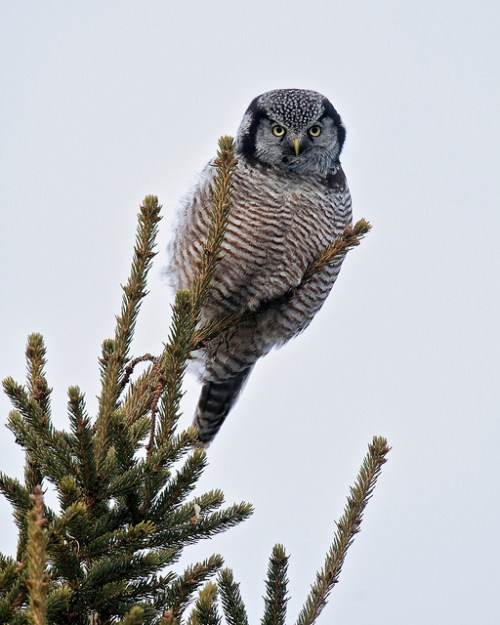
Northern Hawk Owl, and the NMC Hawk Owls

northern hawk owl, chippewa county, michigan

northern hawk owl, chippewa county, michigan, photo by twurdemann

Northwestern Michigan College here in Traverse City has just under 5000 students and is turning from a 2 year to a 4 year college. As part of this, they will be adding athletics again, and that means they need a mascot. So this week they selected a new one – the NMC Hawk Owls.

With a weight of half a pound to a pound, a length of just 14-16″ and a wingspan of just under 2 1/2 feet, the Northern Hawk Owl appears to be the perfect mascot:

Northern Hawk Owl – Surnia ulula at OwlPages.com:

Hunting & Food: Takes mainly small mammals as prey, mostly lemmings and voles. Will also take birds, frogs and occasionally fish. Prey weight is normally below 70g. Hunts by searching from a lookout, then quickly flying to swoop down on prey. Has been observed hovering also.

Breeding: Male advertises potential nest sites, and the female selects one. Nests in Cavities on top of broken trunks, natural tree hollows, abandoned holes of large woodpeckers. Will accept nest boxes, and occasionally use a stick nest of a larger bird. Laying normally occurs in April and the first half of May. Clutch sizes are usually between 5 and 13 eggs, each 36-44mm  x 29-34.4mm. Eggs are laid at 1-2 day intervals, and incubated by the female alone for 25-30 days. During this time, the male feeds the female.

Northern Hawk-Owl at Wikipedia:

The Northern Hawk-Owl has been said to resemble a hawk in appearance and in behavior. In North America, its appearance in flight is often considered similar to a Cooper’s Hawk (Accipiter cooperii). It has been suggested that this may be because the Hawk-Owl may partially fill an important diurnal niche similar to that of day hunters such as hawks.

…Northern Hawk Owls are unevenly distributed and highly variable throughout the boreal forest. They live mostly in open coniferous forests, or coniferous forests mixed with deciduous species such as larchbirchpoplar, and willow. They are found in muskegs, clearings, swamp valleys, meadows, or recently burnt areas, and generally avoid dense spruce-fir forests. Winter habitat is usually the same as breeding habitat. 

Northern Hawk Owl at All About Birds adds that their International conservation status is Least Concern and some cool facts:

  • The Northern Hawk Owl can detect prey by sight at a distance of up to 800 meters (half a mile).
  • Though it is thought to detect prey primarily by sight, the Northern Hawk Owl can find and seize prey under 30 cm (1 foot) of snow.

The Whitefish Point Bird Observatory adds that Northern Hawk Owl were observed yesterday in Trout Lake and Dryburg, Michigan.

Grabbing a mouse through a foot of snow? That’s a seriously scary predator … at least if you’re the prey. Click all those links to explore photos, calls and more about these tiny terrors.

Check this photo from Chippewa County out on black and see more including another shot of this owl in twurdemann’s Birds slideshow.

More owls (and also apparently words that end with owl) on Michigan in Pictures.


Cyanocitta cristata, the Blue Jay

Blue Jay in Winter

Blue Jay in Winter, photo by AcrylicArtist

The UM Animal Diversity Web entry for Cyanocitta cristata blue jay says (in part):

Blue jays are bright blue on top and whitish gray on the belly and chin. They have a gray-blue, feather crested head, which they can raise and lower. The feathers on their wings and tails are bright blue with white and black bands. Blue jays also have a collar of black feathers across the throat and continuing around the head. Their bills, legs, feet, and eyes are black. Males are just a little larger, on average, than females.

…Blue jays are very aggressive and noisy birds,driving other birds away from food sources and their territories. In the winter, Blue jays hide far more food than they can eat, perhaps to remove food from their territories to discourage intruders. They are also partially migratory, and in the fall they can be seen traveling in flocks of more than a hundred birds.

…Blue jays are omnivorous. They feed on fruits, nuts, seeds, insects, mice, frogs, and will rob other nests for small songbirds and bird eggs. To eat nuts, blue jays hold them with their feet and then crack the shell with their bill. Blue jays in captivity have been known to fashion tools in order to get at foods. Blue jays will also steal foods from other birds by frightening them into dropping what they have. They cache foods, such as seeds, for later use.

Read on for much more (including photos)  and don’t miss a previous feature, Things you may not know about Blue Jays.

Check this out background bigtacular and see more in Rodney’s Animals slideshow.

Many more Michigan birds on Michigan in Pictures.

Pairs Skating, Swan Edition

pairskating

pairskating, photo by mozy54

Lynn writes that she didn’t see this pair in the national ice skating finals. Check it out on black and see a couple more shots of these swans in her slideshow.

More birds on Michigan in Pictures!