The Fisher Building in Detroit

iPhone Fisher

iPhone Fisher, photo by Trovarsi

The Detroit News Rearview Mirror feature on the Fisher Building in Detroit begins:

When the seven Fisher Brothers of Fisher Body fame hired architect Albert Kahn in 1927 to design a building that would bear their name, they gave him a blank check and the instructions to build “the most beautiful building in the world.” Plans for a $35 million three-phase project were announced by the brothers in January of 1927. The original program called for three units to be built over a period of several years, but due to the onset of the Great Depression in 1929, only phase one, the Fisher Building, was completed at a cost of $10 million.

The site the brothers had selected for the structure was bounded by West Grand Boulevard, Lothrop Avenue, Third Avenue and Second Boulevard, across from the General Motors building. They originally wanted to build downtown but were unable to put together a suitable parcel of land. They turned to the General Motors area where the idea for a New Center was born.

Read on and see some cool photos at the Detroit News. You can also check out the Fisher Building on Emporis and the Fisher Building on Wikipedia, which notes that the building contains the 2,089 seat Fisher Theatre, a National Historic Landmark, and it is also the location of the headquarters for the Detroit Public Schools. More about Albert Kahn on Michigan in Pictures.

Check this out bigger and in Ryan’s Detroit slideshow.

More architecture from Michigan in Pictures.

Boulderdash: Charlevoix’s Earl Young Houses

Boulderdash

Boulderdash, photo by hausfrau23.

A few month’s ago on Absolute Michigan we featured the quirky & amazing Earl Young and his Charlevoix cottages. One of the articles we linked to from the Freep in 1973 said:

Stone houses seem to sprout as naturally as dandelions from the soil of this pleasant Lake Michigan resort community.

And they do because of an already legendary 84-year-old man named Earl A. Young, who built them all.

For more than half a century Young has combed lonesome fields and dusty quarries searching for the odds and ends of nature. He blends stones and timber with an architect’s skill and a geologist’s respect for his raw material, and so far he has fitted more than 40 local landscapes with his art.

“l have a very strong feeling for stone,” Young explained recently as he sat in his wood-paneled office on the lower level of one of his most flamboyant creations, the Weathervane Inn, a local restaurant.

“Stones have their own personalities. People say I’m crazy when I say so, but they really do. Why I found a stone that weighed 160 tons. It was formed 350 million years ago at the bottom of a warm sea and was carried here 10,000 years ago by glaciers.”

Click through for lots more and links to great resources for seeing some of these architectural oddities including the Earl Young Collection at the Charlevoix Library and Park Avenue Prowl, which has a walking guide.

Check this out big as a boulder and in hausfrau23’s Up North Vacation – September 2010 slideshow.

Atop Jackson’s Golden Towers

Art Deco Tower with Antennas

Art Deco Tower with Antennas, photo by benft.

Jackson County says:

The 17-story Tower Building was built in 1929 for the new Union and Peoples National Bank. The Tower Building was at that time referred to as the “Golden Towers.”

…In 1975 it was sold to the County for a nominal sum by the Raymond Kolowich family and became the County Tower Building. The County Commissioners’ Chamber is located on the 2nd floor up the marble flight of stairs. Italian leaded stained glass windows surround the chamber which was originally the main banking area.

At the top there is a “Falcon Cam” that is trained on the nest of a peregrine falcons! Click through to watch the chicks grow up!

Check this photo out bigger and in Ben’s cool architecture slideshow.

More architecture and more from Jackson on Michigan in Pictures!

Made in Detroit … by Bill Schwab

Detroit

Detroit, photo by Bill Schwab.

Settle back and enjoy Bill’s Made in Detroit slideshow.

More black & white photography on Michigan in Pictures

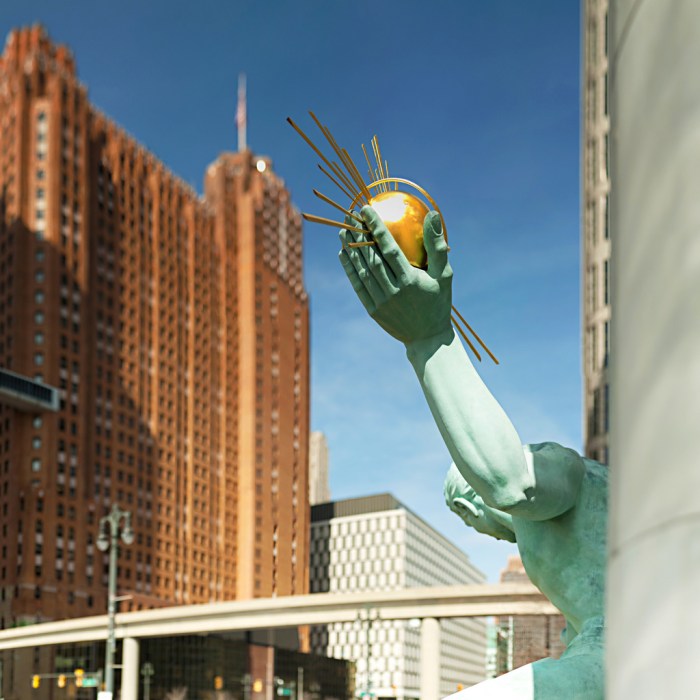
spirit of detroit redux

spirit of detroit redux

spirit of detroit redux | detroit, michigan, photo by s o u t h e n

Michigan in Pictures has more about the Spirit of Detroit by Marshall Fredericks and you can take a step inside the lobby of the Guardian Building.

You can see Ryan’s photo bigger, in his Detroit slideshow or purchase it right here!

The Belle Isle Bridge | Detroit, MI

The Belle Isle Bridge | Detroit, MI

The Belle Isle Bridge | Detroit, MI, photo by .brianday..

Wikipedia notes that the official name of the bridge across the Detroit River to Belle Isle from Detroit is the MacArthur Bridge. The bridge uses nineteen arches to span the 2,193 feet to Belle Isle. Completed in 1923 for $2,635,000, it replaced a mostly wooden bridge that was destroyed by fire in 1915. See The day the bridge to Belle Isle burned down for more on that. While it was once known as the Belle Isle Bridge, was renamed in honor of General Douglas MacArthur in 1942.

Belle Isle Bridge “Douglas MacArthur Bridge” at HistoricBridges.org explains:

This is an extremely long multi-span concrete arch bridge that gives people access to Belle Isle, and the structure is the longest arch bridge in the state of Michigan.

This bridge is extremely significant not only because of its length, but because it is a very early example of a cantilevered concrete arch. A cantilevered concrete arch does not function like a traditional arch. Traditional arch bridges require the arch to be a complete and connected arch to function. This arch bridge does not function in that way. Each half of each arch spans is a cantilever arm that is structurally independent from the other half of the arch in that span. Standing under a span of this bridge, a clear gap at the center of the span is visible. Indeed, on the outermost part of the arch, a decorative “keystone” was placed for aesthetic reasons to cover up this gap.

Wayne County Road Commission was among Michigan’s counties, an innovative and creative road commission and they apparently made significant use of concrete cantilever arch structures. Other examples of concrete cantilever bridges in the county remain. These other examples are different from the Belle Isle Bridge, and feature a third central “suspended” span between the cantilever arms.

Check it out bigger and in Brian’s Long Exposure slideshow.

Slumpy, Michigan Central Station and Reflections on Ruin Porn

still standin

still standin, photo by paulhitz.

The other day I noticed a big spike on one of the most popular posts of all time on Michigan in Pictures, slumpy … the William Livingstone Mansion in Detroit’s Brush Park which tells the story of the fall of this iconic ruin in 2007.

The culprit for this increased traffic was Haunting Images Of Detroit’s Decline by Nicole Hardesty on Huffington Post, a photographic tour of Detroit’s ruins produced in response news that:

…census data indicates Detroit’s population dropped by a startling 25 percent in the last decade, from 951,270 in 2000 to 713,777 last year. That’s a 60 percent decline from its 1950 peak population — 1.85 million — and the lowest count since the 1910 Census put the then-promising Motor City’s population at 285,704.

Definitely shocking numbers, and like many media outlets, they chose to drive the numbers home with pictures of some of the many ruins of the Motor City: United Artists Theater, Michigan Central Station (MCS), the Whitney Building and (of course) Slumpy. The images are drawn from the new photographic book Ruins of Detroit from Yves Marchand and Romain Meffre. The photographs are no doubt gorgeous and there’s no denying that ruin photography provides some powerful commentary on what has happened to Detroit in the last 40 years.

In looking at them, however, I was struck by the thought that seems to always come to mind when I research and write about Slumpy, Michigan Central Station and even the ruin in redevelopment where my office is, the former Traverse City State Hospital. That thought is “Am I adding something positive to the discussion and struggle to redefine Michigan or am I just exploiting the pain behind these ruins?”

There’s two really excellent essays that look at roughly two sides of the ruin porn/ruin photography coin. The first is Detroitism by John Patrick Leary in Guernica Magazine. It’s a probing and critical look at ruin porn that is well worth your consideration that asks “What does ‘ruin porn’ tell us about the Motor City, ourselves, other American cities?” The second is a thoughtful response to Leary’s article On ‘Ruin Porn’ by photographer and historian Ian Ference. Ference takes issue with the assertation that ruin photography cannot help but exploit a city’s misery and takes you through the work of some earlier ruin photographers.

I still don’t know where I come down in this whole debate, but I think that I prefer the work along the lines of Johnny Knoxville to the reporting that he mocks in the opening of his great video about the D. How about you? Add a comment below.

Check this out bigger and in Paul’s My Detroit slideshow.

Indian Village and the 12 Days of Christmas in Detroit

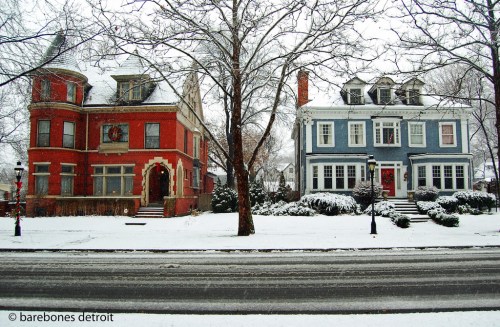
Untitled, photo by BareBonesDetroit

The folks at BareBones Detroit are doing the Twelve Days of Christmas in Detroit, a series on some of the best things to do and see around the holidays. Check their set out on Flickr at the link above (view slideshow) and don’t miss their cool map of Detroit! Of this photo they write:

Day 2: Indian Village. There’s never a better time to take a drive through Detroit’s historic Indian Village neighborhood. Just east of downtown, many of these homes were owned by some of the city’s most prominent, wealthy families. Grab some hot chocolate, turn the radio to 100.3 WNIC and tour some of the Detroit’s most historic homes lit up for the season.

Detroit’s historic Indian Village by Zena Simmons of The Detroit News says that the architecturally diverse Indian Village was home to famous Detroiters including Edsel Ford & Bernard Stroh. Their homes were designed by some of Detroit’s most renowned architects including Albert Kahn, Louis Kamper and William Stratton. The first Village home was built in 1895 at Jefferson and Iroquois and later became the headquarters for WXYZ and the home of the Lone Ranger.

According to the Indian Village Historical Collections, originally, the land belonged to Francois Rivard and Jacques St. Aubin, recipients of French land-grant “ribbon” farms, long narrow strips of land that gave each farmer some river frontage. Abraham Cook acquired the farms between 1811 and 1815. The area consisted mostly of farms, and a couple of upper-class river cottages, but the main attraction was a mile long oval race track. The track was the site of several Michigan State Fairs during the 1860s and was known as the Hamtramck Race Course.

Around 1893, Cook’s heirs formed the Cook Farm Company, Ltd. to develop a “first class residential district on a generous scale”, and the prices were set high so that only the wealthy could build there.

Many assumed that at one time Indians lived on the land. That may be, but John Owen Jr., a key player in the development of the area, selected the name “Indian Village” because he felt the romantic title would add to the sales appeal.

You can also check out Wikipedia’s entry for the Indian Village Historic District and the Historic Indian Village neighborhood site.

The Knapp Building says “Lansing has next”

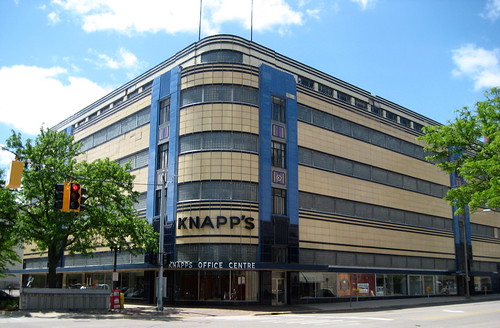
Knapp's Office Centre

Knapp’s Office Centre, photo by Eridony.

Last week on Absolute Michigan we had a story about Lansing being named the Next American City. The article by Ivy Hughes in Next American City is titled Lansing: There’s No Place We’d Rather Be and might change your view of Michigan’s changing capital city. I had selected this photo for a quick link over to the article because I have always thought the building is neat. I soon learned that the long vacant Knapp’s Office Centre building is being renovated, another tangible sign of the new energy that is rising in Lansing.

Wikipedia’s J.W. Knapp Company Building entry says:

The J.W. Knapp Company Building is a historic five-story, 190,000-square-foot (18,000 m2) Streamline Moderne building in Lansing, Michigan, United States. Designed by Orlie Munson of the Bowd–Munson Company, which also designed several other Art Deco landmarks in Lansing, including the Ottawa Street Power Station, it was constructed by the Christman Company in 1937 through 1938. The curvilinear look of the streamlined structure comes from huge plates of concrete faced with enamel, called “Maul Macotta”, a copyrighted product of the Maul Macotta Company and prismatic glass brick windows. Alternating horizontal bands of yellow macotta and glass block are interrupted by vertical blue macotta pylons, rising from the building’s four principal entrances. The pylons are pierced by windows. The entrance portals, display window aprons, and decorative banding are dark blue macotta. Red, yellow and blue spandrels, incorporating the letter “K” as a design element, decorate the entrance portals

The building housed the main department store of the Lansing-based J.W. Knapp Company. When completed in 1939, it was hailed in the contemporary press as “the most modern building in the Midwest”. Today, it is considered to be one of the finest intact examples of Streamline Art Moderne commercial buildings in the Midwest, notable for its size, clarity of design and brilliant colors.

Don’t miss this great set of Historic photos of J.W. Knapps Building in the Lansing State Journal.

See this photo big as a building and see this and other shots of the building in Brandon’s massive Downtown Lansing slideshow.

Michigan’s Tallest: The Renaissance Center in Detroit

renaissance center detroit

renaissance center detroit, photo by Detroitmi97.

The list of the tallest buildings in Michigan says that the title of tallest building in Michigan belongs to the Renaissance Center at 77 stories and 722 feet tall. It also has the distinction of being the tallest all-hotel skyscraper in the Western Hemisphere.

The RenCen is owned by General Motors and Wikipedia says that the Ren Cen was conceived as a catalyst for Detroit’s economy by Henery Ford II and investors, and that it generated in excess of $1 billion in economic growth for downtown Detroit in its first year of operation.

John Portman was the principal architect for the original design. The first phase constructed a five tower rosette rising from a common base. Four 39-story office towers surround the 73-story hotel rising from a square-shaped podium which includes a shopping center, restaurants, brokerage firms, banks, a four-screen movie theatre, private clubs.The first phase officially opened in March 1977. Portman’s design renewed attention to city architecture, constructing the world’s tallest hotel at the time. Two additional 21-story office towers (known as Tower 500 and Tower 600) opened in 1981. This type of complex has been termed a city within a city.

…The architects’ initial design for the Renaissance Center focused on creating secure interior spaces, while its design later expanded and improved to connect with the exterior spaces and waterfront through a reconfigured interior, open glass entryways, and a Wintergarden.

While it might be a little over-photographed, it’s an amazing space for photographers to explore, inside and out.

Mark says he can see the whole world from here – can you? Check it out background boomtacular and see some other shots from high up in the RenCen in his detroit top slideshow.

More Renaissance Center and don’t miss the RenCen slideshow from the Absolute Michigan pool!

More of Michigan’s tallest on Michigan in Pictures.