Michigan Architect Minoru Yamasaki

Roofline: DeRoy Auditorium, Wayne State University--Detroit MI

Roofline: DeRoy Auditorium, Wayne State University–Detroit MI, photo by pinehurst19475

“When people go into good buildings there should be serenity and delight.”
~Minoru Yamasaki

Minoru Yamasaki  (December 1, 1912 – February 7, 1986) was an American architect best known for his design of the Twin Towers of the World Trade Center who ended up making his home in Michigan.

The Detroit News has a feature titled world-class architect Minoru Yamasaki that gives a good overview of the architect and his somewhat tumultuous life, and you should also read the Seeking Michigan feature on Yamasaki and his Michigan architectural practiceMichigan Modern has a list of Yamasaki designed buildings in Michigan as well.

Check this out background bigtacular and see more in Anthony Lockhart’s Wayne State and the Cultural Center slideshow.

More architecture on Michigan in Pictures.

Setting an Example at the Cadillac Tower

Setting An Example

Setting An Example, photo by DetroitDerek Photography

Wikipedia says that the Cadillac Tower was the first building outside New York City and Chicago to have 40 floors with a spire height of 438 ft making it Detroit’s 12th tallest building. It’s a Beaux Arts skyscraper that was designed by the architectural firm of Bonnah & Chaffee and built in 1927 as Barlum Tower.

The building is best known, however, for its hanging murals. From 1994 to 2000, one side of the building featured a 14-story Detroit Lions star Barry Sanders, which was replaced with one of Red Wings star Steve Yzerman. Currently the building features an ad for the Fidelity investments.

Also see the Cadillac Tower website and have a look at the proposed Cadillac Centre for this location.

Check this out bigger and see more in Derek’s Sunset and Sky Series slideshow.

More Michigan architecture on Michigan in Pictures.

Michigan’s Most Haunted: Detroit Masonic Temple

NOTE: Upon further research, it appears that George Mason did not leap to death from the roof of the Masonic, but instead died in bed at the age of 92 in 1948. In my defense, the story of Mason’s suicide has been reported by a number of news outlets!!
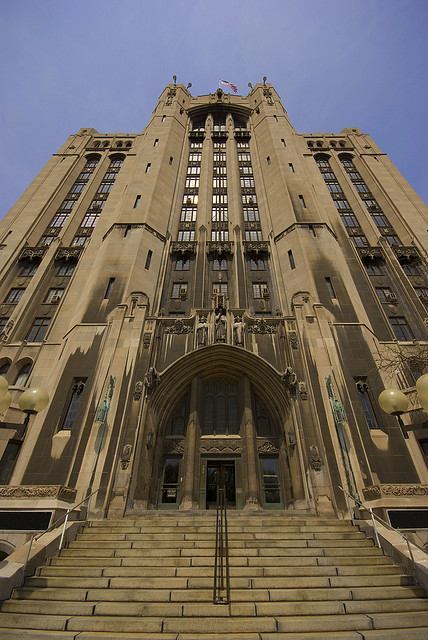
The Masonic Temple

The Masonic Temple, photo by kc Jacoby Photography

Halloween is fast approaching and the Awesome Mitten has a great post on the Ten Most Haunted Places in Michigan. We’ve visited a few of those places on Michigan in Pictures, but #4 on the list, The Masonic Temple in Detroit, was spooky, cool and new:

Built in 1912 by a wealthy gentleman named George D. Mason, the Detroit Masonic Temple has over 1,000 rooms, and several secret staircases, concealed passages, and hidden compartments in the floors. Mr. Mason went slightly overboard when financing the construction of the building, and eventually went bankrupt, whereupon his wife left him. Overwhelmingly depressed about his financial and personal circumstances, Mason jumped to his death from the roof of the temple. Security guards claim to see his ghost to this day, ascending the steps to the roof. The temple, abundant with cold spots, inexplicable shadows, and slamming doors, is known to intimidate visitors with the eerie feeling of being watched…

Read on for more and share any thoughts you have on these or other haunted Michigan places in the comments below!

The Detroit Masonic Temple is the largest masonic temple in the world, and you can get all kinds of pictures and history including some shots from construction on their website. The theater has its own site as well for events and this weekend they are going Beyond the Other Side.  One note about George Mason is that in addition to the masonic temple, he also designed several other Michigan buildings including the Detroit Yacht Club and the Grand Hotel on Mackinac Island. See Historic Detroit for more.

While it may feel like the Ken Jacoby show with 2 appearances in just a week, his shot was the most brooding of the many interior and exterior photos of the temple in the Absolute Michigan pool. Check it out on black and see more in Ken’s The Masonic Temple slideshow.

More ghostly fun on Michigan in Pictures and also at absolutemichigan.com/ghost!

Downtown Synagogue of Detroit

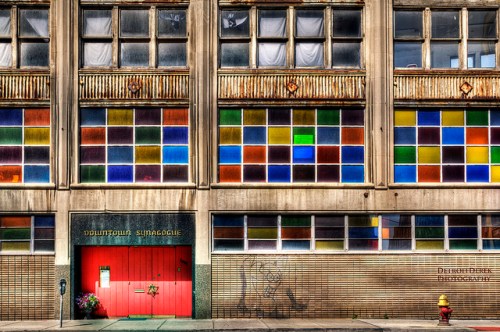
An Amassment of Colors

An Amassment of Colors, photo by DetroitDerek Photography

The Isaac Agree Downtown Synagogue (of Detroit) explains that:

The Isaac Agree Downtown Synagogue (IADS) was established in 1921, at a time when there were many synagogues located in Detroit. Its principal mission was to address the unmet needs of the Jewish community ― particularly for those who worked downtown, were unaffiliated with another synagogue, or were visiting the city―by providing a traditional (Conservative) Jewish presence in the heart of Detroit.

…As much of the Jewish community migrated to suburban Detroit, the IADS―like the city itself―has suffered from a shrinking population and a depletion of resources. In recent years, daily services have, of necessity, been eliminated. However, the Downtown Synagogue proudly continues to offer weekly Sabbath services, as well as High-Holiday services, the latter of which attracts hundreds of worshippers.

The Synagogue is currently housed in a historic four-story building, a building that it has occupied and owned since the early 1960s. Located at 1457 Griswold Street, it is well situated, but is in serious need of major repair. Currently, parts of it are unusable. However, the unique triangular design creates an uncomparable, interesting space. The potential for this building is far from being realized.

This Sunday (August 19), they are offering J-Cycle, a bicycle tour of historic Jewish Detroit. A portion of the proceeds will be donated to the Back Alley Bike Project, at the Hub of Detroit, a non-profit organization providing cycling education and services with a focus on youth development, sustainable practices and community access.

See Derek’s photo on black and in his massive and amazing Detroit slideshow.

Also see a few more pics from the Absolute Michigan pool.

Comerica Park, home of the Detroit Tigers

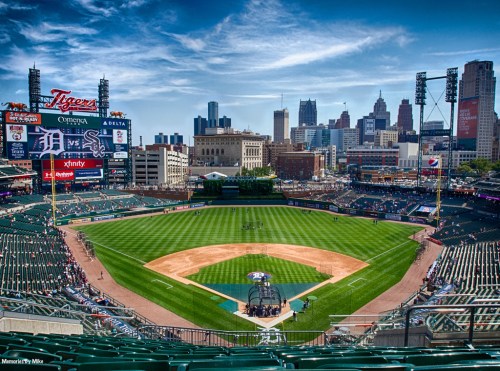
Tigers Game_2012-07-21_15-08-05_P7210017_©MikeBoening_2012_HDR (1)

Tigers Game, July 21, 2012, photo by memories_by_mike

It may come as a surprise to regular readers that despite all the posts about the Detroit Tigers here and at Absolute Michigan, I’ve never been to Comerica Park. Today I not only get to go – I get to sit on the 3rd base line (2nd row!!)as the red-hot Detroit Tigers face the New York Yankees tonight!

Wikipedia’s entry for Comerica Park (edited a bit by me) explains that:

Groundbreaking for a new ballpark to replace Tiger Stadium for the Tigers was held on October 29, 1997 and the new stadium was opened to the public in 2000. In December 1998, Comerica Bank agreed to pay $66 million over 30 years for the naming rights for the new ballpark. Comerica Park sits on the original site of the Detroit College of Law.

In contrast to Tiger Stadium, which had long been considered one of the most hitter-friendly parks in baseball, Comerica Park is considered to be extremely friendly to pitchers. Except for dead center – 420 feet versus Tiger Stadium’s 440 feet – the outfield dimensions were more expansive than those at Tiger Stadium. This led to complaints from players and fans alike, and engendered the sarcastic nickname Comerica National Park.

Although a few public figures—notably radio announcer Ernie Harwell—supported the dimensions, most agreed that the left-field wall, in particular, needed to be brought closer to home plate. Before the 2003 MLB season the club did so, moving the distance from left-center field from 395 to 370 feet. In place of the old bullpens in right field, 950 seats were added for a new capacity of 41,070.

At the time of construction, the scoreboard in left field was the largest in Major League Baseball. The first playoff game at Comerica was played on October 6, 2006 against the New York Yankees. It hosted its first World Series later that month. The stadium also includes many baseball-themed features, including a “Monument Park” in the deep center field stands, complete with statues of former Tigers Ty Cobb, Hal Newhouser, Charlie Gehringer, Hank Greenberg, Al Kaline, and Willie Horton.

A few neat things I found are Comerica Park from Ballparks.com, baseball writer Geoff Baker touring Comerica,  Calvin Johnson hitting a HR in BP, Comerica on Michigan in Pictures, a time-lapse of the installation of the new high-def scoreboard, the slightly bizarre Comerica UFO footage and a very cool RC plane fly-over of Comerica.

Check this photo out big as a ballpark and in Mike’s slideshow.

We’ve got you covered

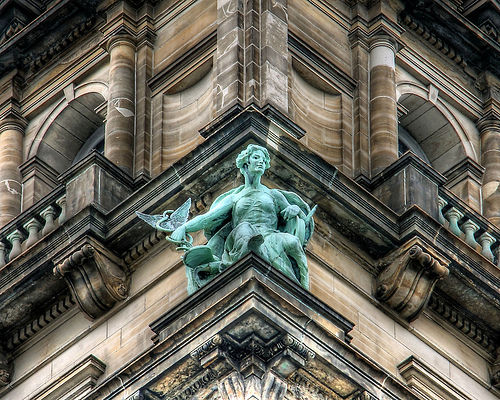
DSC02766_tonemapped

DSC02766_tonemapped, photo by ansonredford.

I thought I’d feature a photo from our Michigan Cover Photos Group. You can add pics to it if you want to have them featured on our Michigan in Pictures Facebook and also the Absolute Michigan Facebook.

Recently we featured Donald’s photo of one of the sculptures on the Wayne County Courthouse. This is one of four that depict Law, Commerce, Agriculture, and Mechanics. They were executed by sculptor J. Massey Rhind.

Check it out background bigtacular and see some more including an amazing HDR of the courrthouse in Donald’s slideshow.

Remembering Michigan’s legendary architect Albert Kahn

Albert Kahn's legacy

Albert Kahn’s legacy, photo by .brianday.

“Architecture is 90 percent business and 10 percent art.”
~Albert Kahn

Legendary Detroit architect Albert Kahn died on December 8, 1942. The Albert Kahn entry at Wikipedia begins:

Kahn was born on March 21, 1869 in Rhaunen, Rhineland-Palatinate, Germany. Kahn came to Detroit in 1880 at the age of 11. His father Joseph was trained as a rabbi. His mother Rosalie had a talent for the visual arts and music. As a teenager, he got a job at the architectural firm of Mason and Rice. Kahn won a year’s scholarship to study abroad in Europe, where he toured with another young architecture student, Henry Bacon, who would later design the Lincoln Memorial in Washington, D.C.

The architectural firm Albert Kahn Associates was founded in 1895. He developed a new style of construction where reinforced concrete replaced wood in factory walls, roofs, and supports. This gave better fire protection and allowed large volumes of unobstructed interior. Packard Motor Car Company’s factory built in 1907 was the first development of this principle.
The success of the Packard plant interested Henry Ford in Kahn’s designs. Kahn designed Ford Motor Company’s Highland Park plant, begun in 1909, where Ford consolidated production of the Ford Model T and perfected the assembly line. On Bob-Lo Island, Henry Ford had a dance hall designed and built by Albert Kahn, which was billed as the second largest in the world in a 1903 account…

Ten Albert Kahn designed buildings are recognized with Michigan historical markers:

    • Battle Creek Post Office
    • The Dearborn Inn
    • Detroit Arsenal Tank Plant in Warren, Michigan
    • Edsel and Eleanor Ford House in Grosse Pointe Shores, Michigan
    • Fisher Building
    • Delta Upsilon Fraternity, 1331 Hill St., Ann Arbor
    • Packard Motor Car Company factory
    • The Detroit News
    • The Detroit Free Press
    • Willow Run

Get the complete list of his firm’s buildings (including the Russell Industrial Center) at Wikipedia. The company that Kahn founded in 1895 is still in the business. There’s an interesting biography of Albert Kahn from Ford that notes that a Detroit sculptor recognized Albert’s artistic talent and allowed him to attend his art school free. However, after discovering that Kahn was color blind, the artist encouraged him to become an architect and secured him a job as an office boy.

Check this photo out bigger and see more in Brian’s Detroit Flavor slideshow. Coincidentally enough, Brian just let me know that this photo is being hung in a gallery today along with 10 other prints from Brian (and another 10 from two other michpics regulars,  Jon DeBoer and Jeff Gaydash) at Studio Couture gallery, 1433 Woodward Avenue. Opening night for the exhibition will be this Saturday from 6pm-9pm. Details right here!

More Michigan architects & architecture from Michigan in Pictures.

Brighter Days Ahead

Brighter Days Ahead

Brighter Days Ahead, photo by Kim.Kozlowski.

Great sentiment, great photo. Learn about the Renaissance Center on Michigan in Pictures.

Check it out bigger and in Kim’s Detroit Slideshow.

fall in detroit

fall in detroit

fall in detroit, photo by buckshot.jones.

Color touring and fall fun isn’t only for Northern Michigan – check out the Detroit Fall Color Tour on Pure Michigan, which begins:

The home of the Motown Sound is the starting point for a 195-mile fall color route that skirts three waterways to the maritime city of Port Huron, and rolls through historic Southeast Michigan towns with connections to three pop music stars. The month of October is prime for viewing autumn hues at a variety of parks, and stopping to taste seasonal treats at cider mills along the way

Read on for more!

Check it out background big and in Scott’s Cass Corridor slideshow.

More Fall Wallpaper on Michigan in Pictures.

What Was There, Michigan Edition

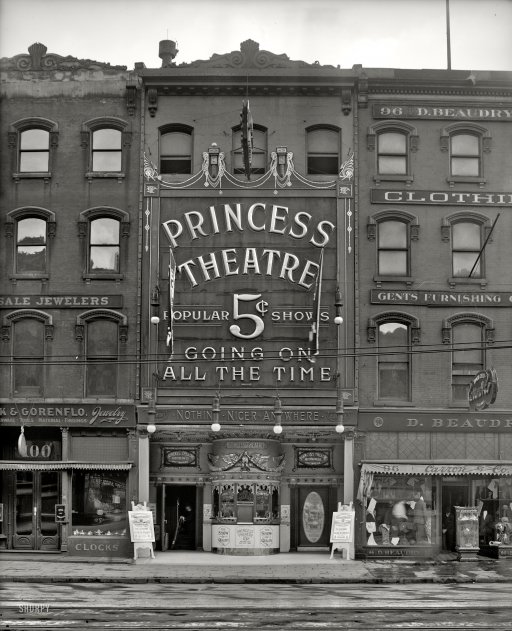
Princess Theatre, Detroit photo courtesy WhatWasThere

The other day I came across a new website called WhatWasThere. This innovative project ties historical photos to Google Maps and Google street views so you can see what was there. You can browse around a map, zooming in and out and then click on photos. The site lays them over the Google street view and lets you fade the old photo to reveal what’s there now!

Unsurprisingly, Detroit has the best coverage so far, and it’s pretty cool to see how sites like Woodward Ave looking north at Jefferson (location of the Spirit of Detroit) or Griswold Street have changed. Water Winter Wonderland (a cool site in its own right) has a sweet shot of the interior of the Princess and says that the Princess Theatre was shuttered in 1922 and located at 520 Woodward. That’s the present site of the old Comerica Bank HQ. At another of my favorite sites for old photos, Shorpy, you can get this photo bigger and even buy a print!

Here’s the link to WhatWasThere for Michigan.  There’s not a whole lot of photos to be found (yet) outside Detroit, but one of the coolest things is that you can add your own historical photos, so the site is only going to get better. There are some definite gems though – be sure to check out Grand Rapids City Hall, the seriously cool looking Lansing Masonic Temple at the site of Cooley Law School and the not very much changed Front St in Marquette. A surprising hot spot is Port Huron – check out Sperry’s Department Store to get going.