
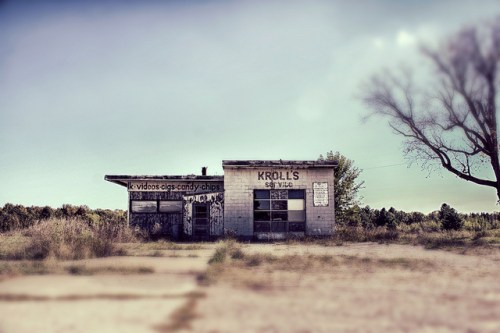
Untitled, photo by J.M.Barclay
Guessing the repair is going to take a while…
View J.M.’s photo bigger and see more in his slideshow.
Untitled, photo by J.M.Barclay
Guessing the repair is going to take a while…
View J.M.’s photo bigger and see more in his slideshow.
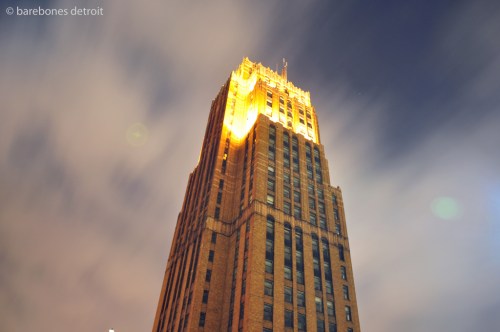
Untitled, photo by BareBonesDetroit
Last week the David Stott Building, Detroit’s 13th tallest skyscraper, sold at auction for just under $9 million. Historic Detroit’s page on the David Stott Building begins:
A towering Art Deco structure honoring Detroit’s flour king, the David Stott Building stretches 38 stories above Capitol Park at the corner of State and Griswold streets.
Construction began on June 1, 1928. The tower cost $3.5 million to build – the equivalent of $46.3 million today, when adjusted for inflation, according to the Bureau of Labor Statistics.
The Stott opened on June 17, 1929, on what had been the sites of the Garrick Theatre, Hodges Building and the Whitney Office Building. It was designed by the architectural firm of Donaldson & Meier, though Henry Meier had died more than a decade earlier. The general contractor was the Martin & Krausmann Co.
The 436-foot tower was first conceived in 1921, and 22 sets of plans were drawn up before a winner was picked. The property was not particularly wide considering the building’s height, which created headaches for Donaldson and led him to go with a tall, slender design.
The tower is made of reddish-orange brick – faced on the first three floors with marble — and limestone, and has several setbacks that taper as the building climbs. “As the new David Stott Building rises a tall, slender but substantial mass of old rose colored brick, it makes a spectacle that arrests the attention and causes the spectator to view it in detail from the sidewalk to the uppermost of its 38 stories,” the Detroit News wrote in June 1929. “The tendency of architectural style in office buildings the country over is toward more lively colors — more lively, but still dignified, warm, pleasing to the eye.”
Read on for more of the history of this hard-luck structure and DEFINITELY click through to view their gallery of historic photos of the David Stott Building – it’s great! You can also follow the listing and sale of the Stott Building at Curbed Detroit.
Check it out bigger and see more in BareBones Detroit’s Rooftops slideshow.
More architecture on Michigan in Pictures.
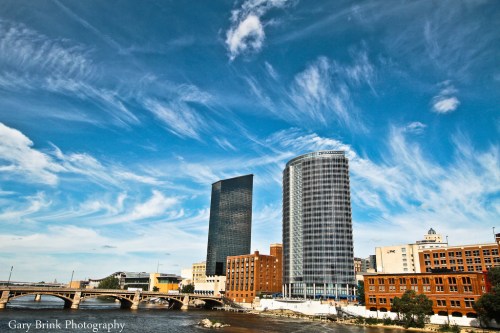
Untitled, photo by photofrenzy2000
An amazing shot of Michigan’s second largest city.
Check it out bigger and see more including some more incredible cloud shots in Gary’s slideshow.
More Grand Rapids on Michigan in Pictures.

Yipsilanti Michigan, photo by vtnn43e48073
It may not be Nighthawks, but I thought this diner looked pretty cool!
Check it out background big or in Zack’s slideshow.

Water Board Building Upper Floors–Detroit MI, photo by pinehurst19475
historicdetroit.org’s page on the Water Board Building explains:
The Art Moderne-styled Water Board Building has been a familiar part of Detroit’s skyline since October 1928. The Common council provided $1 million in the 1927-28 city budget for a triangular-shaped building on a site bounded by Randolph, Farmer, and Bates Streets. Louis Kamper – a Detroit-based architect known for his work on the houses of prominent Detroiters, as well as Detroit landmarks like the Book Building (1917), the Washington Boulevard Building (1923), and the Book-Cadillac Hotel (1924) – originally planned for a 14-story building. But, “because of the high value of the site, the Board decided that … it would build a twenty story building.”
The completed building reflects the trend toward simplification of forms typical of the Jazz Age. Standing 23 stories, it is comprised of a five-story base, a 15-story shaft, and a three-story penthouse. The total cost – including the $250,000 paid for the site, and the architect’s five-percent commission – was $1,768,760.20. It was one of the last buildings designed by Kamper, who was in his late sixties during its design and construction.
…The BOWC’s new building was constructed in a record-breaking seven months. It was considered state-of-the-art and fireproof by 1928 standards.
Click over to Historic Detroit to read a whole lot more and see a couple of old photos. Also check out the Water Board Building at Detroit 1701 where I found a link to this 300 year history of the Detroit Water Board.
View the photo big as the building and see more in pinehurst19475’s water board building slideshow.
More architecture on Michigan in Pictures.

Irish Hills Towers from Route 12 (View 1), photo by DarrylW4
The Adrian Daily Telegram reports that ownership of the Irish Hills Towers has formally been transfered to the Irish Hills Historical Society, a 501(c)(3) nonprofit. The towers have been stabilized and are being evaluated, and it appears that the IHHS would need about $300,000 to restore this attraction. Keep up with their progress at the Irish Hills Historical Society Facebook.
This page on the Irish Hills Towers notes that the top of the towers is 1400 feet above sea level, which makes them the highest point in southeastern Michigan. On a clear day (if they were open) you could see for seven miles with a ten lakes visible. Michigan in Pictures has more shots of these iconic landmarks including the history of the towers and a crazy cool photo by Matt Callow.
Darren took the photo and suggests that he’d like to see the towers restored and converted to a museum for Michigan’s Roadside Attractions. Check it out on black and see more in his Irish Hills Towers slideshow.
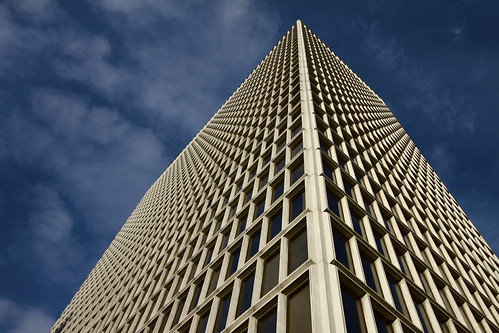
211 Fort Detroit, photo by Mark Hall Aka Mark The kid
Wikipedia says that 211 West Fort Street is a 27 story skyscraper that was completed in 1963. Current tenants include the Detroit Economic Club, the Bankruptcy Court of the Eastern District of Michigan and the United States Attorney. If you’re a measuring sort of person, it’s the 18th tallest building in Detroit, right after the David Broderick Tower.
Check this out big as a building and see more in Mark’s slideshow.
More architecture on Michigan in Pictures.

Born And Raised In South Detroit…, photo by DetroitDerek Photography
Just a small town girl, livin’ in a lonely world
She took the midnight train goin’ anywhere
Just a city boy, born and raised in south Detroit
He took the midnight train goin’ anywhere
~Journey, Don’t Stop Believin’
mLive says that Don’t Stop Believin’ is the world’s all time most dowloaded MP3. It’s certainly one of the most fun songs ever to sing along with, so “South Detroit” is probably the world’s all-time most believed in totally made up place. Former Journey high-note-hitting frontman Steve Perry explains:
“I ran the phonetics of east, west, and north, but nothing sounded as good or emotionally true to me as South Detroit,” he says. “The syntax just sounded right. I fell in love with the line. It’s only been in the last few years that I’ve learned that there is no South Detroit. But it doesn’t matter.”
It doesn’t matter … if you don’t care about Detroit at least. Derek explains:
This image, taken facing South, shows you that… well… South Detroit is on the other side of the river… it’s Windsor… Canada… there is no South Detroit…. sorry if I ruined anyone’s Christmas by revealing this “sacred classic rock” information. Makes a good lyric though…
See it on black and view more in Derek’s My Faves slideshow.
More Detroit on Michigan in Pictures
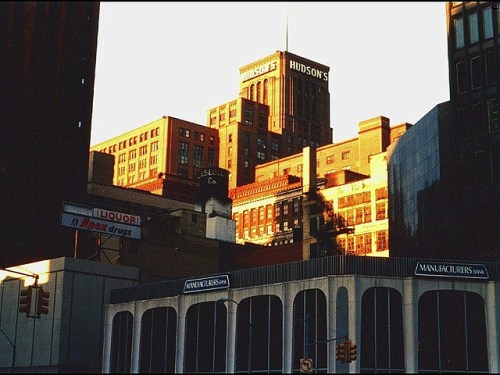
hudsons, photo by johnhoneyman
One of the signs that the holidays are approaching that I see on Michigan in Pictures is a surge of visits to the post about Holiday Shopping at J.L. Hudson in Detroit. Hudson’s was demolished in 1998, but the store remains a cherished memory for many.
Wikipedia’s entry for the J.L. Hudson Department Store and Addition says that the building was designed by Smith, Hinchman, & Grylls and named after the company’s founder, Joseph Lowthian Hudson. Construction began in 1911 with many additions throughout the years before being “completed” in 1946. Hudson’s Department Store at Historic Detroit has some great photos and a lot of facts:
Much more at Historic Detroit and you will also want to check out Hudson’s in the Department Store Museum, a Hudson’s photo tour from Detroit Yes and a nice video of photos of Hudson’s.
Check this out on black and see more in John’s arkitektura slideshow.

Art Museum Night, photo by AaronSnyderPhoto
The Eli & Edy Broad Art Museum at Michigan State University opened in early November. The museum features the historical collection from the Kresge Art Museum. They explain that:
This collection, which spans cultural production from ancient Greece and Rome and pre-Columbian cultures through Medieval and Renaissance art to the modern and contemporary will enable the Broad MSU to explore the art of our time through the long lens of art history. Highlights of the museum’s collection include: Greek and Roman antiquities; medieval and Renaissance illuminations; Old Master paintings; 19th century American paintings; 20th century sculpture by artists such as Alexander Calder and Jenny Holzer; and works by contemporary artists such as Chuck Close and Ann Hamilton. Collection growth and new acquisitions will focus on modern and contemporary works (post 1945).
You can search the collection at collections.artmuseum.msu.edu. The museum was designed by architect Zaha Hadid who has a fantastic photo gallery of the latest addition to MSU’s campus. You might also enjoy their virtual tours.
Check this out background big and see more including another angle in Aaron’s MSU Landscape slideshow.
More Michigan museums on Michigan in Pictures!
 Michigan in Pictures