
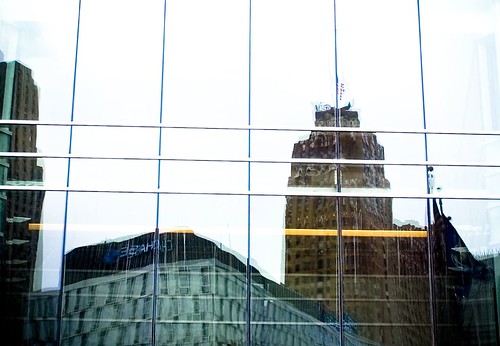
Distorted Reality, photo by A Dubs
Compuware Building, Campus Martius, Detroit, MI. Alan has a blog called Faded Detroit where he turns his eye (and his camera) upon decay and rebirth in the city of Detroit.
Distorted Reality, photo by A Dubs
Compuware Building, Campus Martius, Detroit, MI. Alan has a blog called Faded Detroit where he turns his eye (and his camera) upon decay and rebirth in the city of Detroit.

Untitled, photo by Rhonda_Marie.
Last weekend, the Exposure.Detroit group on Flickr held a photography meetup at Cranbrook. Here is a link to many more great photos taken at Cranbrook.
Cranbrook House and Gardens in Bloomfield Hills is the heart of the over 300-acre National Historic Landmark Cranbrook campus. The English Arts and Crafts-style Cranbrook House was designed by Detroit architect Albert Kahn in 1908 for Detroit News publisher George Gough Booth and Ellen Scripps Booth. The home is the oldest surviving manor in the metro Detroit area. According to the Cranbrook House and Gardens site:
The Booths commissioned the finest artisans, craftsmen and studios of the period to furnish the house with handcrafted furniture, tapestries, tiles, stained and leaded glass, and other works of fine and decorative art.
The 40 acres of gardens that surround Cranbrook House were originally designed by George Booth to entice visitors to savor the serenity of the spring and summer months. From the symmetry of the Sunken Garden to the scent of the herbaceous garden to the casual beauty of the bog garden, there is something to capture everyone’s interest. Sculpture, fountains and architectural fragments enhance the setting with spacious lawns, specimen trees, and a lake stretching out beyond the fieldstone walls.
Also see Cranbrook’s History in the Cranbrook Archives and How one man’s bad luck paved way for creation of Cranbrook from the Detroit News Rearview Mirror. Also see this map of the Cranbrook area with geotagged photos.
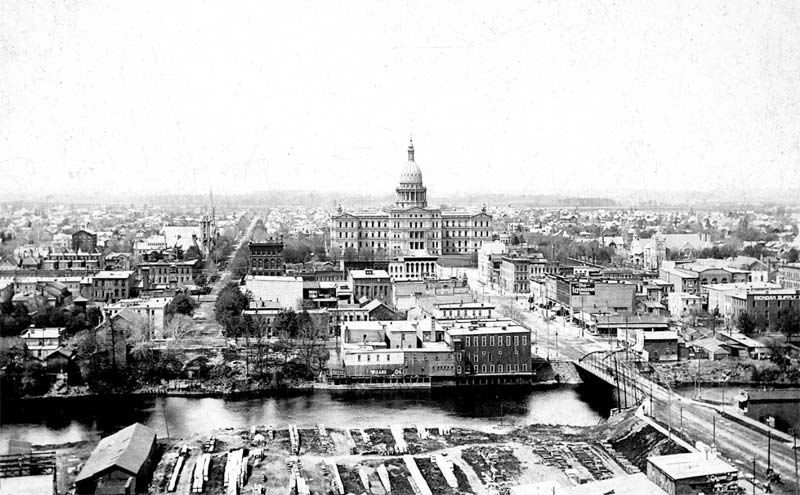
These two photos are from the book Lansing: City on the Grand by James MacLean and Craig A. Whitford from Arcadia Publishing (book details & purchase online). The 128 page book features over 200 historical photos of Lansing. In addition to photos you’d expect (Lansing Olds, REO plant and the Capitol building) there are photos and stories you wouldn’t like Barnes Castle (torn down in 1957 for a parking lot) and Charlie Zmuda, the “Bat Man”.
(above) STANDPIPE VIEW OF LANSING LOOKING WEST, C. 1890s.
A popular location for photographers to capture the city was the standpipe located on south Cedar Street. 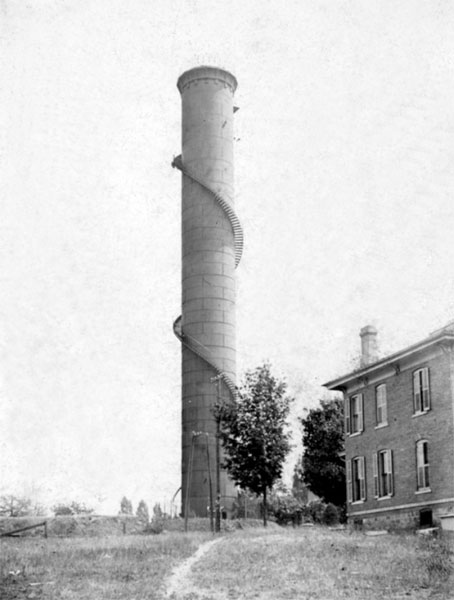 This view was taken prior to the construction of a new wide steel bridge on Michigan Avenue, crossing the Grand River. (FPML/CADL.)
(right) THE MYSTERIOUS STANDPIPE, C. 1890s.
The standpipe was constructed in 1885 and served as the city’s storage tank for water. The tower was located east of Cedar Street and south of Michigan Avenue, where the Board of Water and Light have their holding tanks today. The remarkable aspect of the standpipe was that you could walk to the top on the circular staircase that wraps around the tower. Many a photographer took advantage of this and quite a few panoramic photographs were taken. The standpipe was torn down in 1949. (FPML/CADL.)
Photos reprinted with permission from Lansing: City on the Grand by James MacLean and Craig A. Whitford. Available from the publisher online at www.arcadiapublishing.com or by calling 888-313-2665.
View other excerpts from Arcadia Publishing’s Michigan books at Michigan in Pictures!
Edited Dec 20, 2014: Unfortunately the photo that was featured here was deleted. Here’s the video instead…
Absolute Michigan’s first Michigan photo-video titled Holler: Detroit Photos + Detroit Cobras featuring great photos of the Motor City and a rockin’ Detroit Cobras tune.
Thanks to all the photographers who shared work that is in here and also to those who did but aren’t (there’s over 1500 pics of Detroit in the Absolute Michigan pool!)

Last Look at Promenade by BuildingsOfDetroit.com – SNWEB.ORG
SNWEB says that the Guardian Building is Detroit’s best kept secret. It is considered one of the most significant Art Deco skyscrapers in the world and has been designated as a National Historic Landmark. Billed as “The Cathedral of Finance”, the building was designed for the Union Trust Company in the Roaring 20s by noted architect Wirt C. Rowland. A defining characteristic is the use of color. Rowland explained “We no longer live in a leisurely age … the impression must be immediate, strong and complete. Color has this vital power.”
The Guardian Building web site says:
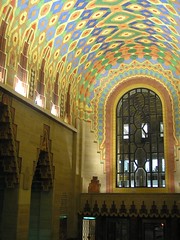
Designed by Michigan architects; erected by Michigan contractors; built by Michigan artisans–the Guardian Building is virtually a temple of Michigan commerce and ingenuity. The Griswold Street entrance is crowned with a semi-dome lined with symbolic custom tiles by Mary Chase Stratton’s Pewabic Pottery of Detroit. The lobby features a large glass mosaic and the banking hall’s spectacular mural are both by Michigan artist Ezra Winter. Flanking the sides of the main entrance are reliefs designed by Detroit’s own architectural sculptor Corrado Parducci. In all, forty artisans worked on the structure’s painted murals and ceilings, intricate tile work, mosaic and stained glass, marble fixtures and vaulted lobby.
Check out a slideshow of Guardian Building photos from Flickr. Also see the excellent article Guardian Building has long been the crown jewel in Detroit skyline in the Detroit News’ Rearview Mirror and Guardian Building in Wikipedia.

Red Scrolls, photo by jnhkrawczyk.
Jill Hamilton-Krawczyk says: We were driving down Woodward in Detriot when this door caught my eye.
This is part of Jill’s great set of Doors & Windows.

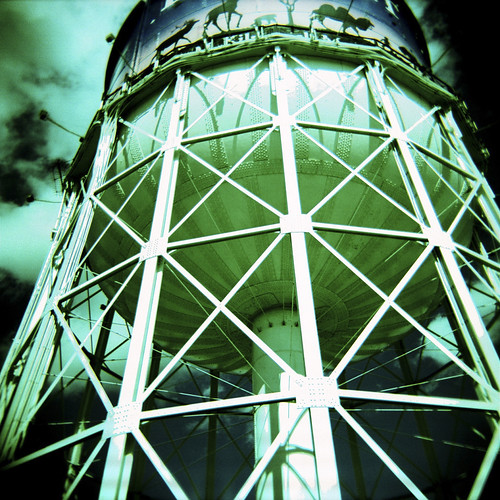
Last one of the Holga Tower, photo by G0Da.
G0Da likes water towers and his holga.
For those who may not know just what the heck a “holga” is, here’s the Lomographic Society International’s explanation of the Holga:
Did you think your eyes were open? I’m afraid to say that until this very moment they have been closed. The unassuming Holga is here to save you from a future of digital pixels and images shared on small screens on cameras or phones. We have all become numbed with photography, there is no denying it, but a chunky camera made almost entirely of plastic has been put on this Earth to save us. It will reawaken your vision, fill you with joy, make you see beauty when you thought it had disappeared forever, and bring out sunshine on a cloudy day.

World Series in Detroit, photo by UrbanTiki.
Bobby Alcott’s photo of Comerica Park was taken before Game 1 of the 2006 World Series from the top of the Fox Theatre parking garage. The detail on this photo is incredible. Click above or check it out on black.
While Game 1 wasn’t very happy for Tiger fans, Bobby got a great shot of Kenny & Pudge at Game 2!
Maybe this will be available soon You can order a copy of this photo of Comerica Park on Opening Night of the 2006 World Series from Bobby Alcott Photography!

Anastacia Campbell says this photo is best viewed large.
The Detroit Nighthawks group says…
A city isn’t just one place. It changes by the hour. The boarded up derelict at midday becomes the heaving nightclub by midnight. Places you simply don’t notice in the thronging crowd can appear majestic in the darkness. Theatre lights wink on and off unwatched and the crosswalk lights command only shadows.
Detroit can be a challenge to the late night photographer, both acquisitive street folk and inquisitive police are just waiting to happen. But if you’re out at 4am and wandering streets through which only drifting steam moves, then Detroit appears lonely, powerful and alluring.
Et Erimus Umbra

yummmmmm, photo by vanessamiller.
The next EXPOSURE.Detroit show takes place next Friday (Oct 20, 2006) from 7:00pm – 10:00pm at Karras Bros Tavern, Detroit, MI and features “CAVE CANEM”, radiospike, rckrawczykjr and vanessamiller. As Ms. Miller is the only photographer from whom Michigan in Pictures has not yet featured a photo, the choice of who to pick out of these 4 talented artists was easy!
As this photo from high up in the abandoned David Whitney Building demonstrates, Vanessa seems to gravitate toward abandoned buildings and is not at all afraid of heights. She also free-lances for The Real Detroit Weekly.
 Michigan in Pictures