Vermilion Point and the Vermillion Life Saving Station

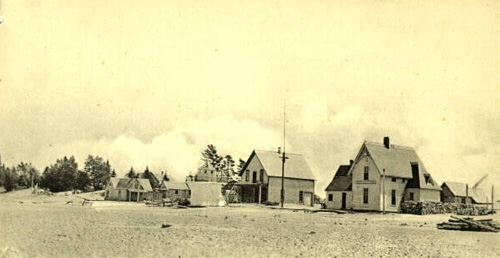
Vermilion Bunkhouse, photo by Odalaigh

The Little Traverse Conservancy says that the Vermilion Point Nature Preserve is a 175 acre tract on Whitefish Point (north of Paradise in Chippewa County) that features over 9000 feet of Lake Superior frontage:

This preserve is defined by the majesty and moods of Lake Superior and its remote location. It contains a wide sandy beach, low shore dunes, upland forest, old cranberry bog wetlands, and a stream. Ecologically, the land is known habitat for the federally endangered piping plover.

…Historically, this property and its associated buildings were a life saving station first built in 1847. Years of neglect and harsh Lake Superior weather have taken a toll on the buildings which are being restored. Researchers from Lake Superior State University, The Nature Conservancy, and Michigan Audubon use the property to study the piping plovers as well as other birds, and the wetlands.

Charles works for the Conservancy and has a ton of photos of their preserves everything from installing the new sign to these cool bird prints. He posts his photos in beautiful, background bigness – check out his Vermilion set and this slideshow of his vermilion tag.

Marty Hogan has some pictures from the Vermillion Life Saving Station, and more pics can be found at Vermilion Michigan and this photo map for the Whitefish Point area on Flickr.

If you’d like to go back in time, check out the Vermillion Life Saving Station courtesy Archives of Michigan Digital Collection

Vermillion Life Saving Station


Heidi Johnson and the angels in the architecture

Heidi Johnson, Third Floor, Men's Ward

Heidi Johnson, Third Floor, Men’s Ward, photo by mstephens7.

Michael told me yesterday that Heidi Johnson passed on. He has a post Remembering Heidi Johnson and took a tour of Building 50 with her (slideshow).

I didn’t know her well, but I’ve always had an enormous amount of respect for her work and her depth of passion for photography, and specifically her teaching of photography and Interlochen and her photography of the former Traverse City State Hospital. I don’t know what role (if any) her work played in the rebirth of the former mental institution as The Village at Grand Traverse Commons, but I do know that it did awaken the community to what an architectural and natural treasure it was.

On her web site, heidijohnson.com she wrote:

about the book Angels in the Architecture

I have been fascinated by the history of rural America for years and specifically with the history of the former Traverse City State Hospital in Traverse City Michigan (also called The Northern Michigan Asylum until 1911.) Based upon childhood memories of having an Aunt institutionalized there from the 1950’s – 1970’s to the belief that I was meant to tell this story lead me to embark upon a three year immersion into the early history of the facility as well as special permission to photograph inside the various structures (primarily Building 50) from 1997 -1998. This body of work evolved into a book which was published by Wayne State University Press in 2001 entitled Angels in the Architecture: A Photographic Elegy to an American Asylum

You can view an amazing gallery of Heidi Johnson’s photography through her site and learn more about the Traverse City State Hospital from Kirkbride Buildings.

Heidi’s obituary in the Record-Eagle directs memorials to the American Institute for Cancer Research and the Arthritis Foundation.

Saginaw River Rear Range Light

Saginaw River Lighthouse

Saginaw River Lighthouse, photo by SNiedzwiecki.

Stacy says that she took this photo on a boat tour of the Saginaw River and that access is very limited. It’s one of a number of photos in her Michigan Lighthouses set. She has also placed it on a map.

Terry Pepper’s page on the Saginaw River Rear Range Light brings the usual 110% of awesome with historical photos and a complete history of the lighthouse that explains (in part):

Eleventh District Engineer Major Godfrey Weitzel’s design for the combined rear range tower and dwelling was unique. Consisting of a large elevated concrete base supporting a combined brick dwelling and tower, the swampy ground in the chosen site first required the driving of timber piles deep into the ground to provide a solid foundation on which timber forms for the concrete base could be erected and filled. Atop this concrete foundation, a square two-story Cream City brick keeper’s dwelling 26′ 6″ in plan was constructed. Integrated into the northwest corner of the dwelling, a tapered 53′ tall square tower with double walls housed a set of prefabricated cast iron spiral stairs. Winding from the cellar to the lantern, these stairs also serving as the only means of access to the first and second floors by way of landings on each floor, each outfitted with tightly fitting arch-topped iron doors designed to stem the spread of fire between floors. A timber deck supported by timber columns encircled the dwelling at the first floor level, providing easy and dry access to all sides of the structure. The living quarters consisted of a kitchen, parlor and oil storage room on the first floor, and three bedrooms above. The tower was capped with a square iron gallery, supported by five cast iron corbels on each of its four sides. An octagonal cast iron lantern was installed at its center, with a fixed white Fourth Order Fresnel lens placed at a focal plane of 61 feet.

You can also check out some photos of the light and information from the Saginaw River Marine Historical Society and read a bit about the possible haunting of the Saginaw River Lighthouse.

Rock Harbor Lighthouse, in lifting fog – Isle Royale National Park

Rock Harbor Lighthouse, in lifting fog - Isle Royale National Park

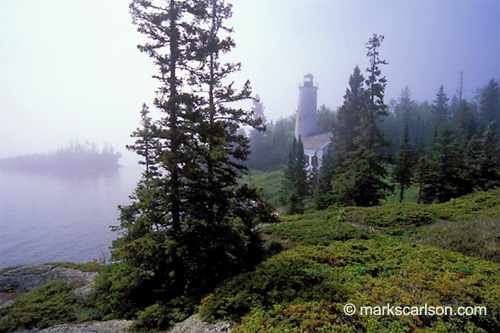
Rock Harbor Lighthouse, in lifting fog – Isle Royale National Park, photo by Mark S. Carlson

Mark writes:

This was one of my favorite photographs made during my last visit to the island in spring 2006. I’ve been to the wilderness isle many times and every time is special. It’s ruggedly beautiful, inspirational and one of the most exciting places in Michigan to make photographs if you appreciate pure nature.

You can see more from the island in Mark’s Isle Royale gallery, and more of Michigan in his other galleries and in his book Michigan, Simply Beautiful. Along with fellow photographer Mark also operates Great Lakes Photo Tours, providing personalized and in-depth instruction in nature photography in some of Michigan and the region’s most beautiful locations.

The entry for Rock Harbor Lighthouse at Terry Pepper’s Seeing the Light tells the history of this remote lighthouse and includes a number of historical photos. With the boom of mining on Isle Royale and the new lock at the Soo, a light at Rock Harbor was approved by Congress (for the outrageous sum of $5000). The light was completed in 1856 and:

The station’s rubble stone tower stood 16 feet 11 inches in diameter at the foundation, with its 49 foot 11 inch high walls tapering gently to a diameter of 14 feet 1 inch below the circular gallery. A set of spiral pine stairs supported by a central pine post wound within the tower from the first floor to a trap door in the gallery floor to provide access to the lamp. The lantern itself was fabricated of cast iron, and featured a domed copper roof. Centered within the lantern, a fixed white Fourth Order Fresnel lens sat at a focal plane of 70 feet above lake level, and cast its light 15 miles across the lake The attached rubble stone dwelling, stood 29 feet square and 20 feet 9 ½ inches high at the apex of the cedar shingled roof.

Tiger Stadium demolition: When the walls come tumblin’ down

Tiger Stadium Demolition

tiger stadium, photo by Rhonda_Marie

View bigger in Rhonda’s Tiger Stadium slideshow (view set). Demolition has begun on Tiger Stadium. You can follow the bouncing wrecking ball using any or all of the ways below:

In the Jacksonburg Public Square … History of Jackson, Michigan

Casler hardware 2

Casler hardware 2, photo by tstevensphoto.

The photo is part of Travis’s Jackson, MI set (slideshow). The marker denotes the location of the Jacksonburg Public Square – click through for full text of this marker and map of the location.

The best history online I’ve found is Jackson: The First One Hundred Years, 1829-1929 from the Ella Sharp Museum. It says, in part

Over one hundred and fifty years ago, a young New Yorker named Horace Blackman, a frontiersman from Ann Arbor and a Pottawattomie Indian guide, camped on the west bank of the Grand River at the intersection of what is now Jackson Street and Trail Street in the city of Jackson, Michigan. Blackman had been ‘spying out the land’ looking for a ‘location.’ Satisfied with what he saw, he purchased a quarter section and registered his one hundred and sixty acre claim. Several months later, he built himself a log cabin and then went home to collect his family, having become the founder of a future city.

…Jackson-for this is what the village would be called, after brief encounters with the names ‘Jacksonburgh’ and ‘Jacksonopolis’– had location. As the Indian trails clearly indicated, it was a cross-roads-a point through which people, ideas, information and materials going in various directions passed. Now, at a time when transportation had become a critical organizational link between the nation’s eastern populations and the frontier’s seemingly limitless resources and wealth, Jackson was in a position to benefit.

You can get much more at the link above and also check out Jackson, Michigan in Wikipedia.

The Last Days of Tiger Stadium

Tiger Stadium Usher 2, circa 1999

Tiger Stadium Usher 2, circa 1999, photo by LAWRENCEcreative.

Greenberg, Kailine, Manush, Heilmann, Kell, Newhouser, Jennings, Harwell – the stadium may be gone, but the names live on. Brett writes:

These are pictures taken from the last season of Tiger Stadium. Rather than watching all of the the games, I would find myself wandering the hallways and aisleways trying to capture moments significant to this iconic place…

I hope these pics bring back some great memories as we all wait for the final brick to fall on this historic landmark.

View his Tiger Stadium, circa 1999 slideshow (photo set). Do it, for real. The scenes he captured of the daily life of this grand old ballpark are priceless.

Although a series of bids to save all or part of the ballpark over the last several years, the Old Tiger Stadium Conservancy has until August 1st to prove it can raise $12-15 million to preserve the diamond, dugouts, 3,000 seats and an area that would house Hall of Fame Tiger’s broadcaster Ernie Harwell’s collection of sports memorabilia. Detroit News story.

Here’s some more Tiger Stadium Stuff:

Relighting the South Manitou Island Lighthouse

South Manitou Light

South Manitou Light, photo by dhoop.

Most nights I can see the red pulse of the North Manitou Shoal Light far out on the Manitou Passage (that stretch of Lake Michigan off the western shore of the Leelanau Peninsula).

Right now, a group of nonprofit & government organizations, businesses, historic engineers and private individuals are working to add another light to the passage. The effort is called “Relight the Light” and is funded in part by the National Park Centennial Initiative:

Lighting the South Manitou Island Lighthouse is a joint effort with three partners: Manitou Islands Memorial Society, Manitou Island Transit, and Electro-Optics Technology, Incorporated. The project will include purchasing and installing a replica third-order Fresnel lens, illuminating the lens with a low-wattage bulb using solar power as the energy source, and restoring the lantern room and stairwell.

As with many public projects these days, there’s a match component and organizers are seeking to raise funds to complete work currently underway on the lens by Artworks Florida.

For more information about the project and to view photos of the construction of the lens, visit South Manitou Island Lighthouse: Re-light the Light.

The South Manitou Island Lighthouse page from the Sleeping Bear Dunes National Lakeshore has more about the light and its history and (as always) Terry Pepper’s Seeing the Light has a lot more. You can also see photos of the light and floorplans from the Library of Congress and here’s a South Manitou Island Light slideshow!

(lighthouse buffs might note a similarity between this tower and the tower of the Au Sable Point light)

McClellan School in Mason County

McClellan School.jpg

McClellan School.jpg, photo by smartee_martee.

This photo of the McClellan School in Mason County (near Custer, Michigan) is on of two photos (so far) in Marty’s Mason County set. The other one is a cool old photo of the Pere Marquette Station in Freesoil that I probably would have featured if I didn’t need to see some color so badly!

Summer is a good time to tune into Marty’s photostream as there are a lot of new photos of farms, old homesteads and other forgotten and abandoned structures popping in every week. buckshot.jones writes:

“It is what us folks in Michigan, at least us Detroiters call, “Going Up North.” Most people in MIchigan have a special affinity for the countryside in Northern Michigan. If you you’ve never been, well then you may never know. Here’s my solution. Take a tour of Smartee Martee’s photostream. Click on the sets and read the descriptions of the places he’s been. Then find a set you really like, mine is Osceola County, and watch the slide show. It isn’t quite the same as being there, but damn close. This is the heart and soul of rural Michigan captured on film.”

My own favorite is his massive Broken Souls set (slideshow).

Michigan Drive-ins and the 75th anniversary of the drive-in

Wayne Drive-In Theatre Marquee - Wayne, Michigan

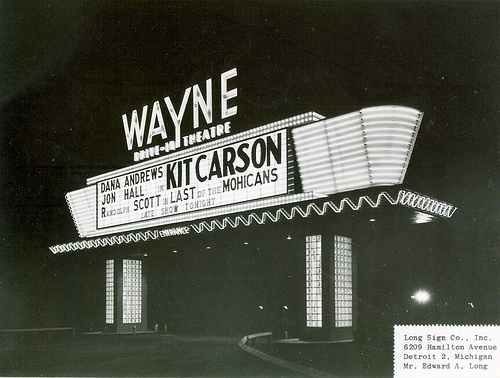
Wayne Drive-In Theatre Marquee – Wayne, Michigan, photo by michigandriveins.

In recognition of yesterday’s 75th anniversary of the drive-in, WIRED Magazine featured June 6, 1933: A Car, a Movie, Some Popcorn and Thou. You have to check it out, if only for the photo of the reverse side of the world’s first drive-in movie screen (Richard M. Hollingshead, Jr’s Camden NJ theater) advertising the opportunity to SIT IN YOUR CAR – SEE AND HEAR MOVIES for 25¢ per car, 25¢ per person and $1 for 3 or more people.

About the above photo of the marquee of the Wayne Drive-In Theatre, michigandriveins writes:

What an amazing display this must have been to pass through. This giant neon masterpiece was apparently built by the Long Sign Company. Detroit-based Long also constructed the still-standing Commerce Drive-In Marquee, and the long-gone Waterford Drive-In Marquee.

Amazingly, the top portion of this marquee was saved during demolition. A Ford plant now stands on the grave of the Wayne Drive-In. When the Wayne went down in 1990, speakers, projectors, and three of it’s four screens went to the Ford-Wyoming 6-9 Drive-In in Dearborn, they are still in use today.

I’d like to hear from anyone connected with the Long Sign Co.

Much (much) more about Michigan’s drive-ins and drive in history at michigandriveins.com (also see Drive-in theater on Wikipedia).

You can get even more cool old photos, posters and history about drive-ins in general and in Michigan from the Drive-in Theater History page at WaterWinterWonderland.com.

It was in the period of the late 1930’s that the state of Michigan was introduced to the drive-in, with the opening of the so-called “Drive-In”, later known as the Eastside, on May 26, 1938 with the film “The Big Broadcast of 1938.” A Mr. John H. Flancher filed a petition in court in July of that year on behalf of the residents of 3 Detroit suburbs. His contention was that the new Theater could be heard from two miles away and should be deemed a public nuisance. Although the petition contained over 500 signatures, the case was dropped when the Theater agreed to take steps to alleviate the problem which seemed to satisfy the petitioners and the court. This would not be the last time a drive-in Theater operator would run afoul of the local community however.

I’ll leave you with the Michigan Drive-in Theater slideshow on Flickr (just the photos) and say I hope you and yours get a chance to take in a film or three at a Michigan drive-in this summer! (There are 10 open in Michigan today!