Creating Cities in Michigan

Lansing, Detroit, Grand Rapids, Flint, Traverse City, Marquette and Kalamazoo are by no means all of Michigan’s cities (or even the largest). Each, however, seems to be an anchor for its region – a center to which people look to for culture, entertainment and commerce.

October 13-15, 2008, lovers of cities large & small from Michigan and all over the country will head to Detroit for the Creative Cities Summit 2.0 (CCS2), an exploration of what our cities could become and how we can work to make them. Organizers have chosen Detroit, a city so deeply forged in America’s industrial fires that it’s been devastated by the flickering of that flame. I’m headed down there and will try to bring some of the ideas back to you through Absolute Michigan – I hope that some of you can join me there.

The Photos (left to right)

Creative Cities Summit 2.0 in Detroit on Oct. 13-15, 2008

CCS2 will present a dynamic and engaging conversation about how communities around the world are integrating innovation, social entrepreneurship, sustainability, arts & culture and business to create vibrant economies. Full conference registration is $300 for the two and half day event, and there’s also a “no frills” registration that is only $100. There’s also a free “Unconference” at the Museum of Contemporary Art Detroit (MOCAD) on the 12th for designers, urban planners, civic leaders, entrepreneurs, artists, students, community leaders to explore and discuss what’s possible for Detroit.
Keynote speakers include:

  • Bill Strickland, MCG-Bidwell Corp.
  • Richard Florida, Author Who’s Your City
  • Charles Landry, Author The Art of City Making
  • John Howkins, Author The Creative Economy
  • Dean Kamen, Inventor, DEKA
  • Majora Carter, Sustainable South Bronx
  • Doug Farr, Architect and Author Sustainable Urbanism
  • Ben Hecht, Pres. & CEO Living Cities
  • Tom Wujec, Fellow, Autodesk
  • Carol Coletta, CEOs for Cities
  • Giorgio Di Cicco, Poet Laureate, City of Toronto and Author, The Municipal Mind
  • Diana Lind, Editor, Next American City magazine

Breakout sessions on topics such as:

  • Race and the Creative City
  • Cities, Universities & Talent
  • Marketing, Media and the Creative City
  • Measuring New Things – ROI in the Creative Economy
  • Creative (Small) Cities
  • New Ideas in Urban Amenities
  • Community Vitality: The Role of Artists, Gays, Lesbians & Immigrants
  • Midwest Mega-region: How the Midwest Can Compete
  • Transportation Innovation for Cities
  • Making the Scene: Music & Economic Development

Much (much) more at creativecitiessummit.com.

Haunted Houses, Corn Mazes & Spooky Attractions, oh my!

Haunted House Behind the Middle School

Haunted House Behind the Middle School, photo by country_boy_shane.

‘Tis now the very witching time of night,
When churchyards yawn and hell itself breathes out
Contagion to this world.
~William Shakespeare

Hold on, man. We don’t go anywhere with “scary,” “spooky,” “haunted,” or “forbidden” in the title.
~Shaggy from Scooby-Doo

Over on Absolute Michigan, our Fearsome Finder of Frights has compiled a list of haunted houses, corn mazes and scary attractions from all over Michigan that you can enjoy throughout the month and all across the state.

The photo is part of Shane’s Romeo (Michigan) set (slideshow) and he and the readers lay out the tale of what appears to be a haunted house in training. Check it out, if you dare…

Detroit Nighthawks: the core at night

the core at night

the core at night, photo by g. s. george.

When not vanquishing evil, it appears Spiderman likes to indulge in a little photography.

You can (and should) see Geoff’s photo bigger in the Detroit Nighthawks group slideshow.

Victory Eagle, Marshall Fredericks

"Victory Eagle" at Former Veterans Memorial Building--Detroit MI

“Victory Eagle” at Former Veterans Memorial Building–Detroit MI, photo by pinehurst19475.

Anthony Lockhart writes:

This monumental sculptural relief (twenty-eight feet tall) by Marshall Fredericks is on the north wall of what was the Veterans Memorial Building. It symbolizes both sacrifice and victory. The building is now the UAW-Ford National Programs Center. It was designed by the firm of Harley, Ellington and Day and dedicated in 1951.

He has many more statues & sculptures from Detroit (view slideshow)

Editor’s note: I’m always surprised when I find that I’ve never featured a photo from a photographer whose work I follow closely. This is one of those times – if you’re looking for architectural photographs of Detroit and the surrounding area with informed commentary … look no further.

Clare Union Station

tracks pano

tracks pano, photo by scott.gosnell.

Click the photo to see this excellent panorama larger and to see it on a map. Michigan in Pictures often features stories of historical structures that are being preserved. As near as I can tell, this is not one of those.

The Michigan Passenger Stations page on Clare Union Station begins:

The Clare depot was built by the Pere Marquette and Ann Arbor Railroads in 1898 at a total cost of $6585. The Queen Ann style depot has wings paralleling each set of tracks. There are two bay windows, presumably for agents of both railroads. The door and window arrangement suggests waiting rooms and freight rooms for both roads also.

The Pere Marquette built through Clare around 1870. This was part of the original PM land grant railroad…

Passenger service on the Ann Arbor ended in 1950 and after being used for many years for storage, the building was abandoned. Click to read more and see some more views of the station, including historical photos.

For more photos of the station you can check out Clare, Michigan at Michigan’s Internet Railroad History Museum.

Big Sable Point Lighthouse in Ludington State Park

Big Sable Point Lighthouse

Big Sable Point Lighthouse, photo by photoshoparama.

Dan has a number of photos from Big Sable Point Lighthouse and you can see them bigger by checking out the slideshow.

Terry Pepper’s Seeing the Light is down (I fervently hope temporarily) so I can’t get the crunchy details on from his Big Sable Lighthouse page. Wikipedia’s Big Sable Point Lighthouse entry says that the historical marker reads:

Called Grande Pointe au Sable by French explorers and traders, Big Sable Point was an important landmark for mariners traveling a treacherous stretch of Lake Michigan shoreline between Big Sable Point and present-day Ludington. In 1855, twelve ships wrecked in that area. Commerce linked to the burgeoning lumber industry required that Big Sable Point be suitably lighted. State senator Charles Mears pressed the legislature to ask the federal government for a light station at Big Sable. In 1866 the U.S. Congress appropriated $35,000 for a lighthouse, which was built the following year. As the lumbering era waned, steamers carrying coal, foodstuffs, and tourists continued to rely on the lighthouse for navigation.

The Big Sable Point Lighthouse is one of the few Michigan lights with a tower reaching 100 feet. Completed in 1867, Big Sable’s tower measures 112 feet high. In 1902 the deteriorating brick tower was encased in steel. The keeper’s dwelling, which once housed a single family, has been enlarged over the years, resulting in the present three-family residence. Indoor plumbing and heating and a diesel electric generator were added in 1949. In 1953, power lines were extended to the Point. In 1968 the tradition of light-keeping begun in 1867 by Alonzo A. Hyde and his wife, Laura, ended when the station was fully automated. Big Sable Point Light Station is listed in the National Register of Historic Places.

The light is located in Ludington State Park (Wikipedia) and is open for tours May – October (see bigsablelighthouse.org for details). The Sable Points Lighthouse Keepers Association maintains several lighthouses on the east coast of Lake Michigan: Big Sable, Ludington North Breakwater, and Little Sable.

For more views of the lighthouse and the area, check out Big Sable Point on Flickr, some Big Sable Point Lighthouse panoramas (go to full screen!) and these rocking aerial photos of Big Sable Lighthouse at marinas.com – be sure to use the zoom!

You can check out Big Sable Point Lighthouse on the Absolute Michigan map (satellite view).

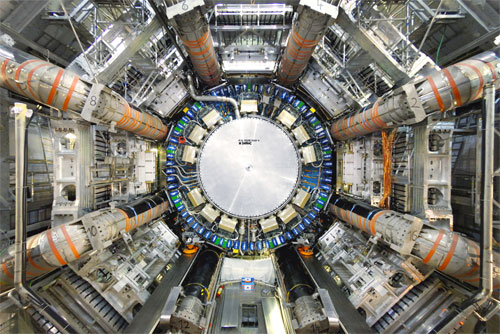
The Atlas Experiment and the Large Hadron Collider

Large Hadron Collider

ATLAS instrument (Large Hadron Collider), courtesy University of Michigan

The Large Hadron Collider (LHC) is the world’s largest and highest-energy particle accelerator, involving over eight thousand physicists from over eighty-five countries as well as hundreds of universities and laboratories. University of Michigan physicists and students were heavily involved in designing and building major components of ATLAS instrument which is one of two main particle detectors in the LHC. In Michigan integral to world’s largest physics experiment, the UM relates that tomorrow:

After 20 years of construction, a machine that could either verify or nullify the prevailing theory of particle physics is about to begin its mission.

CERN’s epic Large Hadron Collider (LHC) project currently involves 25 University of Michigan physicists and students. More than 100 U-M researchers have been involved in the project over the years. CERN is the European Organization for Nuclear Research, located in Geneva, Switzerland.

…The collider will, in essence, recreate the conditions of the earliest universe. It will tear apart particles so physicists can study their components and observe as the particles put themselves back together.

You can see the Atlas being built in this video and also take a video tour of the LHC on YouTube. There’s some cool large photos at the Boston Globe. For more photos of Atlas and other components of the LHC, visit the official LHC web site and (highly recommended) The Atlas Experiment, where you can see movies, watch webcams, read about the experiment and even check out a virtual tour of the Atlas instrument.

When writing about the LHC, it’s pretty much required that you note concerns about the safety of the experiment, and then say that the chances are infinitesimal (1 in 50,000,000 or less) that Earth-devouring black holes, strangelets or quantum gates will be created.

You’ll be able to tune into a live webcast of the Large Hadron Collider almost certainly not destroying the world at 4 a.m. Eastern Time on Wednesday, September 10, 2008.

Linden Mills on the Shiawassee River

Linden Mill, photo by Patrick T Power

MichMarkers.com has the text from the historical marker at Linden Mills in the village Linden (also a map).

The Linden Mills were a vital source of this village’s economic growth. The first mill, located on land granted to Consider Warner, was used to cut lumber. From 1845-1850 Seth Sadler and Samuel W. Warren, local residents, erected both a saw and grist mill. Operating along with the earlier facility, this complex was called the Linden Mills. The grist mill continued to function for over a century until the machinery was dismantled and sold at auction in 1956. The village then purchased the building for municipal offices and a public Library.

Today the mill is the site of the Linden Mills Historical Museum.

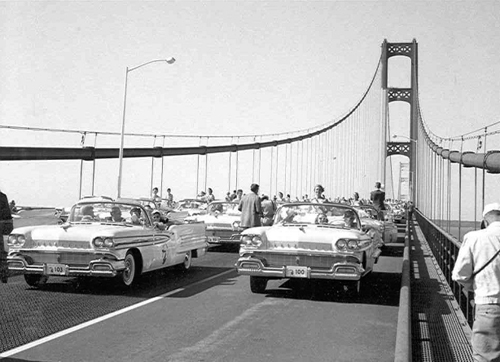
51st Annual Mackinac Bridge Walk

Mackinac Bridge Opening

While this year’s annual Labor Day walk across the Mackinac Bridge isn’t getting nearly the fanfare of last year’s 50th anniversary walk across the Mighty Mac, it’s still the one day each year that you can walk across Michigan’s engineering wonder.

The photo above is from the Opening Ceremony gallery at the Mackinac Bridge Authority web site where you can also find a Bridge Walk gallery and more information about the bridge. For a ton more photos and stories about the Mackinac Bridge, click the button below!

The Mackinac Bridge

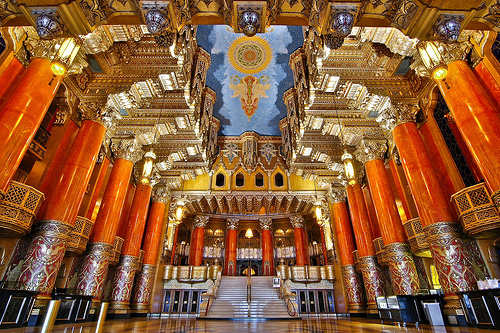
The Fabulous Fox Theater of Detroit

Fox Theatre Detroit

The Fabulous Fox Theater of Detroit, photo by SNWEB.ORG Photography

Wikipedia’s Fox Theatre (Detroit) entry says that Detroit’s Fox is the largest of the 28 Theaters built by movie mogul and 20th Century Fox founder William Fox (or purchased by his company):

…it was the first movie palace to have live sound. The architect, C. Howard Crane, designed a lavish interior blend of Burmese, Chinese, Indian and Persian motifs. There are three levels of seating, the Main Floor above the orchestra pit, the Mezzanine, and the Gallery (balcony). The exterior of the attached 10-story building features an Art Deco facade, which at night is illuminated and can be seen for several blocks.

The Fox was Detroit’s premier movie palace for decades, but by the 1970s it was a shadow of itself, showing horror and Kung fu movies to sparse audiences. In 1988, new owners Mike and Marian Ilitch conducted a $12 million renovation by its new owners which restored the theater to its former glory as Detroit’s premier venue.

Detroit’s historic Fox Theatre from the Detroit News has some great historical photos and details some of the amazing materials utilized. Those red columns, for example, are solid marble and each apparently holds a jeweled figure representing various Asiatic Gods and the lobby held the largest wool rug ever made in the US.

You can see a whole lot more photos of this amazing structure in a Flickr search for Fox Theatre Detroit (slideshow) and you can purchase the photo above at snweb.org.

Here’s a link to the official site for the Fox Theatre (where you can order tickets to Broadway and other shows) and here’s the Fox Theatre on the Absolute Michigan Map.