
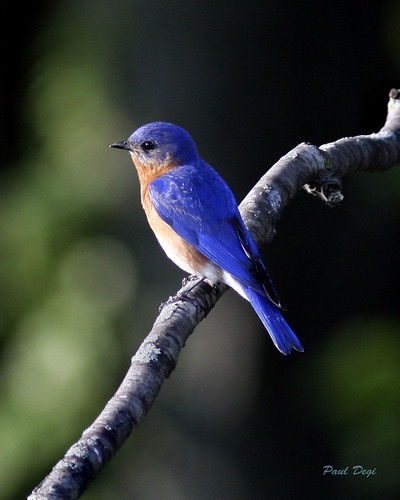
Michigan Bluebird

Michigan Bluebird

Michigan Bluebird, photo by incaseofme.

Paul suggests that you view this photo larger. It’s part of his Birds & Wildlife set (slideshow) and also appears in the Birds of Michigan group.

All About Birds: Eastern Bluebird from the Cornell Lab of Orinthology has some great information (including photos and sounds) of this lovely bird. They have a range map that shows bluebirds are seasonal residents of Michigan, preferring to head south in wintertime. You can also see the UM Animal Diversity Web’s Eastern Bluebird (Sialia sialis) and the Wikipedia Eastern Bluebird.

The Michigan Bluebird Society says that:

Back in the 1700’s when the eastern U.S. was getting populated, indications are that bluebirds were more common than they are now. As more and more farmland was created, bluebird numbers almost certainly expanded even more. Why? First, more farms meant there was more open habitat which bluebirds love. Second, the early settlers typically planted apple orchards. Apple trees are one tree which easily produces cavities which are perfect for bluebird nests. And third, in building these early farms, settlers would erect fences made of wooden posts from the trees they cleared. These many fenceposts would eventually develop rotted out cavities and woodpecker holes which again, would provide ideal bluebirds nesting sites.

Bluebird numbers are believed to have expanded up until the late 1800’s when two non-native bird species were introduced to the U.S. – the House Sparrow and the Starling. These two aggressive and invasive species quickly spread and out-competed bluebirds for natural nesting sites. In addition, as urban areas expanded in the 1900’s and pesticides started to be used in agriculture in increasing amounts, bluebird numbers declined more quickly.

They and bluebird groups across the country have worked to restore these birds and their numbers have been increasing since the 1970s.
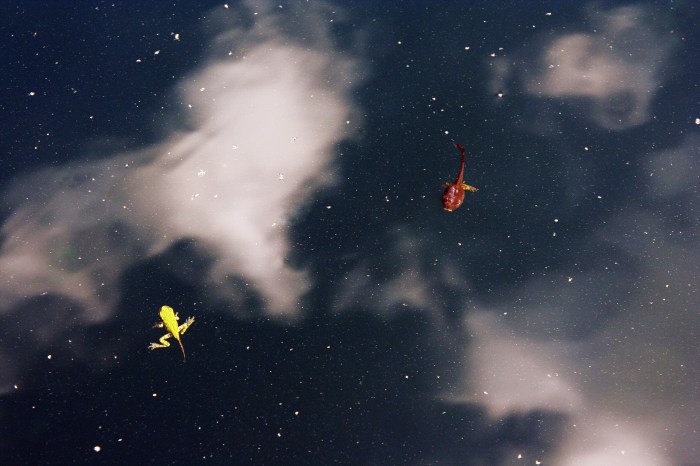
When Frog stole the Waters

When Frog Stole the Waters

When Frog stole the Waters, photo by Apocaplops.

I don’t know what the story is here, but I like it. You can see it in full-size glory in Erich’s slideshow.

The Wood Turtle in Michigan

Turtle by LuckyGus

Turtle, photo by LuckyGus

Updated September 30, 2008: LuckyGus captured this photo on the Betsie Valley Trail in Benzie County. Below you can read about TurtleGate ’08, which was touched off when I misidentified this turtle as a common snapping turtle. My Ranger Rick Top Terrapin Tagger badge has been repossessed and sources tell me that a number of zoologists are “keeping an eye on me”.

The Michigan DNR’s page on the wood turtle (which should have helped me identify it) says that:

As its scientific name, Glyptemys insculpta, implies, the shell of the wood turtle is one of the most ornate of the turtles in Michigan. A noticeable keel running down the back of the carapace and the pointed edges of the scutes along the back edge add to its sculpted appearance. The yellow on the underparts of its neck, legs, and stomach, plus the highly visible deep circular growth rings of the scutes on the brownish carapace help with identification. The adult carapace length is 6.3 to 9.4 inches (16 to 24 cm)

Wood turtles live in rivers with sandy-bottomed streams and rivers. They spend most of their time in the river from September to May, but in summer can be found foraging in woods, swamps, and meadows in the upland areas edging the stream or river. Logs or banks near water and sunny woodland openings are often utilized for basking.

These turtles are omnivores eating a variety of plants and animals and carrion found in and along the river. Wood turtles employ a unique technique to hunt earthworms. Using either an alternating foot stomp, or by lifting and dropping its shell on the ground, they create vibrations in the ground. These vibrations will cause earthworms to surface where they are quickly snatched for a meal. Anglers seeking bait can employ a similar technique. A stick stuck in the ground and wiggled back and forth to create vibrations will cause earthworms to leave the ground.

Michigan’s wood turtle population has declined in recent years and it’s considered rare in the northern Lower and Upper Peninsulas. More about wood turtles can be found at Wikipedia’s Wood Turtle entry, woodturtle.com and from the MSU Museum’s “critter guy”, James Harding who notes that They may not be taken from the wild or possessed without a scientific collector’s permit issued by the DNR.

You can also check out What’s Up With the Wood Turtle? from MyNorth.com for a look at fieldwork being done in Northern Michigan on the wood turtle.

(from July 2008) TurtleGate Update: A Nation in Slow, but Very Real Peril

I have finally gotten back to this to find out if I am indeed a dirty, no-good turtle mis-indentifying so-and-so or merely guilty of the litany of other things that I may or may not be guilty of per the comments. From the Michigan DNR Turtle page I was able to learn:

  • The eastern box turtle appears to not look like this turtle at all.
  • The wood turtle appears to have a black face, but this photo looks sort of similar.
  • However this snapping turtle’s shell looks very similar.
  • I am forced to conclude that I don’t know the answer.
  • I’ll end with a shout-out to a herpetologist or other expert to set me straight.

The Opossum Family Road Trip

close up

close up, photo by gerrybuckel.

Well, the weekend is here and all around Michigan folks are packing their families into cars for a family getaway. This photo is dedicated to any who are tempted to lose their temper or otherwise complain about their lot.

Gerry has a few more photos of the possum family at her “animals” tag.

Have a great weekend people!

Garter Snake

Garter Snake by Alanna St. Laurent Photography

Garter Snake, photo by Alanna St. Laurent Photography

The Michigan DNR’s page on the Eastern Garter Snake (Thamnophis sirtalis) says that the Eastern Garter is Michigan’s most common snake, inhabiting both peninsulas and even urban areas. Wikipedia notes that they are often mistakenly called garden snakes or gardener snakes and the UM Animal Diversity Web entry for garter snakes adds more info and lots of photos and says that although there are very rare cases of allergic reaction from bites from people handling garter snakes, these reptiles deserve their reputation as a harmless and beneficial low-level predator. Be warned if you handle them that their main defense is a stinky secretion!

This picture is part of a cool set of photos from the Bald Mountain Recreation Area (slideshow). Alanna also commented that she thinks snakes are cool. If you do too, you’ll probably enjoy the Snakes of Michigan page from Snaketamers. It lists Michigan’s 18 species of native snakes (with photos). You can also check out the listing of Michigan’s Snakes from the DNR.

to water

Untitled, photo by Brooke Pennington.

I know that I’m supposed to feature different photographers, and that it hasn’t been that long since the last time Brooke made an appearance.

I plead helplessness in the face of photographic awesomeness … and ducks.

Have a lovely weekend folks.

Is this a Paddle, Raft, Plump, Team, Brace or Dopping of Ducks?

Swarm!

Swarm!, photo by OtisDude.

OtisDude writes:

I was shooting some duck pictures today when all the sudden something startled all the ducks. Calm to chaos in less than a second. I managed to snap off 4-5 pics before I got a little panicked and got out of the way.

We’ve all heard of the many Inuit names for snow. In case anyone was wondering, ducks are pretty much the same. There’s quite a collection of names for a group of ducks including a paddling of ducks or a raft of ducks (when floating along), a plump or team of ducks (in flight overhead), a brace of ducks (post hunting I believe) or a dopping of ducks (when diving). More ducks on Michigan in Pictures.

None of these seemed quite right but fortunately there’s also a flush of ducks, which I’m going to assume covers exactly this scenario.

Trumpeter Swan and the Birds of Michigan

trumpeter swan

trumpeter swan, photo by tobibritsch.

On the Michigan DNR’s page on the trumpeter swan, says that at 25-35 pounds when fully grown, the trumpeter swan is the world’s largest waterfowl with a wingspan of nearly 8′ and that:

Historically, trumpeter swans were most likely abundant throughout the Great Lakes region, even in the southern Michigan marshlands. On his travels along the Detroit River in 1701, Cadillac compared the abundance of swans to lilies among the rushes. However, with the settlement of America, the populations of trumpeters plummeted. Beginning in the late 1800s, European settlers cleared the land, draining and filling important marsh habitat, and market hunters took swans for their fine down and quills. By 1933, only 66 trumpeter swans remained in the continental United States, mainly in remote parts of the Rocky Mountains and Alaska. Nearly 100 years passed before trumpeter swans were seen again in the Michigan wilds.

In the 1980s Michigan began a swan reintroduction program as part of the North American Restoration Plan. While the program has been a success and dramatically increased the number of nesting pairs, there are some who question whether these birds did in fact historically nest in Michigan. Nuthatch at the excellent Michigan blog bootstrap analysis presents the case in with great links in swans, take 2. It’s something that merits consideration as swans are pretty rough on aquatic habitats!

For more on these birds, check out The Trumpeter Swan Society. Also, the UM Animal Diversity Web Cygnus buccinator (trumpeter swan) listing has some photos but unfortunately no sounds. Wikipedia’s Trumpeter Swan entry also includes creative commons photos of trumpeter swans for use and download.

The photographer has a cool set of waterbird photos (slideshow) and this photo is in the Birds of Michigan group on Flickr. It’s for sharing photos of birds found anywhere in the State of Michigan and they say that if you cannot identify the bird, post it to the group and likely someone there can!

The U.P. 200 & Midnight Run Sled Dog Races

P1010050c

P1010050c, photo by Dan & Mary.

The web site for the annual UP 200 / Midnight Run and Jack Pine 30 sled dog races explains that 1988 a group of mushers and others began to discuss a dogsled race in the Upper Peninsula.

When the race finally began to take shape, the trail encompassed Marquette, Alger, and Delta counties, and ran from Marquette to Chatham, Rapid River, Escanaba, Gwinn, and back to Marquette…

…and on a snowy Friday evening in February of 1990, the dedication and perseverance finally paid off. To the cheers of 10,000 spectators, the mushers of the first UP 200 Sled Dog Championship ten dog race sped down Washington street in Marquette into the night. At midnight, in the community of Chatham the first Midnight Run racers departed on the long, cold journey towards Escanaba. These racers went on their way into history, with many “tails of the trails” for the years to come.

The UP200 and Midnight Run have remained successful events each year and they take place this weekend (Feb 15-17) and you can get all the details (including the trail map and Breakaway’s Blog at the link above!

Mary writes that this photo shows a team is approaching the crossing at Forest Highway 13, heading west to the next checkpoint at Munising/Wetmore, MI. It’s part of a set of UP 200 / Midnight Run dogsled races 2007 photos (slideshow)

Bobcat in Michigan

Bobcat

Bobcat, photo by pnygirl1.

Sometimes when I’m not sure what Michigan in Pictures will be about, I look at my Michigan events calendar for inspiration. There were no events, but the calendar also shows hunting information. I saw that on Monday, Bobcat Trapping Season opened in northern Michigan. That jarred me enough to go looking for stuff about bobcats in Michigan.

In this closer view of the cat, BJ says that she photographed this bobcat the Blandford Nature Center in Grand Rapids, that he was taken in from Tennessee as an injured animal and that his name is BOB.

The very excellent University of Michigan Museum of Zoology’s Animal Diversity Web has information & photos about bobcat (Lynx rufus). You can find a lot more in the Wikipedia entry for Bobcat, which says that these cats are phenomenal climbers that are crepuscular (most active at twilight and dawn) and found all over North America. As to their size:

The adult male Bobcat is 28 to 47 inches long, averaging 36 inches; this includes a stubby 4 to 7 inch (10–18 cm) tail, which has a “bobbed” appearance and gives the species its name. An adult stands about 14 or 15 inches (36–38 cm) at the shoulders. Adult males usually range from 16 to 30 pounds (7–14 kg); females average about 20 pounds (9 kg). The Bobcat is muscular, and its hind legs are longer than its front legs, giving it a bobbing gait. At birth it weighs 0.6 to 0.75 pounds (280–340 g) and is about 10 inches (25 cm) in length. By its first year it will reach about 10 pounds (4.5 kg)

Don Harrison has several photos of a bobcat by the side of the road and also old postcards of a bobcat crossing the Military Rd near Stateline, MI and a bobcat at Lake Baldwin. Here’s a video of a bobcat crossing a bridge that gives you an idea of how these animals move.

Finally, any of you who were hoping for bobcat trapping are out of luck as the season is (permanently?) closed south of the bridge according to the DNR’s bobcat trapping page. Here’s the link to report bobcat, cougar and lynx to the Michigan DNR.