Invasive Menace of the Day: Round Goby

must be exterminated

must be exterminated, photo by Kasey Carroll.

Kasey writes:

About ten seconds after I caught this, my fiancee’s uncle beat it repeatedly against the side of the boat. He said that it was an “intruder from outer waters and it must be exterminated because it eats all the perch eggs in Lake Eerie.” I’m sorry Peta. I didn’t do it.

See this bigger in her Things slideshow. The USGS Invasive Species Center page on the round goby says:

The round goby, Neogobius melanstomus, is a small, bottom – dwelling fish that was first found in the Great Lakes region in 1990. Originally from the Black and Caspian Sea areas of Eastern Europe, it is believed that this exotic species arrived in the ballast water of vessels coming into the Great Lakes. Since the first sighting in the St. Clair River, round gobies have spread to all of the Great Lakes and are working their way inland through the rivers and canal systems.

…Round gobies are found in all of the Great Lakes with the greatest numbers in Lake Erie, Lake St. Claire and southern Lake Michigan. Many of the areas with round goby populations are best described as infested. Once round gobies arrive they can become the dominant fish species. Round gobies prefer rocky, shallow areas, but have flourished in a variety of habitat types. Regardless of the habitat, round gobies are very aggressive fish that compete with native fishes for food and space. Anglers who fish in areas with round gobies often find that the gobies steal their bait and appear to be the only type of fish in the area.

Round gobies can eat zebra mussels in addition to fish eggs, plankton, fish, and benthic invertebrates. Because zebra mussels are filter feeders that accumulate contaminants in their body tissues, round gobies that eat zebra mussels may be consuming a high level of contaminants. When a predatory fish such as a walleye eats a round go by that has fed primarily on zebra mussels, they may be getting a much larger load of contaminants than they would from eating other types of prey fish. This could put dangerous concentrations of contaminants into sport-fish at a much faster rate.

According to the MLive, there are now an estimated 10 million pounds of gobies in Lake Michigan alone! More information at round goby on Wikipedia and from the round goby page on Protect Your Waters. How do we stop their spread? Always follow the procedure to Stop Aquatic Hitchhikers!

A boat full of Michigan bluegills

One of Many

One of Many, photo by mickey-finn.

Mickey Finn says that this picture is from an awesome night of fly fishing for bass and bluegills in Michigan in which he landed over 30 of these hand-sized beauties. The Michigan DNR’s Bluegill (Lepomis macrochirus) page says:

The bluegill is a native to eastern and central North America, including the lower Great Lakes. This fish enjoys a well-deserved popularity with anglers. Many a young angler boasts the delicious bluegill as a first catch, while seasoned anglers using light tackle find it a valiant fighter. Bluegills favor warm waters (64 to 70 degrees F) with plenty of cover such as weed beds, submerged logs, or drop-offs. They usually stay in relatively shallow water, but as temperatures rise in the summer, large bluegills will head for deeper water. This fish also provides good winter sport since it remains active all winter long.

The bluegill spawns in the shallows in the late spring or early summer when the water temperature reaches 65 degrees F. Males build nesting colonies in gravel, sand or mud and will guard the eggs and newly hatched fry until they reach the swimming stage.

Wikipedia’s bluegill entry has lots more about this common sunfish.

The bubblegum Prince

The bubblegum Prince

The bubblegum Prince, photo by SolsticeSol.

Solstice Sol says that she hadn’t had any luck finding these cuties during the day lately so she took a flashlight out the other night. She found this charmer in mid song on the pool ladder.

See it larger in her My Pets & Nature’s Pets slideshow.

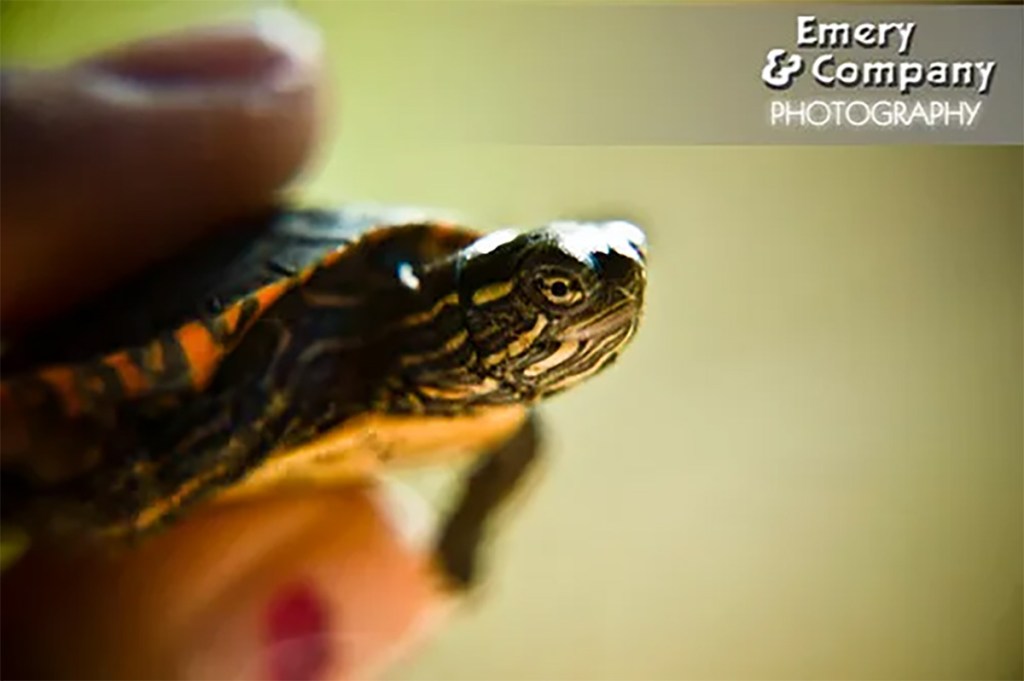
The Painted Turtle in Michigan

-3, photo by Emery Co Photo.

NOTE: there are two subspecies in Michigan: the Western Painted Turtle and Midland Painted Turtle

When I saw this photo in the Absolute Michigan group, I wondered it it was the right day to talk about painted turtles (I have to be careful after last summer’s TurtleGate incident as you may recall). When I saw the siskokid’s shot of a painted turtle basking in the sun just a few photos later, I figured it was a sign of some sort.

The painted turtle is one of the most common turtles in the US. It’s Michigan’s state reptile and the Michigan DNR’s Painted Turtle page has a map that shows where you can find them in the state. Wikipedia’s Painted Turtle entry notes that turtle nests are the snack bar of the animal world, vulnerable to predation by raccoons, squirrels, chipmunk, woodchucks, skunk, badger, foxes, fish crows, garter snakes, deer, ants, beavers and humans. The UM Animal Diversity web has pictures and information about Chrysemys picta (the painted turtle) and says that:

Painted turtles prefer living in freshwater that is quiet, shallow, and has a thick layer of mud.

Painted turtles are brightly marked. They have a smooth shell about 90 to 250 mm long. Their shell acts as protection, but since the ribs are fused to the shell, the turtle cannot expand its chest to breathe but must force air in and out of the lungs by alternately contracting the flank and shoulder muscles. The painted turtle has a relatively flat upper shell with red and yellow markings on a black or greenish brown background.

See some more photos of this little guy in Emery Co’s slideshow and check out even more in the turtle slideshow from the Absolute Michigan pool!

Swan Origami

Swan Oragamy

Swan Oragamy, photo by MudPhish.

…it’s apparently all the rage these days.

Be sure to check it out bigger.

Cerulean Warbler and 68 endangered friends

Cerulean-Warbler-at-Embury-

Cerulean-Warbler-at-Embury-, photo by richard.sleeman.

I’ve recently posted about the de-listing of the gray wolf and bald eagle in Michigan. The osprey was recently removed as well, but the Michigan Department of Natural Resources recently revised its list of threatened and endangered species and added 69 to the list. They say that the most notable addition is the cerulean warbler.

The All About Birds page on the Cerulean Warbler has some excellent photos and even the warbler’s song. The Audubon Watchlist for the Cerulean Warbler (Dendroica cerulea) estimates that there are about 1/2 a million of these birds in the world and says:

This wood-warbler is not easily confused with other warblers. The adult male is a deep cerulean blue above with a streaked back, and is white below with a narrow blue-black band across the throat. The adult female is bluish-green above with no streaks, and white washed with yellow below with a distinct white or yellowish line over eye. All plumages and both sexes have white wing bars and white tail-spots.

The species suffers from habitat loss and degradation in both its summer and winter range. The remaining population breeds in the northeastern and central parts of the United States as far north as s. Ontario, as far south as Arkansas, as far east as the Atlantic Coast, and as far west as Iowa. Ceruleans are not evenly distributed throughout this range.

Typically found in mature forested areas with large and tall trees of broad-leaved, deciduous species and an open understory, but may also inhabit wet bottomlands, some second-growth forests, and mesic upland slopes. Eats insects in the foliage and a small amount of plant material in the winter. Nests high in the canopy on a lateral limb of a deciduous tree above an open area. The nest is concealed from above by leaves or vines. The 3-4 eggs are incubated by the female, but both parents feed the young. As a medium- to long-distance migrant, these warblers may arrive on their breeding range from late March to mid-May and be back on their wintering grounds as early as August.

Richard took this photo at the Waterloo State Game Area. See it bigger in his Warblers slideshow.

Happy Birthday to you, Traverse Colantha Walker

The 2010 Traverse Colantha Walker Festival happens on Sunday, June 13, 2010.

State Hospital Memorial Marker For Traverse Colantha Walker (Traverse City, MI)

State Hospital Memorial Marker For Traverse Colantha Walker (Traverse City, MI), photo by takomabibelot.

From World Champion Cow of the Insane at Roadside America:

Northern Michigan Asylum opened in 1885 and gradually became a sprawling complex on the western outskirts of Traverse City. It was so vast that it had orchards of cherries, peaches and apples, vineyards and vegetable gardens, field crops, and livestock from beef to chickens, horses to pigs. And it had its own herd of cows.

The most famous of these — the most famous inhabitant, period, of the entire Asylum — was Traverse Colantha Walker. She was a grand champion milk cow, producing 200,114 pounds of milk and 7,525 pounds of butterfat in her long life. When she died in 1932 the hospital staff and patients held a banquet in her honor. They buried her in a small, grassy knoll, under a marble tombstone, outside of the stately brick dairy barn that had been her home.

The inaugural Traverse Colantha Walker Dairy Festival will take place on Saturday, September 12, 2009 at the Grand Traverse Commons.

See this bigger right here and also check out takomabibelot’s slideshow. The marker reads:

Traverse Colantha Walker
361604
Born 4-29-1916
Died 1-8-1932
World’s Champion Cow
Milk 200,114.9 lbs.
Fat 7,525.8 lbs.
Nine Lactations
Bred, Owned, Developed
By Traverse City Hospital

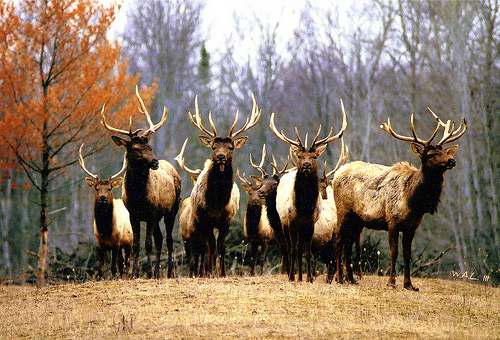
Got Rut? Chillin’ with Michigan’s Elk Herd

Got Rut?

Got Rut?, photo by lonewolv / William A. LaCrosse III.

When I saw this picture (shot in Hillman, MI in 2004) I figured “elk farm.” However, as I looked into the subject I discovered that Michigan has a significant wild elk population. Michigan Elk: Past and Present from the Michigan DNR says:

Michigan’s native elk disappeared around 1875. Today’s elk herd dates back to 1918, when seven western animals were released near Wolverine. From that reintroduction, the number of animals grew steadily to about 1,500 elk in the early 1960s. They reached the point where limited hunting was possible in 1964 and 1965.

… Reduced poaching losses, habitat improvement and successful management of hydrocarbon development resulted in an increase in elk numbers to 850 by 1984.

As the herd grew, problems also increased with forest and agricultural damage. To bring the herd in better balance with its natural food supplies and with the needs of landowners, elk hunting resumed in 1984. Biologists estimated the January 2006 population to be between 800-900 animals. This goal is a winter herd of 800 to 900 elk.

The village of Atlanta claims the title of Elk Capital of Michigan and holds an Elk Festival every September (September 25-27, 2009). You can read more about the second largest species of deer (following only the moose) in Wikipedia’s Elk entry which has this to say about rut:

Adult elk usually stay in single-sex groups for most of the year. During the mating period known as the rut, mature bulls compete for the attentions of the cows and will try to defend females in their harem. Rival bulls challenge opponents by bellowing and by paralleling each other, walking back and forth. This allows potential combatants to assess the others antlers, body size and fighting prowess. If neither bull backs down, they engage in antler wrestling, and bulls sometimes sustain serious injuries.

Find even more elk info and photos under Cervus elaphus, elk (also: red deer; wapiti) from the University of Michigan Museum of Zoology’s Animal Diversity Web.

See this larger in William’s slideshow.

The Timber Wolf (canis lupus) in Michigan

2007 0300 Wolf on LakeMIUS2

2007 0300 Wolf on LakeMIUS2, photo by Dennis Raney.

Alexis writes Paw took this one of a wolf on Lake Michigan off US2 on the way back downstate. There was another wolf on the ice, but it didn’t make it into this frame It’s part of her very cool Michimania set (slideshow).

Wikpedia says the timber wolf, gray wolf or simply wolf is the largest member of the Canidae family. From the Michigan DNR page on the Gray Wolf (canis lupus) and a recent DNR release regarding the delisting of the gray wolf, we get a picture of the state of wolves in Michigan:

It is believed that wolves were once present in all 83 counties in the state of Michigan. A combination of European werewolf mythology, fairy tales, views that wolves were incompatible with civilization, and active predator control programs throughout the 20th century virtually eliminated the gray wolf from Michigan: by 1840, they could no longer be found in the southern portion of the Lower Peninsula; by around 1910 they had completely disappeared from the Lower Peninsula; and by 1960, when the state-paid bounty on wolves was repealed, they had nearly vanished from the Upper Peninsula.

In 2008, a minimum of 520 gray wolves lived in Michigan’s Upper Peninsula, part of an estimated population of 4,000 gray wolves living in Michigan, Minnesota and Wisconsin.

(DNR Director Rebecca Humphries) emphasized that while the gray wolf has been removed from the federal endangered species list, it remains on the state’s protection as a species. There currently is no hunting or trapping of gray wolves allowed in Michigan, and starting on April 22, the gray wolf will be listed as a nongame species in Michigan. In order for hunting to occur, the Michigan Legislature would need to pass a law to add the gray wolf to the list of game species in the state, she said.

You can get more about Canis lupus (gray wolf) from the University of Michigan Museum of Zoology’s Animal Diversity Web and check out pictures & sounds of the gray wolf from Wikimedia including this pic of a wolf print and these sounds from a wolf pack.

You might also want to check out this Absolute Michigan “Weird Wednesday” on the Giant Wolf of Flint by the author of Weird Michigan, Linda Godfrey.

Michigan’s Rattler: the Eastern Massasauga Rattlesnake

Bothered

Bothered, photo by Aaron Fortin.

Aaron writes that he spent an entire summer tracking 18 of these snakes around the park and watching their habits and where they went throughout the season. Lots of fun trekking through swamps, up hills, through shrubbery, etc. You can see more of his rattlesnake photos (slideshow) including a great shot of the rattler’s fangs. You might also enjoy this Michigan rattlesnake slideshow on Flickr!

The Michigan DNR says that the Eastern Massasauga Rattlesnake (Sistrurus catenatus catenatus) is Michigan’s only venomous snake. They say that Massasaugas are found throughout the Lower Peninsula, but not in the Upper Peninsula and that they are becoming rare in many parts of their former range, due to wetland habitat loss and persecution by humans. After reading Wisconsin’s very excellent page on the Massasauga Rattlesnake I’m also thinking that wild pigs are accounting for some of that drop. Remember that they are classed as an Endangered Species so don’t kill them! Here’s a few tidbits:

  • They say that although drop for drop the massasauga’s venom is more toxic than the timber rattler, with a smaller volume of venom, their bite would probably not cause severe harm to an adult human.
  • The adult massasauga is usually two to three feet in length.
  • “Massasauga” means “great river mouth” in Chippewa, so named because it is usually found in river bottom forests and nearby fields. Massasaugas are characteristic of mesic prairies and lowland places, such as along rivers, lakes, and marshes.
  • The infamous rattles are actually modified epidermal scales with a bony core. Each time the snake sheds its skin a new “button” is added to the rattle, therefore these rattles are not an indication of age, but the amount of times the animal has shed its skin. Massasaugas can shed their skin between 3 and 5 times a year, depending on their health and growth rate. The rattles are believed to serve as warning communications to predators. The rattle produces a buzzing sound similar to that of a grasshopper or cricket.
  • It is interesting to note that rattlesnakes can control the injection of venom when biting. Medical experts familiar with snake bites indicate that up to 60% of all snake bites to humans by poisonous snakes are “dry” bites containing no venom.
  • Massasaugas are preyed upon by raccoons, hogs, skunks, foxes, hawks, and eagles. They in turn will eat cold-blooded prey, such as frogs and other snakes, but they usually prefer warm-blooded prey like mice and voles.

You can learn more about this snake at Wikipedia, Sistrurus catenatus and at Sistrurus catenatus (massasauga rattlesnake) from the University of Michigan Department of Zoology Animal Diversity Web.