Muskrat

Muskrat

Muskrat, photo by Adore707.

The University of Michigan Animal Diversity Web entry for Ondatra zibethicus, muskrat says:

Muskrats are found in wet environments, favoring locations with four to six feet of water. While muskrats are found in ponds, lakes, and swamps, their favorite locations are marshes, where the water level stays constant. Marshes provide the best vegetation for muskrats. They find shelter in bank burrows and their distinctive nests. Bank burrows are tunnels excavated in a bank. The nests of the muskrats are formed by piles of vegetation placed on top of a good base, for example a tree stump, generally in 15 to 40 inches of water.

…Muskrats have large, robust bodies, with a total body length of twelve and a half inches. The tail is flat and scaly and is nine and a half inches in length. Muskrats have dense fur that traps air underneath for insulation and buoyancy. Their heads are very large and their ears are almost invisible underneath the fur. The whiskers are mediun size. Muskrats have short legs and big feet; the back feet are slightly webbed for swimming. Adult muskrats have glossy upper parts that are dark brown, darker in winter and paler in the summer.

A Michigan muskrat recently made the news in these photos from the Kalamazoo River oil spill.

See this photo bigger in Eli’s Nature slideshow and check out more Michigan animals on Michigan in Pictures.

Dog Days of Summer: August in Michigan

Dog_Parade_3

Dog_Parade_3, photo by Steven Scherbinski.

“If you saw a heat wave, would you wave back?”
– Steven Wright

Every month, we post a Michigan event calendar on Absolute Michigan. Our 2010 August Calendar of Michigan Events features too many cool Michigan events to list here – click that link and get a little relief from the Dog Days of Summer!

You can see this photo bigger (if you dare) and also have a look at Steven’s slideshow from the Northport Dog Parade.

Also check out the August slideshow from the Absolute Michigan pool!

Michigan Cougar Photo Evidence


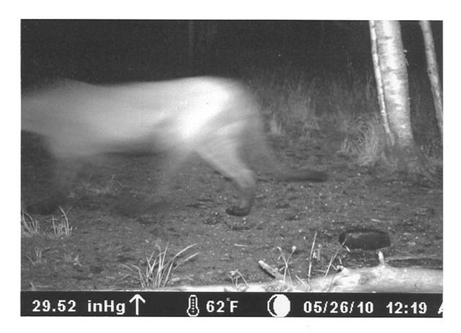
Menominee County Cougar, June 2010, photo courtesy Michigan DNRE

The Michigan Natural Resources and Environment reports that a trail camera photo from Menominee County on May 26th is likely a cougar:

“This is the first confirmed cougar picture in Menominee County. We appreciate the cooperation of the caller who shared the photograph and contacted the DNRE,” said DNRE wildlife biologist Kristie Sitar, who is a member of the DNRE’s cougar team. “Other landowners who believe they have evidence of a cougar on their property, such as tracks or a kill site, are encouraged to contact their local DNRE field office as soon as possible, which allows staff to investigate before the evidence is compromised. Without good evidence, such as verifiable photographs or tracks, confirmation becomes increasingly difficult.”

Cougars, also known as mountain lions, originally were native to Michigan but were thought to have been extirpated around the turn of the last century. The last known wild cougar taken in Michigan was killed near Newberry in 1906. The Menominee County photograph represents the latest in a series of track and photo verifications of cougars in the Upper Peninsula. Since March 2008, five sets of tracks and two trail camera pictures have been verified in Delta, Chippewa, Marquette, Schoolcraft and now Menominee counties. The origin of the animal or animals is unknown. There have been no confirmations of breeding activity of cougars in Michigan in recent years.

If you sight a cougar or find evidence, call your local DNRE office or the 24-hour Report All Poaching line at 800-292-7800. Click through to the story for more, including tips on human/cougar encounters.

While the DNR is only prepared to admit cougars in the UP, SavetheCougar.org has reports from all over Michigan and there’s lots more at michigancougar.com.

Know Your Michigan Frogs: Northern Leopard Frog

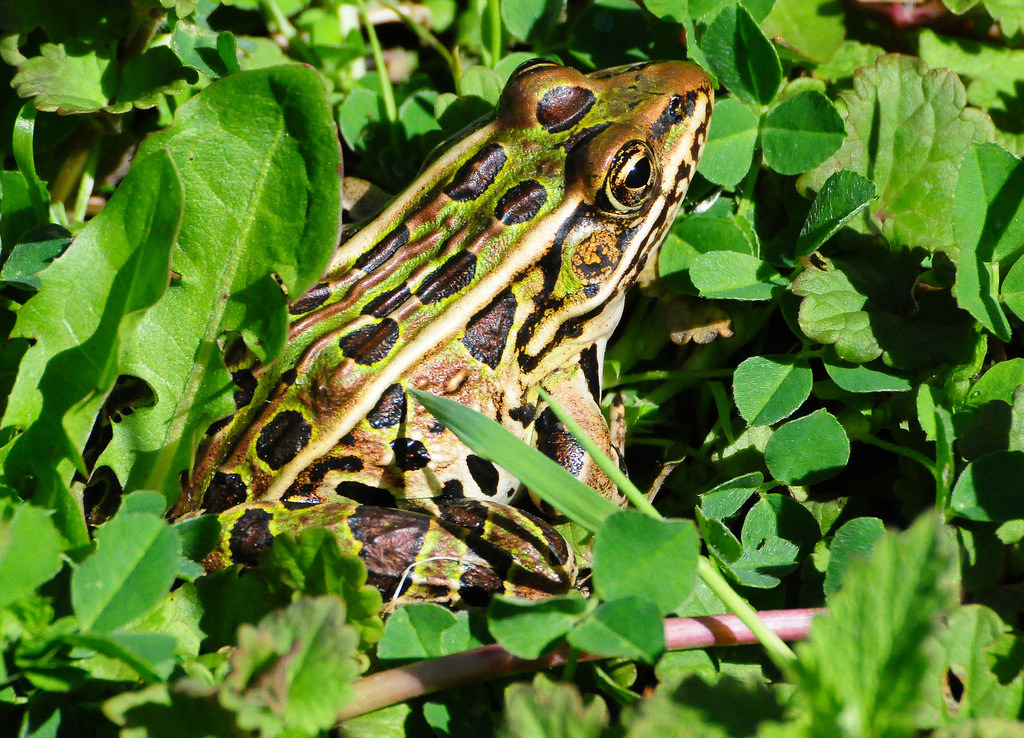
Northern Leopard Frog

Northern Leopard Frog, photo by Adore707.

National Geographic’s Northern Leopard Frog page says that the range of the species:

…is most of northern North America, except on the Pacific Coast. They generally live near ponds and marshes, but will often venture into well-covered grasslands as well, earning them their other common name, the meadow frog.

Leopard frogs will eat just about anything they can fit in their mouths. They sit still and wait for prey to happen by, then pounce with their powerful legs. They eat beetles, ants, flies, worms, smaller frogs, including their own species, and even birds, and garter snakes.

They also note leopard frogs were once the most abundant and widespread frog species in North America, but that declines beginning in the 1970s have significantly reduced their numbers. The Michigan DNR’s Northern Leopard Frog (Rana pipiens) page says that the frogs have had a similar and equally mysterious decline in Michigan, making a sighting of them rare in may parts of the state where they were once common. For more pictures & information, see Rana pipiens at the UM Animal Diversity Web and Northern Leopard Frog on Wikipedia.

See this bigger in Eli’s Nature slideshow.

More Michigan frogs on Michigan in Pictures!

Mom & Kit

Mom & Kit

Mom & Kit, photo by smiles7.

Sorry about missing yesterday … sometimes life happens

Do you suppose foxes celebrate Mother’s Day too? Happy Mother’s Day to all you moms out there – thanks for keeping the kids learning, the world turning and the flame of love burning.

I waited 364 days to blog this great photo from Julie. Check it out bigger (along with more great shots) in her Foxes slideshow.

Learn more about Michigan’s red fox (Vulpes vulpes fulva) on Michigan in Pictures.

Step back in time at Greenfield Village

Greenfield Village
Greenfield Village, photo by Michael Lavander

“I am collecting the history of our people as written into things their hands made and used…. When we are through, we shall have reproduced American life as lived, and that, I think, is the best way of preserving at least a part of our history and tradition.”
~Henry Ford on his museum

Greenfield Village in Dearborn (satellite map) is part of The Henry Ford, dubbed America’s Greatest History Attraction. If you’ve ever been to either, you know that’s not just a marketing slogan. Greenfield Village has seven historic districts that are jam packed with historical buildings & artifacts from all over:

Entering Greenfield Village is like stepping into an 80-acre time machine. It takes you back to the sights, sounds and sensations of America’s past. There are 83 authentic, historic structures, from Noah Webster’s home, where he wrote the first American dictionary, to Thomas Edison’s Menlo Park laboratory, to the courthouse where Abraham Lincoln practiced law. The buildings and the things to see are only the beginning. There’s the fun stuff, too. In Greenfield Village, you can ride in a genuine Model T or “pull” glass with world-class artisans; you can watch 1867 baseball or ride a train with a 19th-century steam engine. It’s a place where you can choose your lunch from an 1850s menu or spend a quiet moment pondering the home and workshop where the Wright brothers invented the airplane. Greenfield Village is a celebration of people — people whose unbridled optimism came to define modern-day America.

Michael took this photo at the museum’s opening day and you can see it bigger in his Greenfield Village 041510 slideshow.

Need more? Check out the Greenfield Village slideshow from the Absolute Michigan pool and more posts about Greenfield Village on Michigan in Pictures.

Enjoy your weekend and remember that Michigan’s museums need your patronage more than ever!

American Toad

American Toad

American Toad, photo by James Marvin Phelps (mandj98).

The UM Animal Diversity Web says that Bufo americanus (American toad):

…have an immense ability to adapt to their surroundings as long as there is a source of semi-permanent water for them to use in the breeding season. This quality has allowed them to successfully colonize suburban and agricultural areas.

American toads have short legs, stout bodies, and thick skins with noticeable warts. These warts can be colored red and yellow. The warty skin contains many glands that produce a poisonous milky fluid, providing these toads with excellent protection from many of their predators. This poison is only harmful if it is swallowed or if it gets in the eyes, but it can make many animals very sick.

Head over for much more including photos and sounds of the American Toad. More at American Toad on Wikipedia and the Michigan Herps Froga & Toads page.

Toads do not cause warts, and in case you’re tempted to harm these guys, consider what the Michigan DNR says about the American Toad: A beneficial species in gardens, eats many insect pests – a modest-sized toad will eat about 3200 insects in a season.

James says he caught this guy soaking up the sun on the lava rocks in his yard. You can view it extra-large at his web site.

This Bud’s for you? Champion Clydesdale Breeding Farm for Sale

clydesdale139team500

clydesdale139team500, photo by CreateWithKim.

Last week’s Traverse City Business News Ticker reported that East Jordan’s Beaver Chase Farms, where the famous Anheuser-Busch Clydesdales have been bred for more than a decade, is now on the market.

The Anheuser-Busch page on the The Clydesdales says:

On April 7, 1933, August A. Busch, Jr. and Adolphus Busch III surprised their father, August A. Busch, Sr., with the gift of a six-horse Clydesdale hitch to commemorate the repeal of Prohibition.

Realizing the marketing potential of a horse-drawn beer wagon, the company also arranged to have a second six-horse Clydesdale hitch sent to New York on April 7 to mark the event. The Clydesdales, driven by Billy Wales, drew a crowd of thousands as they clattered down the streets of New York City to the Empire State Building.

…Today, Anheuser-Busch owns approximately 250 Clydesdales; they continue to be an enduring symbol of our heritage and tradition.

Kim took this photo of the Budweiser Clydesdales in Marquette Michigan Mattsson Lower Harbor. See more in her Budweiser Clydesdales set (slideshow).

gulo gulo: The Wolverine and Why Michigan is the Wolverine State

Gulo gulo

Gulo gulo, photo by anikarenina.

Wikipedia’s wolverine entry says that the wolverine (Gulo gulo), also referred to as glutton, carcajou, skunk bear, quickhatch, or gulon, is the largest land-dwelling species of the Mustelidae (weasel) family in the genus Gulo (Latin: “glutton”). It is a stocky and muscular carnivore, more closely resembling a small bear than other mustelids. The wolverine has a reputation for ferocity and strength out of proportion to its size, with the documented ability to kill prey many times its size.

For more detailed information and photos, check out gulo gulo (wolverine) from the UM Animal Diversity Web. You can also see videos of the wolverine at ARKive.

Speaking of videos, recently Michigan lost its only known wild wolverine. Just days before, the Bay City Times put together this cool feature on Deckerville High School science teacher Jeff Ford’s longtime fascination with the wolverine that includes photos and video.

As to the question of why Michigan is called the Wolverine State, I couldn’t find anything definitive, but 50 States offers two theories:

Some people believe that Ohioans gave Michigan the nickname “The Wolverine State” around 1835 during a dispute over the Toledo strip, a piece of land along the border between Ohio and Michigan. Rumors in Ohio at the time described Michiganians as being as vicious and bloodthirsty as wolverines. This dispute became known as the Toledo War.

Another reason given for the nickname is a story that has Native Americans, during the 1830s, comparing Michigan settlers to wolverines. Some native people, according to this story, disliked the way settlers were taking the land because it made them think of how the gluttonous wolverine went after its food.

About this photo, Andrea writes:

Everett adopted a Detroit Zoo wolverine for me for Valentine’s Day last year. The zoo’s “Wildlife Preservers” adoption package came with a cute stuffed wolverine that we named Winchell.

Detroit’s wolverines produced 2 kits in 2005, who were fondly nicknamed Bucky and Sparty by the zookeepers. At the time, there were only 77 wolverines in captivity in North America, and Aggie’s litter was the only pair of surviving kits that year–and Detroit’s first surviving wolverine kits ever. Their official names are now Tamarack and Tilia.

See this photo bigger or in her Detroit Zoo set (slideshow).

More animals from Michigan in Pictures.

Shark Attack Triple X: The Michigan Shark Experiment

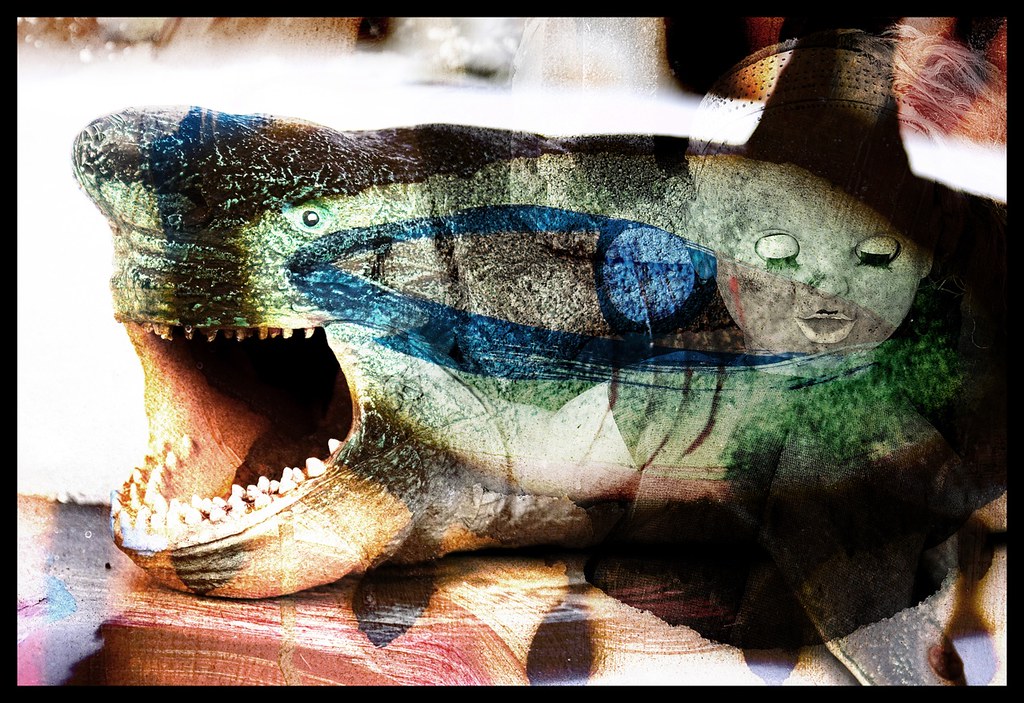
Shark Attack Triple X, photo by jnhkrawczyk.

Via the Herald-News in Roscommon:

…3 lakes in northern Michigan have been selected to host “an in-depth study into the breeding and habits of several species of fresh-water sharks.” Two thousand sharks are to be released into the lakes including blue sharks, hammerheads, and a few great whites.

The experiment is designed to determine whether the sharks can survive in the cold climate of Michigan, and apparently the federal government is spending $1.3 million to determine this. A representative from the National Biological Foundation is quoted as saying that there will probably be a noticeable decline in the populations of other fish in the lake because “the sharks will eat about 20 pounds of fish each per day, more as they get older.”

County officials have protested the experiment, afraid of the hazard it will pose to fishermen and swimmers, but their complaints have been ignored by the federal government. Furthermore, fishermen have been forbidden from catching the sharks. The report concludes by again quoting the National Biological Foundation representative, who says that “We can’t be responsible for people if they are attacked. Besides, anyone foolish enough to believe all this deserves to be eaten.”

Jill took this at The Heidelberg Project in Detroit. See it bigger in her Found Art slideshow.

PS: This was a spoof that the Roscommon News thought was real.

Support Michigan in Pictures with Patreon