Butterflies are blooming in Grand Rapids

Wingspan

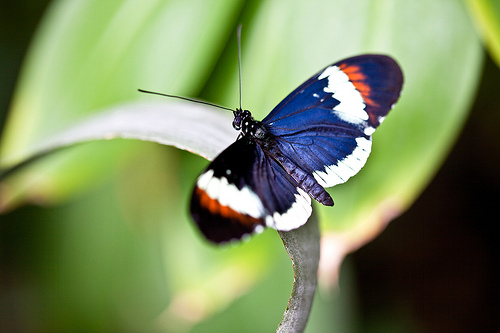
Wingspan, photo by TerryJohnston.

…at Meijer Gardens to be precise, where Butterflies Are Blooming is:

…Meijer Gardens’ most popular annual exhibition and the largest temporary tropical butterfly exhibit in the nation. March 1–April 30, visitors can escape the Michigan winter and mingle with more than 6,000 tropical butterflies flying free in the 15,000-square-foot Lena Meijer Tropical Conservatory.

The exhibition boasts more than 40 different species from the Far East, Africa and Central America. Each week hundreds of chrysalises arrive at Meijer Gardens and are painstakingly sorted, inspected, labeled and pinned in our sealed Butterfly Bungalow. The chrysalises are then placed in a special emergence area of the Bungalow where visitors can witness through a window their magical transformation into butterflies!

Once ready to be released into the conservatory, the butterflies are placed on plants where they acclimate to the environment and gain strength before taking to the air. It’s a wonderful place for photos and just one of the opportunities for visitors to observe the butterflies up-close and personal. Throughout the tropical environment, butterflies can be viewed drinking nectar from the flowering plants and feeding stations, lighting on the odd nose or shoulder, and congregating along the stream beds, as well as in flight all around.

Here’s a little butterflies & Beethoven for you in this video! Many more great ways to get out and about in our March Event Calendar on Absolute Michigan!

Check this out bigger than a butterfly and see many more in Terry’s butterfly slideshow.
Michigan Snakes: Blue Racer (Coluber constrictor foxi)

Blue Racer

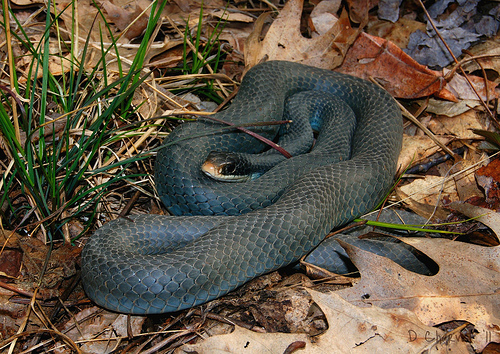
Blue Racer, photo by d charvat.

“I liked to go on the road and catch the blue racers and sort of scare my brothers,” she said. “I’d drape them around my neck and around my wrist. I was the ultimate tomboy when I grew up here in Manistee and I loved the Great Lakes. “
~Ann Romney recalling her Michigan childhood (article)

While Mitt Romney’s “the trees are the right height” memories of Michigan drew some laughter, I doubt that anyone would laugh at tomboy Ann Davies with a couple of blue racers draped around her arms.

The DNR’s page on Michigan snakes says that Michigan has 17 native species. Their Blue Racer (Coluber constrictor foxi) page explains:

A large gray or blue snake with smooth scales. The head is usually darker than the body, though the chin and throat are white. The belly is light blue or white. Young racers are grayish, with a pattern of darker blotches and spots. Adult length: 4 to 6 feet.

Racers inhabit a variety of places, including open woods, meadows, hedge rows, marshes, and weedy lake edges. They are alert, active snakes that may climb into low bushes to escape enemies. These snakes feed on rodents, frogs, smaller snakes, birds, and insects. Although they will bite if cornered or grabbed, racers are not venomous.

Females lay 6 to 25 eggs in rotting wood or underground during June and July. The young racers hatch in late summer and, as noted above, are colored differently than the adults.

Racers have been found through most of the Lower Peninsula (except the northernmost sections) and the southern tip of the Upper Peninsula. Once common, their numbers have fallen in many places. Needless persecution by humans as well as habitat loss are probable factors in this decline.

The Coluber constrictor Eastern Racer entry from Animal Diversity Web says that the blue racer is one of several different racer subpopulations and adds a lot more information and photos including that in the wild, racers have been known to live over 10 years. You can also watch a cool video of a BIG blue racer by the Saline Snake Guy.

d charvat writes that they saw this good-sized blue racer while hiking in the Middleville MI state game area. Check it out background big and see a lot more cool shots from out and about in their slideshow.

American Marten: A Michigan wildlife success story

American Marten 1

American Marten 1, photo by 13Miles.

The UM Animal Diversity web page on the American marten (Martes americana) says that American marten, also known as pine marten, are found in the northern reaches of North America and sporadically in Michigan, primarily in mature, northern forests:

These animals are closely associated with lodgepole pine, Douglas fir, spruce, and mixed harwood forests. They tend to be found in structurally complex, mature forests, and can occur at all elevations where such habitat exists. They den in hollow trees, crevices, or vacant ground burrows.

…American martens are somewhat arboreal (tree dwelling) and move with great ease in trees. They mark scent trails from tree to tree with their strong scent glands. In spite of this, they are reported to do most of their hunting on the ground. Most hunting occurs at dusk and dawn, when prey species are most active. In addition, these animals are accomplished swimmers and can even swim under water.
…Home range sizes vary considerably with habitat and prey densities. American martens do not hibernate and is active all winter.

You can read more and see pictures from Animal Diversity Web and on the American marten page at Wikipedia. The Michigan DNR’s page on the American marten says that:

According to records, the American marten was eliminated from Michigan around the 1930s. Removal of the mature evergreen forests and unregulated harvest of martens reduced the species to small populations in the Upper Peninsula. These eventually disappeared from the state. The 1927-28 Biennial Report stated, “They (marten and fisher) are so nearly exterminated in Michigan that there appears no chance they will ever come back.” Recovery efforts were initiated as early as 1958 with releases of captured martens into the Upper Peninsula Porcupine Mountains. Additional releases in the UP were conducted in the 1970s.

…Biologists have followed their progress over the years tracking pine martens to learn about their habitat use and home range needs. These studies along with sighting reports from hunters and other recreationists and incidental catches indicated the martens were readapting to their native Michigan.
During the review of the current Endangered Species List, biologists felt the population has recovered enough to upgrade its status. Martens are frequently becoming a part of the outdoor experience in Michigan with more and more encounters reported by hikers, campers, trappers, and hunters.

Once gone, the martens have returned home due to the efforts of many private organizations and agencies, but especially due to the support given by the donations of Michigan’s taxpayers to the nongame income tax checkoff.

Dixie took this photo last February around Grand Marais. Check it out bigger and see a few more shots of this beautiful animal in her marten slideshow.

More Michigan animals from Michigan in Pictures.

Lumber Day in Saginaw … make that Chesaning!

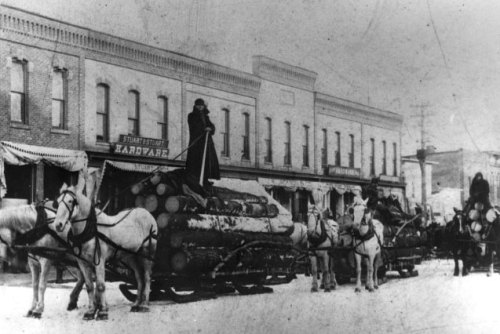
(Apr 27, 2015) Brett Russell shares: Not to correct your article, but I actually believe the bottom black and white photo was taken in Chesaning, MI. The building in the background looks like the Nason Block, which still stands today. The building far left where the brick color changes I believe to be the Chesaning State Bank. This photo would have been taken on Broad St. just before the intersection of Saginaw St.

Saginaw – Winter street scene, photographer unknown

This black and white photo shows winter carts loaded with lumber on an unidentified street in Saginaw. It’s from Seeking Michigan .

Old Moon, January Moon, Wolf Moon … and wolves in Michigan

January full moon

January full moon, photo by KatheD

Amid the cold and deep snows of midwinter, the wolf packs howled hungrily outside Indian villages. Thus, the name for January’s full Moon. Sometimes it was also referred to as the Old Moon, or the Moon After Yule. Some called it the Full Snow Moon, but most tribes applied that name to the next Moon.
~Old Farmer’s Almanac.

Speaking of wolves and January, last month the US Fish & Wildlife Service removed wolves in the western Great Lakes region from the federal endangered species list. Wolves are now managed by states in the region and the ruling takes effect on Friday, January, 2012. A release from the Michigan DNR about wolf de-listing says:

Returning wolves to state management will allow the DNR to more effectively manage the species under Michigan’s highly regarded Wolf Management Plan, which was created through a roundtable process involving interested parties representing viewpoints from all sides of the wolf issue.

“This is great news for the state’s wolf population and for Michigan citizens who have been affected by this issue,” said DNR Director Rodney Stokes. “Treating wolves as an endangered species, when the population has exceeded federal recovery goals in Michigan for more than a decade, has negatively impacted public opinion in areas of Michigan where wolves are established on the landscape. I firmly believe that the more flexible management options allowed under the state’s Wolf Management Plan will help increase social acceptance of the species while maintaining a healthy, sustainable wolf population.”

…After the wolf is taken off the federal endangered species list, the animal will remain a protected species in Michigan. There is no public hunting or trapping of wolves allowed in Michigan. The DNR and the U.S. Fish and Wildlife Service will investigate and continue vigorous prosecution of any wolf poaching cases..

You can find a lot more from the Western Great Lakes Wolf page, and the Michigan DNR’s Wolves in Michigan section has the Wolf Management Plan and a lot of information about the Gray Wolf (Canis lupus). Also see The Timber Wolf (canis lupus) in Michigan on Michigan in Pictures.

Check this out on black and this and another view in her winter slideshow.

Get Ready to ROAR!

PP_Zoo_0132-2-2 Lion web

PP_Zoo_0132-2-2 Lion web, photo by alj70.

The Detroit Lions travel to New Orleans tomorrow to face the New Orleans Saints in their first playoff appearance of this century.

My favorite sports blog, the Bleacher Report, has a nice preview of what should be a high scoring and exciting affair. Here’s a fantastic highlight video to get you roaring!

Check it out on black and in Alan’s slideshow … and GO LIONS!!

Chesaning and the Chesaning Rock

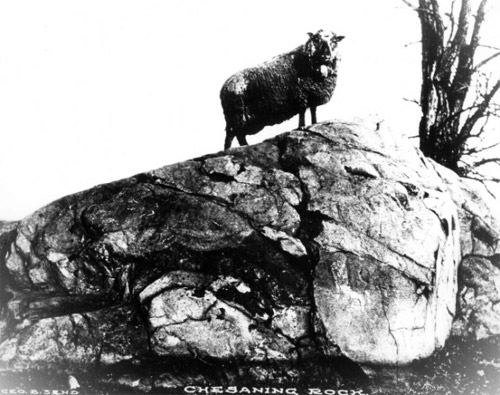
Chesaning Rock, photo by George B. Send (Courtesy Seeking Michigan)

The Wikipedia page for Chesaning, Michigan says that:

The first mention of Chesaning in the written pages of history is the Saginaw Treaty, signed in 1819. This treaty was between members of the Saginaw Tribe, Chippewa Indians and the government of the United States. They established a number of reservations, including 10,000 acres (40 km2) along the banks of the Shiawassee River known as “Big Rock Reserve.” Chesaning is a Chippewa word meaning “big rock place”. The treaty continued in effect until 1837 when a second treaty led to the reserve being surveyed and offered for sale in 1841. The first land was sold at $5 per acre to brothers Wellington and George W. Chapman, and Rufus Mason. After making their land purchase, they traveled back to Massachusetts and moved their families to their new wilderness home by late summer of 1842.

During the months they had been away from their land, several settlers had moved into the area, building a dam and a sawmill. A few years later, a grinding mill was added. The new settlers named their community “Northampton” in honor of the home they had left in Massachusetts. In 1853, the legislature changed the name to Chesaning, the traditional name for the village and township. The first township elections, held in 1847, are considered to be the official birthday of the community.

The Chesaning Historical Society has some more old photos of Chesaning, and Michigan GenWeb has a lot more Chesaning history.

I found this photo from the early 1900s at Seeking Michigan when I was looking for a photo for a feature on Saginaw’s coal mines. I think you’re agree it was simply too awesome not to share. ;)

They explain that The rock was one of the features of the area since Chesaning was settled. Located in woods to the east of Chesaning, the large rock inspired the name of the area. See it bigger at Seeking Michigan and check out more funny photos on Michigan in Pictures.

The Deer That Jumped Into the Sun

The Deer That Jumped Into the Sun

The Deer That Jumped Into the Sun, photo by arrdubyazee.

Today is Opening Day of deer season in Michigan, and for over 600,000 people, it’s a pretty important holiday. Over on Absolute Michigan we have a roundup of of the 2011 deer hunting season that has all kinds of information about this annual ritual.

If that feature is a shout-out to the hunters, this one is for the deer, because my hunch is that it’s pretty hard to hunt on the sun. arrdubyazee writes:

This is not a composite–I have the original Kodachrome to prove it.

This doe saw something odd in the grass, and came over to investigate. When she discovered just how odd that something was, she turned and bolted.

I count myself very lucky to have captured her in this pose, and I don’t ever expect to be as lucky again. Note that the antlers of a large buck are poking above the grass in the lower right of the image.

See it on black and in his wildlife slideshow.

More about White-tailed deer from Michigan in Pictures and don’t miss this great vintage deer camp photo!

People meet Bear, Detroit Zoo meet Google

People meet Bear

People meet Bear, photo by FHGVZEhyde.

The Freep had a feature this week on Google adding the Detroit Zoo to their Street View this week. Street View is feature of Google Maps that presents 360-degree views of locations, allowing you to explore through your computer. Normally, they use a car for the photos – sometimes with humorous results – but that leaves a lot of interesting sights off the map. To that end, they developed the Street View trike.

In July, Royal Oak Patch posted a video of the Google Trike in action at the Detroit Zoo. They explained that this summer:

Google asked its users to submit nominations for pedestrian-only locations they’d most like to see on its popular map feature in several categories, including theme parks and zoos. More than 15,000 voters said they wanted a virtual tour of the Detroit Zoo, beating out the San Diego Zoo and Universal Studios in Florida, among others.

The Google Street Trike is a three-wheeled pedi-cab equipped with digital cameras. Google technicians spent two days collecting digital images of the zoo’s award-winning habitats and attractions, both indoors and out.

Here’s the the Detroit Zoo on Street View. TIP: Turn RIGHT to start your exploration of the Detroit Zoo!

Check this photo out bigger and in her Animals and Nature slideshow. She explains:

There is a little tunnel underneath the polar bear exhibit where you can see the seals swimming around, but today the bear decided to chill right on top of the tunnel. That has never happened before. People were freaking out left and right but it was so cool.

PS: The Street View technology also powers a previous Michigan in Pictures feature, What Was There.

Rigging

Rigging

Rigging, photo by Elizabeth Glass.

The Spider’s Web

The spider, dropping down from twig,
Unfolds a plan of her devising,
A thin premeditated rig
To use in rising.

And all that journey down through space,
In cool descent and loyal hearted,
She spins a ladder to the place
From where she started.

Thus I, gone forth as spiders do
In spider’s web a truth discerning,
Attach one silken thread to you
For my returning.

~ E B White

Check this out really big in Fluidr (Elizabeth’s favorite new Flickr app) and in her slideshow.