Thursday Morning Face-off: Michigan Moose Edition

Foggy Morning Face-off

Foggy Morning Face-off, photo by yooper1949

In their History of Moose in Michigan, the DNR notes that moose are native to Michigan and were present throughout the state except for the southwestern Lower Peninsula prior to European settlement. Due to extensive logging of their habitat, hunting and likely a parasitic brainworm, they disappeared from the Lower Peninsula in the 1890s, with only a few hanging on in the UP. You can click the link above for the story of the recovery to the current level of around 500 and see Moose in Michigan for more.

Nature Works page on Moose – Alces alces tells us that:

The moose is the largest member of the deer family and the tallest mammal in North America. It stands six feet tall from shoulders to feet. Females weigh between 800 to 1,300 pounds and males weigh 1,200 to 1,600 pounds. The moose has long, thick, light brown to dark brown fur. Moose hair is hollow, which helps keep the moose warm. The moose has long legs. Its front legs are longer than its rear legs. This helps it jump over fallen trees and other forest debris…

The male or bull moose has huge broad and flat antlers that can stretch 4 to 5 feet across. Antlers start to grow in the early summer. When antlers first start to grow, they are covered with a soft fuzzy skin called velvet. The velvet has blood vessels in it that deliver nutrients that help the antlers grow. By late summer, when the antlers reach full size, the blood supply dries up and the velvet starts to drop off.

Moose mate in early fall. During mating season, females attract males with their deep calls and strong scent. Bull moose use their antlers in threat displays when they are fighting over females. Sometimes they will get into a pushing fight with their antlers. These fights rarely get too serious because the antlers could catch together and both moose could die.

The UM Animal Diversity Web entry for Alces alces Eurasian elk aka Moose has a lot of great information and photos as well and they add that:

The word “moose” comes from the Native American tribe, the Algonquins, which means “twig eater” in their language. It is an appropriate name because moose primarily browse upon the stems and twigs of woody plants in the winter and the leaves and shoots of deciduous plants in the summer.

If you happen to come across moose and want to help Michigan out with moose management, consider filing a moose observation report.

Carl says that the two young moose locked horns and pushed each other around for a while, but no real battle ensued. Check this out big as a moose, see a close-up of the confrontation and in his slideshow.

More Michigan animals on Michigan in Pictures.

Eastern Chipmunk (Tamias striatus)

Untitled

Untitled, photo by kdclarkfarm1

The newly redesigned University of Michigan Animal Diversity Web says that Tamias striatus (eastern chipmunk):

Eastern chipmunks live in shallow burrows in the ground. They are partial to areas near rocky crevices, decayed tree trunks, and fence corners. They do not like dense forests where no sunlight reaches the ground. Burrows are made by digging and carrying away the dirt in their pouched mouths. Unlike prairie dogs and other sciurids, eastern chipmunks do not leave the dirt in mounds near the entrances of their burrows. This makes it harder for predators to find chipmunks in their homes. These burrows can be up to 30 ft. in length with several different exits and tunnels. Eastern chipmunks conceal the exits with leaves and rocks. They may inhabit these burrows for several years.

Eastern chipmunks are larger than most chipmunks. They are reddish brown in color with 5 black stripes on their backs. These stripes are separated by brown, white, or grey fur stripes. They also have white and dark markings around their eyes. The stomach is usually a yellowish brown or white color. Their tails are reddish brown and furry, but not bushy like common squirrels. Like many rodents, Tamias striatus has 4 toes on the front feet and 5 toes on the rear feet.

…Eastern chipmunks have excellent vision, hearing, and sense of smell. They communicate with each other by making a variety of sounds, including the ‘chip’ for which they are named.

Tamias striatus eats a wide variety of foods including nuts, acorns, seeds, mushrooms, fruits, berries, and corn. They also eat insects, bird eggs, and sometimes small vertebrates such as young mice.

Read more and see a bunch more photos of chipmunks as well!

Check this out background big (which is decidedly bigger than a chipmunk) and see more in Diane’s slideshow.

More Michigan animals right here.

God’s Duck

SQUASH DUCK

SQUASH DUCK, photo by marsha*morningstar

Here’s the latest in the always popular Michigan in Pictures Duckie Series.

Marsha writes:

Seriously, untouched—-exactly how it grew and the markings are natural…just a little saturation of color and edging but this is really Gods duck.

See it bigger and in Marsha’s slideshow.

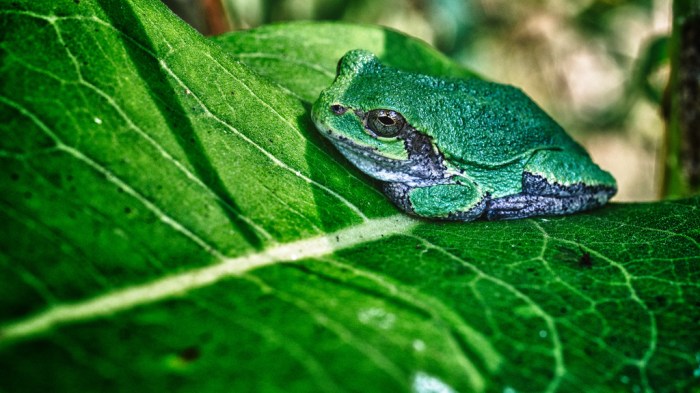
The Gray Treefrog doesn’t care if you’re confused

Gray Tree Frog

You Can’t See Me, photo by MacDonald_Photo (Formerly Sl33stak)

Michigan has two species of Gray Treefrog – the Eastern (Hyla versicolor) and Cope’s (H. chrysoscelis) that are hard to distinguish, sometimes even sharing the same ponds. Check out the Hyla versicolor page at the UM Animal Diversity Web for a bit about that. Their color spans a range of gray, green or brown according to environment or activity. See a collection of photos showing their wide range of color at the UM Animal Diversity Web.

They can be found in woods, swamps and your own backyard. Their ability to climb vertically & horizontally is due to their specially adapted toe pads, and you’ll sometimes find them on your screen windows at night. You’ll hear their short musical trill on warm spring & summer nights.

Jamie writes that he walked 20′ into the woods off a heavily used path and ran into this little guy – small as his thumb and sitting on a milkweed. Check this out background bigtacular and see more in his Fauna slideshow.

More Michigan frogs on Michigan in Pictures. Or, for something different, here’s what we have for green!

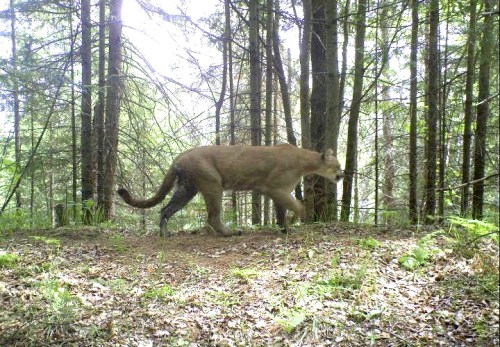
Photographic Proof of the Michigan Cougar!

Marquette County Cougar, photo by Michigan Wildlife Conservancy

A trail cam in southern Marquette County operated by the Michigan Wildlife Conservancy (MWC) recently captured the above photo of a cougar. Dr. Patrick Rusz, Director of Wildlife Programs for the MWC and retired DNR forester Michael Zuidema verified the trail camera’s location on a well-worn wildlife trail atop a wooded ridge. The camera has also photographed wolves, coyotes, fishers and numerous other species at the same site over a four year period.

The MWC is publicizing this photograph because it may be the best, clearest photograph of a wild Michigan cougar ever taken. It is also unusually interesting because Mr. Zuidema has recorded over twenty credible cougar sightings in the same vicinity since the 1970s. These include several sightings within a few miles of the trail camera location.

Dr. Rusz stated that “the long history of sighting reports in the area indicates the cougar photographed on June 1 may be part of a resident population rather than a wandering cat from a western state.” Dr. Rusz has studied cougars for the Conservancy for 14 years and is co-author of a peer-reviewed study that confirmed cougars in both peninsulas of Michigan by analyses of DNA in droppings. He has also identified a long list of additional physical evidence dating back to 1966, and notes that Michigan State College zoologist Richard Manville documented several cougar sightings or incidents when he inventoried the fauna of Marquette County’s Huron Mountains from 1939 to 1942.

“The MDNR cougar team should now look at the very good evidence of a remnant cougar population collected before 2008,” said Bill Taylor, President of the Conservancy. “They could still easily verify cougar photos taken in the 1990’s in Alcona and Oscoda Counties in the Lower Peninsula and some others. The vegetation and other landmarks needed to confirm the photos are still there.”

You can compare the photograph above with photos of a wolf, coyote, raccoon, and porcupine taken by the same camera in the same location at the MWC website at www.miwildlife.org.

The Michigan Wildlife Conservancy is a non-profit citizens group established to restore Michigan’s wildlife legacy. They have restored more than 8,200 acres of wetlands, 2,500 acres of prairies and grasslands, and hundreds of miles of trout streams, and helped with several rare species recoveries and the creation of many backyard habitats.

More about cougars in Michigan on Michigan in Pictures and weigh in with your comments below or on the Absolute Michigan Facebook!

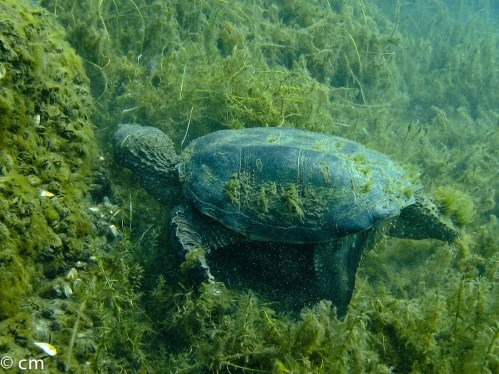
Snapper

Snapping Turtle, photo by Michigan Free Diving

Christopher Morey got a couple of nice shots of this snapping turtle – be sure to check out his slideshow of diving photos!

The Michigan DNR notes that while snappers are dangerous if molested on land, they are less likely to bite under water. Read more snapping turtles on Michigan in Pictures!

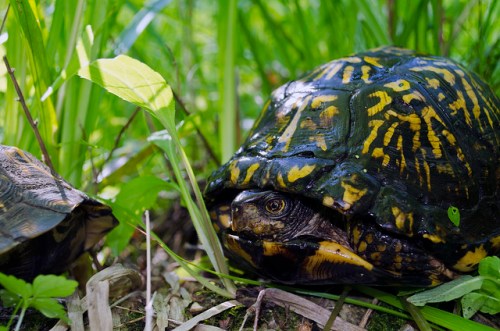
Michigan Turtle Tuesday: Eastern Box Turtle

Eastern Box Turtle

Eastern Box Turtle, photo by DavidGuthrie

According to the oral stories and traditions of the Great Lakes Woodland Indians, the turtle is a powerful symbol. One legend details how the turtle’s back provided a base for the first land that was formed in the midst of the great waters. Mackinac Island takes its name from a word in the Ottawa language meaning “Great turtle”.

So begins the Michigan DNR’s Turtle page. I found it fascinating reading, and I hope you enjoy it as well.

The earliest fossil remains of turtles date back about 225 million years to the late Triassic period. For millions of years they shared the planet with the dinosaurs. Unlike the dinosaurs, turtles survived the ecological and climatic changes that caused the extinction of many forms of life. All this was accomplished with little change to their anatomy: early fossils still closely resemble today’s turtles. Soft bodies were covered by a bony shell, with an oval shaped skull and beaked mouth; however these early turtles had teeth and had not yet evolved a way of pulling their heads into their shells. Today some 260 species of turtles (including the terrestrial tortoises) are found worldwide in nearly all temperate and tropical habitats.

The protective shell is one key to the turtle’s survival. Unlike the turtles in children’s cartoons, real turtles cannot climb out of their shell: A turtle literally wears part of its skeleton on the outside of its body. A turtle’s shell is composed of two parts. The upper portion, or carapace, is formed from the flat dermal bones covered by broad scales (scutes) and is connected to the backbone and ribs. The lower shell is the plastron and includes the abdominal ribs and portions of the shoulder girdle.

The shape and weight of a turtle’s shell can provide clues to its lifestyle. Shells can be helmet shaped, like the Blanding’s and eastern box turtle shells, for better protection against predators. A further adaptation of hinges in the middle of the plastron allows these turtles to partly or fully close their shell, offering even more protection for the head and legs. Shells can also be soft and rubbery like the pan caked shaped shell of the fast swimming spiny soft shell turtle, which is covered by skin instead of hard scales. Snapping and Musk turtles have very small, cross shaped plastrons, probably adapted to facilitate walking on pond and lake bottoms. Land living turtles have heavier shells – while these shells offer extra protection from land predators, their weight makes it more difficult to move quickly. The shell of a turtle that spends most of its life in a water environment is lighter in weight and more streamlined in shape.

Read on for more. Regarding the Eastern Box Turtle, they say that its high, domed carapace is dark with a radiating pattern of yellow or orange. The plastron has a flexible hinge that allows the turtle to completely close its shell. Box turtles are Michigan’s only true land-based turtle. They prefer open woodlands and adjacent meadows, thickets, and gardens, often near shallow ponds, swamps, or streams and eat plants, berries, worms & insects and carrion.

Box turtles’ home range is less than five acres, and they routinely live for several decades, occasionally a century or more! One important note is that the turtle’s life in captivity is MUCH shorter, so please enjoy them in their natural habitat! The box turtle is uncommon to rare in southern and western Lower Peninsula and the southern & eastern UP, and they are protected by Michigan law as a special concern species.

Here’s a (pdf) map of Eastern Box Turtle occurrences and you can get some more info and photos from Wikipedia’s Box Turtle entry and also get some really great information & photos about the Eastern Box Turtle and conservation efforts from the Herping Michigan blog!

Check this out bigger and in David’s Critters slideshow.

More of Michigan’s animals on Michigan in Pictures!

Chillin’

Bullfrog

Bullfrog, photo by d charvat

Over on Absolute Michigan this morning we reported that we were taking the summer off as we re-assess things.

I apparently decided to go on vacation as well. Since that photo was such a great one, I decide to share it here!

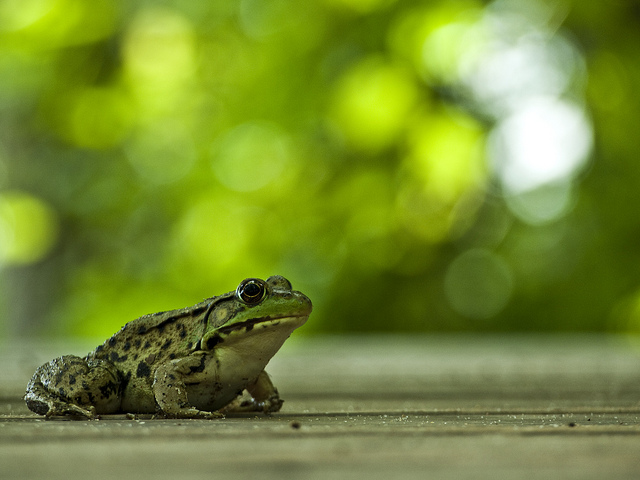
FYI, despite the name, this is a Northern Green Frog. The Michigan Herps page on Frogs & Toads explains:

Green Frogs are the most common species of frog in Michigan. They are large and are usually brown or green in color, with a very bright green face. However, some individuals may be bronze in color instead of brown. Often confused with the Bullfrog, Green Frogs have a fold of skin running from their eardrum to their back.

Check Diane’s photo out background big and in her Frogs slideshow.

* Don’t worry, Michigan in Pictures will still be published!

Omagakii: Frog in Anishinaabemowin

Ribbit Tell'em

Ribbit Tell’em, photo by EEKaWILL

Spring is frog season, and today’s Anishinaabemowin word of the day is Omagakii which means frog. Omagakiins means little frog and Omagakiinsag means little frogs.

Anishinaabemow.in is a very cool (though no longer updated) website that used short videos to teach words and short phrases in Anishinaabemowin. They explain that:

Anishinaabemowin is the traditional language of the Anishinaabe people. It is sometimes referred to as Ojibwe, Ojibway, Saulteaux or Indian by people in the community. Outsiders sometimes refer to it as Ojibwa or Chippewa. On this site we refer to it by the proper name in the language Anishinaabemowin.

Some facts about Anishinaabemowin

  • During the Fur Trade era Anishinaabemowin was referred to as the ‘Lingua Franca’ or trade language of what is now called Canada, meaning at one time if you wanted to conduct business here you had to speak Anishinaabemowin
  • At one time Guiness Book of World Records listed Anishinaabemowin as having the most complex verb structure of any language in the world, a testament to the intellectual capacity of our ancestors
  • A number of English words are adopted from Anishinaabemowing including Totem (used in Freudian studies and to refer to West Coast art) which is adapted from Dodem or clan, Mocassin (leather slipper) which is adapted from Makasin or shoe and countless place names.
  • Anishinaabemowin is spoken in communities from Quebec to British Columbia, From Northern Ontario to the Midwestern United States. The diffusion of speakers means that it is now spoken in places where there never were Anishinaabeg before.
  • Old Anishinaabeg don’t die, they just Maazhiwe.

Check Will’s photo out bigger and also see the Frog slideshow from the Absolute Michigan pool!

Signs of Spring in Michigan: Spring Peepers (Pseudacris crucifer)

Spring Peeper Pseudacris crucifer

Untitled, photo by Tim Mayo.

The Michigan DNR’s page on Northern Spring Peeper (Pseudacris crucifer) says:

The tinkling of bells is a popular description of the spring peeper’s spring mating call. Spring peepers are one of the earliest callers among the dozen frog species found in Michigan. During the first warm evenings of spring in late March or early April through May, their distinctive single note, high pitched “peep” is considered a harbinger of spring. The intensity of calling increases and can become a deafening chorus during humid evenings or just after a warm spring rain when many males congregate.

Only the male frogs call. They establish territories near the edge of permanent or ephemeral wetlands. They may call from elevated perches of submerged grass or shrubs near the water. The faster and louder a male sings, the more likely he is to attract a mate.

The female will lay between 750-1,200 eggs. The strings or clumps are attached to twigs and aquatic vegetation. Depending on the temperatures, eggs may hatch within four days or may take up to two weeks during cooler periods. After another two to three months, young tadpoles are fully transformed into young frogs and leave the pond.
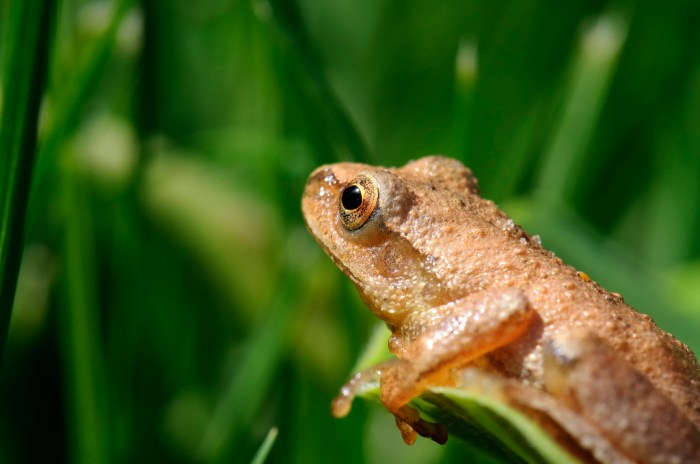
They resemble their parents with the most distinctive mark being a dark brown “X” (may be irregular or incomplete on some) on their lighter brown or tan back. They begin feeding on small food items like spiders, mites, ticks, pill bugs, ants, and caterpillars. By the end of the summer, they have reached the adult size of about 1 – 1 1/2 inches. As the days cool, the peepers dig into the soft mud near ponds for the winter. Still, during warm spells into the fall they can be confused and emerge to give their spring mating call.

The spring peeper is the most abundant of Michigan’s singing frogs and is common statewide. They prefer damp woodlands, swamps, and marshes. However, they still need protection – local populations around small ponds and wetlands can be highly susceptible to surface water runoff. These waters can carry chemicals, pesticides, or silt that can kill adults, eggs, or tadpoles. Good soil erosion practices and the careful application of pesticides and fertilizers are good for spring peepers.

The most distinctive thing about peepers is their call, which can become deafening in springtime. The Pseudacris crucifer (Spring Peeper) section from UM Animal Diversity Web has a short peeper call from Livingston County, and you can see a peeper peeping in this video.

Some more peeper particulars: Wikipedia’s Spring Peeper entry notes that their calls can be heard from as far as 1 – 2.5 miles depending on the number of peepers in a pond, that peepers generally like to breed when it is closer to dusk and throughout the evening and early morning hours, and that peepers can live up to 3 years in the wild. At Portage Lake in Washtenaw County, Michigan in the 1950s, surveys in March, April, and May found that spring peepers were the most abundant animals. The page on peepers from watersheds.org notes that spring peepers produce glucose (sugar) in their livers that acts as an anti-freeze and is pumped to vital organs including the heart and lungs to allow them to freeze and thaw without developing ice crystals. Our Peeper-pedia on Absolute Michigan has a few more links and a cool video of a Michigan peeper in action.

Check Tim’s photo out bigger and in his PJ Hoffmaster State Park slideshow.

More frogs on Michigan in Pictures.