January 26th is Michigan’s Birthday!

Leaping in a Winter Wonderland

Leaping in a Winter Wonderland, photo by karstenphoto

Today is Michigan’s 176th birthday. For the 175th birthday last year we compiled some fun facts that you can check out. Here’s hoping that you get a chance to get out and celebrate what Michigan has to offer this weekend!

If you’re staying warm inside, consider reading about Michigan’s statehood and associated documents at Seeking Michigan.

Check Steven’s photo out big as Michigan and see this and more winter fun in his winter slideshow.

The Michigan Moose Lift

Like posts like this? Please consider supporting Michigan in Pictures through Patreon!

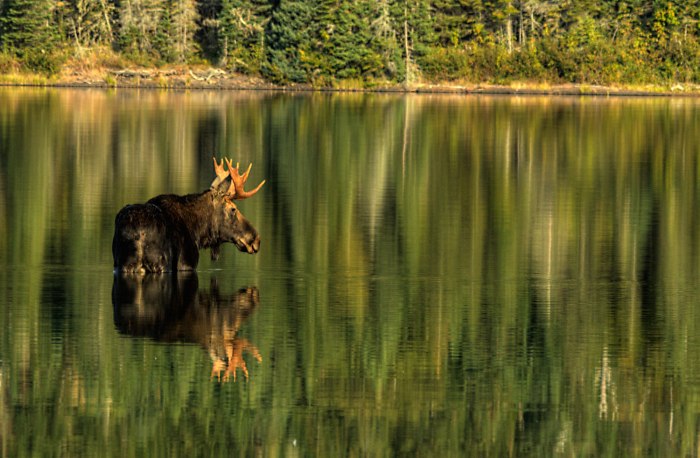
Michigan Moose Reflections

Moose Reflections, photo by yooper1949

NOTE: I’ve edited this post because the State of Michigan removed it from the internet. Thank you archive.org for saving it via The Wayback Machine so I could share it in its entirely!

Remembering Michigan’s Historic Moose Lift from the Michigan DNR says:

On Jan. 20, 1985, separate convoys carrying men and equipment set out from Michigan on a mission to reach the 3,000-square-mile Algonquin Provincial Park in Ontario, Canada.

Over the next two weeks, this team of wildlife biologists and veterinarians from the Michigan Department of Natural Resources, working with a team of Canadian specialists from the Ontario Ministry of Natural Resources, would locate, capture, transport and release a number of wild moose to form the nucleus of a new population in Michigan’s Upper Peninsula.

It was an unprecedented, historic operation. The wind chill at times approached 100 degrees below zero. Utilizing helicopters, tranquilizing dart guns and slings, some moose were air-lifted as far as 14 miles from the capture area to base camp.

At base camp, each animal was subjected to thorough medical testing and was fitted with a sophisticated radio collar, before being lifted into a shipping crate and placed onto a transport truck for the non-stop 600-mile overnight journey back to Michigan.

The remarkable effort was called “moose lift.” A total of 29 moose (10 bulls, 19 cows), ranging in size from 750 to 1,250 pounds, survived the arduous journey.

Crowds assembled each day at the release site north of Lake Michigamme in Marquette County. Despite temperatures well below zero, a welcoming committee of U.P. residents always showed up to greet the new “American” citizens.

As we mark the 20th anniversary of the first moose lift, the most common question that arises is, “How are the moose doing now?”.

“The department’s goal was to produce a self-sustaining population of free-ranging moose, and we have that,” said Dean Beyer, wildlife research biologist for the Michigan Department of Natural Resources.

Since the first moose lift in 1985, and a similar effort two years later when another 30 moose were released in the same area, the DNR has closely monitored the reintroduced moose population.

“At first, the size and growth of the herd was determined through a simple process–similar to balancing a checkbook,” Beyer said. “Because all moose were radio-collared, biologists could monitor each animal and tell when it died, and they could follow cows to record any births. The population could be tracked simply by adding the number of calves born and subtracting the number of animals that died.”

As the population grew, the new animals in the herd did not have radio collars.

“Over time, maintaining an adequate sample of radio-collared animals for the population would not be feasible,” Beyer said.

So in 1996 and 1997, the DNR conducted aerial surveys, which are the most common method of estimating moose numbers. Unfortunately, the population estimates from the aerial surveys were lower than estimates from the population model.

“At that point we knew we needed to conduct a more intensive study of the reintroduced population,” Beyer said. “And we also wanted to determine a more accurate picture of what’s reasonable growth for this population.”

With the help of the Michigan Involvement Committee of Safari Club International, which also provided the single largest financial contribution to the first moose lift, the DNR began a more intensive study of the reintroduced population in 1999, in cooperation with Michigan State University.

“Our research team is developing a technique to estimate the size of the population by estimating the probability of seeing moose from an airplane given the group size; behavior, whether the animal is standing or bedded; and the amount of canopy cover,” Beyer said.

When the moose were reintroduced into the western Upper Peninsula, biologists hoped the population would grow to 1,000 animals by the year 2000. Although that objective was not reached, results of the current study indicate the population is growing, on average, between five and ten percent each year. The research also has shown that poaching, moose/car accidents, brainworm and wolves are not major factors influencing the moose population at this time.

According to Beyer, the herd ranges over approximately 1,800 square miles in Marquette, Baraga and Iron counties. Moose also are found in several parts of the eastern U.P., most notably around the Tahquamenon River.

“Moose in this region have not been studied in detail,” he said.

Although records from the early explorers show that moose were common throughout Michigan, by the late 1800s moose numbers were very low. Moose soon disappeared from the Lower Peninsula and only a small number survived in the U.P., perhaps supplemented by animals coming in from Minnesota and Canada.

Thanks to the vision and hard work of many DNR biologists a generation ago, moose are once again establishing themselves as a premiere Michigan mammal.

Several U.P. communities, in fact, now vie over the self-proclaimed title, “Moose Capital of Michigan.” Mascots, motels, restaurants, candy and even ice cream are named after the mighty moose. Its image is common on billboards, television, artwork and printed materials. But most importantly, moose are alive and well, and rambling about in the wilds of Michigan’s Upper Peninsula once more.

Here’s a great video about the Moose Lift – highly recommended!

The last DNR moose survey pegs the UP’s moose population at about 500 with another 750 on Isle Royale.

Carl took this shot on Isle Royale in September. Check it out big as a moose and see much more (including some more moose shots) from one of Michigan’s coolest parks in his Isle Royale slideshow.

More moose on Michigan in Pictures!

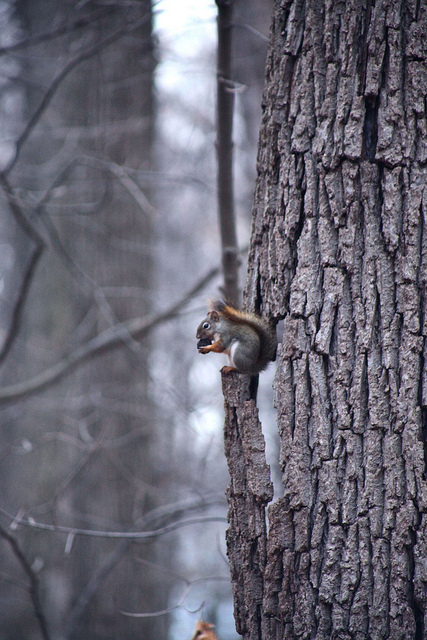
Tamiasciurus hudsonicus alias American red squirrel alias Pine Squirrel

pine squirrel in winter coat

pine squirrel in winter coat, photo by jb goodwater

The University of Michigan Museum of Zoology Animal Diversity Web is a massive online database of animal natural history, distribution, classification and conservation biology. Their entry for  Tamiasciurus hudsonicus red squirrel says (in part) that:

Red squirrels occupy northern boreal coniferous forests abundant with conifer seeds, fungi, and interlocking canopies … Populations of red squirrels occur in different habit conditions due to the vastness of their range. They occur in both temperate and polar environments and are considered to be primarily arboreal. They can be found in a mixed variety of forests including coniferous, deciduous, and mixed forests and they are also able to thrive in suburban and urban settings, as long as cool, coniferous forests with dense, interlocking canopies and abundant fungal resources are present.

Red squirrels differ from other tree squirrels by their deep reddish color, territorial behavior, and their smaller body size. They are less than 30% the size of grey squirrels (Sciurus carolinensis). While size and pelage color can vary geographically, they generally have a reddish back and white underside that is demarcated by dark lateral lines, which are especially visible in summer. A white eye ring is present year-round and tufted ears are during the winter.

Read on for a whole lot more including photos, lifespan (5 years average), how they communicate and mark their territory, and what they eat (and what eats them).

Check this photo out background bigtacular and see more in Joshua’s slideshow.

More squirrels on Michigan in Pictures.

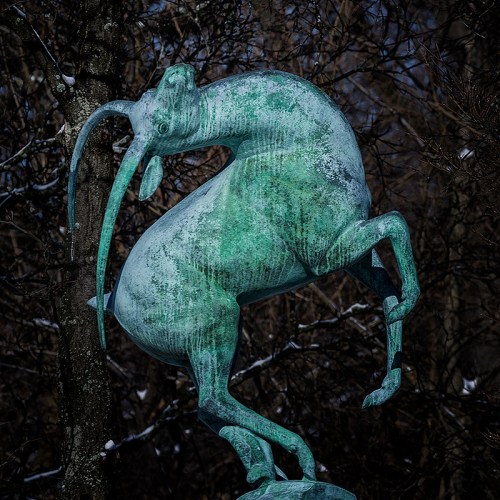
Deco Dance: Leaping Gazelle by Marshall Fredericks

Deco Dance

Deco Dance, photo by MichaelinA2

One of Michigan’s most renowned artists was Marshall Fredericks. He’s well known for the Spirit of Detroit sculpture, but this artist who spent much of his life in Michigan created many public works. Wikipedia’s entry for Marshall Fredericks has this to say about Leaping Gazelle:

This sculpture was the first commissioned work for which Marshall Fredericks was paid. In 1936, the sculpture won first prize in a national competition, and as a result, Fredericks became well known as a public sculptor. Since the gazelle is not native to Michigan, Fredericks made four animals that are, and placed them around the gazelle on Belle Isle. These animals are the otter, grouse, hawk and rabbit. Fredericks sculpted the gazelle in a characteristic movement called wheeling, which is when an animal quickly changes direction while being pursued by a predator.

The Leaping Gazelle is one of the most duplicated of Fredericks’s sculptures.

This particular sculpture is located near the entrance of the Detroit Zoo, one of many Fredericks sculptures on the Detroit Zoo grounds.

Also, I’ve been meaning to post a really cool exhibit that’s currently at the Dennos Museum in Traverse City titled Sketches to Sculptures, Rendered Reality: Sixty Years with Marshall M. Fredericks:

An exhibition of 31 small sculptures and 36 related drawings and sketches that showcases the creative process of Fredericks both as designer and sculptor. From simple pencil sketches to presentation drawings, the creative mind of Fredericks is on display as he transforms two-dimensional ideas on paper into three-dimensional sculptures. While many of the drawings in this exhibition resemble the final sculpture they would become, others only hint at elements of their outcome or point to a different outcome entirely. This exhibition is comprised of four genres that represent most of Fredericks’ work: architectural, commemorative, spiritual and whimsical. The exhibition was organized from the collections of the Marshall M. Fredericks Sculpture Museum at Saginaw Valley State University.

It includes some very cool maquettes – small, scale models of the finished Fredericks sculptures that are really amazing!

View Michael’s photo on black and see more in his Design, Special Settings, Lifestyle slideshow.

More sculpture on Michigan in Pictures.

Andy’s Trees … and Michigan Bigfoot

Andy'sTrees

Andy’s Trees, photo by swatzo

I’m guessing these trees aren’t for me, but I still love them. Another thing that I’ve loved since I was a kid was the search for Bigfoot. mLive reports that last April, the team of Bigfoot researchers from Discovery Channel’s Finding Bigfoot show came to Michigan:

After their first search yielded no sightings or additional evidence, BFRO held a town hall meeting in Houghton Lake to solicit additional leads from local residents. A show of hands revealed that a large group of those gathered had seen what they thought was a Bigfoot creature. One woman had made recordings of what she claimed could be a sasquatch which prompted Moneymaker to investigate further.

During the second night of searching, BFRO was joined by Mike Berg, a Michigan Bigfoot tracker. Berg partnered with Barackman to explore one tract of forest while Moneymaker camped out in a tree stand on the property of the woman who had made the sound recordings. While both locations yielded sounds that were thought to be from a Big Foot creature, no visual evidence was obtained.

Meanwhile, Holland and Fay were investigating woods where a local boy reported a sasquatch sighting. The two attempted to communicate with the creature by making different types of calls at varying pitches. After hearing several wood knocks after the calls, Bobo clapped back, which was followed by more of the wood knocks. The knocks were followed by movement on the road, but their chase also failed to provide a definitive picture of sasquatch.

Watch a clip at the Finding Bigfoot website and also on YouTube. The episode airs this Saturday at 7 PM and other times this week on Discovery. More about Bigfoot in Michigan at the Michigan Bigfoot Information Center.

Check this out on black and see more in Steve’s slideshow.

More trees on Michigan in Pictures.

More Michigan Cougar Photos Verified

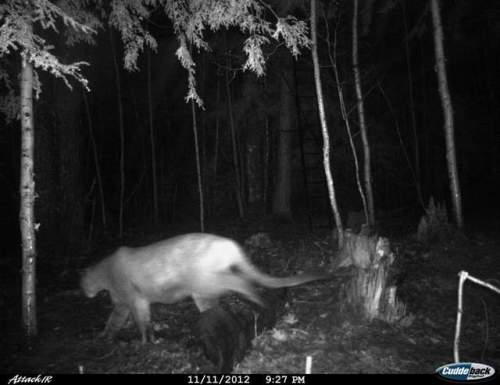
November 11, 2012 Upper Peninsula Cougar, photo courtesy Michigan DNR

The Michigan Department of Natural Resources announced yesterday that three recent trail camera photos of cougars in the Upper Peninsula have been verified by the DNR:

Two of the photos, both of a cougar with a radio collar, were taken in October in Menominee County – one near Cedar River and one near Menominee just north of the Wisconsin border. The third photo was taken in northern Marquette County in November. The cougar in the Marquette County photo is not wearing a radio collar.

The DNR does not place radio collars on cougars; North Dakota and South Dakota are the nearest states where wildlife researchers have placed radio collars on cougars to track their movement. The DNR has not yet been able to determine the origin of the radio-collared cougar that is in Michigan.

…DNR Wildlife Division staff have now verified the presence of cougars in the Upper Peninsula 20 times since 2008.

To date, the DNR has confirmed 11 photos, eight separate sets of tracks, and one trail camera video from 10 Upper Peninsula counties: Baraga, Chippewa, Delta, Houghton, Keweenaw, Mackinac, Marquette, Menominee, Ontonagon and Schoolcraft.

“The increasing number and frequency of verified cougar sightings in recent years are likely due to three factors in particular: The growing popularity of trail cameras used to monitor wildlife activity in the woods 24 hours a day; additional transient cougars moving east from established populations in western states as they seek new territory; and the cooperation of the public in reporting cougar sightings and sharing their photos with us for official review, which we greatly appreciate,” said Adam Bump, one of four DNR biologists specially trained to investigate cougar reports.

The DNR adds that cougars may travel hundreds of miles in search of new territory – as far as Connecticut from South Dakota.

You can report cougar tracks and other evidence should be made to a local DNR office or by submitting the sighting on the DNR’s online reporting form at www.michigan.gov/cougars.

More on the Michigan cougar saga on Michigan in Pictures.

Deer Season in Michigan: 2012 Edition

IMG_9524

IMG_9524, photo by flickaway1

Today is Opening Day, a de facto holiday that will bring hundreds of thousands of deer hunters to the woods & swamps of the Great Lakes State. As almost all of the state is potentially open to hunting, you’re advised to take extreme care for the next two weeks during the November 15-30 Deer Hunting Season.

Read all about the 2012 Michigan Deer Season at Absolute Michigan.

Check this out big as a buck and see more deer shots in Brent’s slideshow.

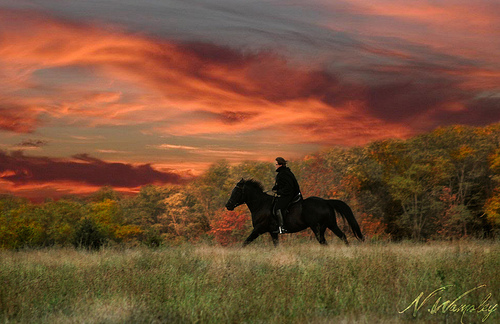
Riding towards Halloween

Halloween sunset... ©n.wamsley

Halloween sunset…, photo by Through My Eyes, Nicole Wamsley (astra.amara)

Nicole has the perfect photo for the day before Halloween. Check it out on black and see more including some really cool Headless Horseman (woman?) shots in her Halloween slideshow.

More Halloween photos on Michigan in Pictures.

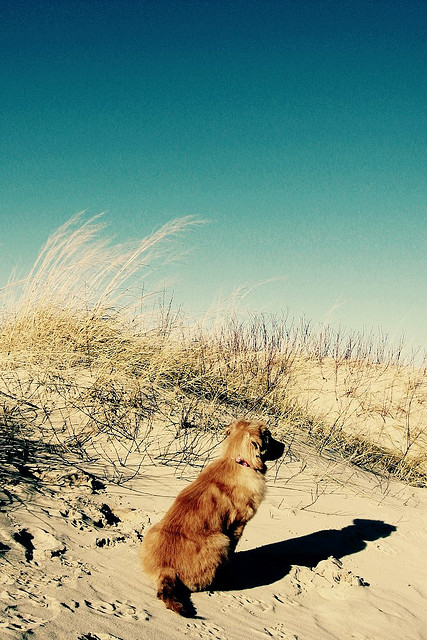
Dogs vs Seagulls (and bacteria)

Untitled

Untitled, photo by jenny murray

The Great Lakes Echo has a feature on an Environmental Science & Technology journal report on how scientists have used dogs to rid a Lake Michigan beach of seagulls. Why do that you ask? While gulls are certainly part of the Great Lakes beach experience, seagull waste contains bacteria that harms water quality & sometimes closes beaches. The test took place in Racine, Wisconsin and they explain:

For eleven days researchers calculated the concentration of different bacteria on the Lake Michigan beach. They measured E.coli and Enterococcus concentrations to calculate fecal contamination. In addition, the study collected information on potentially pathogenic bacteria, which can cause infectious diseases.

Researchers then used two trained border collies with handlers to harass gulls while continuing to survey the water quality.

The dogs prompted the gull population to drop 98 percent, from nearly 670 birds to just fewer than 20.

Fewer gulls meant better water. E.coli bacteria decreased nearly 30 percent with the removal of half the gulls. Before the dogs started working, water samples tested positive for potentially infectious bacteria on seven out of eleven days. After the dogs chased the seagulls, researchers failed to find any contagious bacteria.

Read on for more about this innovative solution.

Check this photo of Dot out on black and see more in Jenny’s dot slideshow.

More beaches on Michigan in Pictures.

Bobcat or Lynx?

Bobcat

Bobcat, photo by sharona 315 사론아

Today’s post got an assist from 5-year-old Landen, who when I showed him this photo of a ‘bobcat’. After a careful look, he told me “Nope, that’s a lynx.” When I asked how he was so sure, he pointed out the prominent black ear tufts. Sure enough, as How Stuff Works explains on What’s the difference between a bobcat and a lynx? the ears are a big clue:

To begin with, the bobcat looks a bit more like an overgrown house cat than a lynx does. With extra-long tufts of fur on its ears and a shaggy mane of fur around its cheeks, the lynx takes on an otherworldly appearance. The long black ear tufts, which can grow to be almost an inch (2.5 centimeters) long, act as excellent hearing aids, enabling the agile cat to pick up on the soft footsteps of its prey.

A lynx also has larger feet and longer legs than a bobcat to help it navigate the deep snow common in its range. Its big, furry paws act like snowshoes to help this feline chase down food in the winter.

I couldn’t tell whether or not this is a lynx or bobcat, but it’s an interesting bit of knowledge. It’s pretty certain it’s a bobcat as the pic was taken near Howell, and the US Fish & Wildlife Service endangered species list for Michigan lists counties with the highest potential for Lynx presence as all UP counties: Alger, Baraga, Chippewa, Delta, Dickinson, Gogebic, Houghton, Iron, Keweenaw, Luce, Mackinac, Marquette, Menominee, Ontonagon and Schoolcraft.

The UM Animal Diversity Web adds more about lynx, and the Michigan DNR has a guide for distinguishing bobcat & lynx as well. If you do see one, report it to the DNR.

Check this out bigger than a bobcat or on Sharon’s map.

More Michigan animals on Michigan in Pictures including our Bobcat article.