Castor canadensis, the American beaver

Floating Beaver

Floating Beaver, photo by Kevin Povenz

Castor canadensis (American beaver) from the University of Michigan Animal Diversity Web explains:

Beavers are primarily aquatic animals, and the largest rodents in North America. They have a waterproof, rich, glossy, reddish brown or blackish brown coat. The underhairs are much finer than the outer, protective, guard-hairs. The ears are short, round, and dark brown in coloration. A beaver’s hind legs are longer than its front legs, thus making the rear end to be higher than the front end while walking.

Some facts:

  • Beavers eat bark and cambium (the softer growing tissue under the bark of trees). Their favorites include willow, maple, poplar, beech, birch, alder, and aspen trees. They also eat water vegetation, as well as buds, and roots. Cellulose, which usually can not be digested by mammals, is a major component of their diet. Beavers have microorganisms in their cecum (a sac between the large and small intestine) that digest this material.
  • Under favorable conditions, beavers will produce their first litters at two or three years of age. The average lifespan of a beaver in the wild is 10 to 20 years.
  • Beavers usually live in family groups of up to 8 related individuals called colonies. The younger siblings stay with their parents for up to 2 years, helping with infant care, food collection, and dam building. Beaver families are territorial and defend against other families.
  • Beavers build dams to slow down the flow of water in streams and rivers and then build stable lodges for shelter. The dams are engineered according to the speed of the water; in slow water the dam is built straight, but in fast water the dam is built with a curve in it.
  • Beavers maintain wetlands that can slow the flow of floodwaters. They prevent erosion, and they raise the water table, which acts as a purifying system for the water. This happens because silt occurs upstream from dams, and toxins are then broken down. As ponds grow from water backed up by the damn, pond weeds and lilies take over. After beavers leave their homes, the dams decay, and meadows appears.

Head over to ADW for more information including some photos.

Check this photo out on black, see it bigger in his Animals slideshow and also view more great shots from Kevin on Michigan in Pictures.

More Michigan animals on Michigan in Pictures.
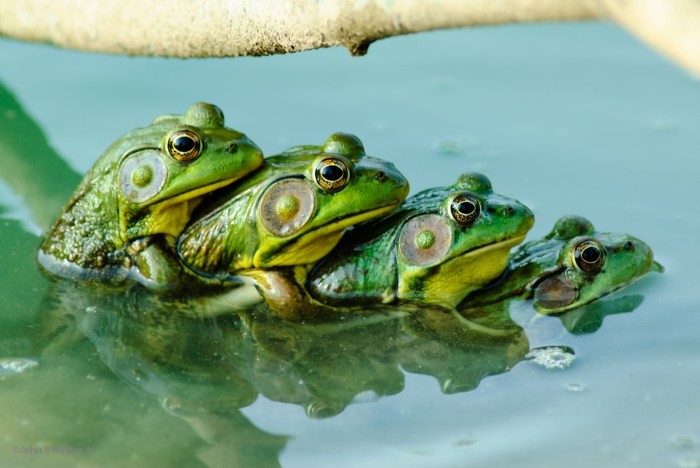
Frog Sex: It’s Complicated

Frog Sex Its Complicated

BACKYARD NATURE, photo by John E Heintz Jr

April is the time when we start to hear some of Michigan’s 13 species of frogs and toads making noise. While the green frogs pictured above were confusing their Frogbook friends in July, most of the distinctive spring frog calls are males advertising that they’re looking for love. The Michigan frog & toad page from the DNR explains:

As temperatures rise in early spring, frogs begin to move to their breeding sites. The actual timing depends on the warmth of the air and water, and the humidity, but there is noticeable order in which the various Michigan species become active and begin voicing their breeding calls. For example, in southern Michigan the raspy voice of the Western Chorus Frog is usually heard first, often in late March, followed quickly by the highpitched peeps of the Spring Peeper. In a few days the woodland swamps are filled with the quack like calls of the male Wood Frogs, while in another week in open marshes the low snores of the Leopard Frog are barely heard over the squeaky songs of newly arrived Red Winged Blackbirds.

The first warm rains of April bring American Toads out of the woods to the breeding ponds, where the air is soon filled with their melodious trills. Several of our frogs postpone their breeding activities until later in spring, when air and water temperatures are higher. Included in this late group are the Gray Tree Frog, Blanchard’s Cricket Frog, and Green and Bull Frogs.

Frogs are far more often heard than seen. Most frog sounds are the advertisement calls of the males, intended to attract the females for breeding. Frog voices may carry for long distances, especially the higher pitched calls of the smaller species. The males increase the loudness of their calls by ballooning out their throats or special sacs at the sides of their throats, creating a kind of resonating chamber. Only males produce advertisement calls, but both sexes may give shorter warning calls or screams when danger threatens. Males can also produce distinct calls that warn away rival males that approach their calling or breeding sites.

Female frogs and toads may lay hundreds or even thousands of eggs. These are usually attached to underwater vegetation or left floating in large masses at the surface. During egg laying, the male clings to the female’s back and fertilizes the eggs. The small, dark eggs are protected by layers of a jelly like substance. They may be in rounded masses (as in Wood and Leopard Frogs), loose clusters (Gray Tree Frogs), long necklace like strings (Toads), thin surface films (Bull and Green Frogs), or deposited singly or in small clusters (Spring Peeper). Many frog eggs are eaten by predators such as fish, turtles, and aquatic insects, or are lost to drying or destruction by micro organisms.

Read on for more and also read more about the frog life cycle from All About Frogs.

Check this out on black and see more in John’s BACKYARD NATURE slideshow.

More frogs & toads and more of our “Best Friends in Nature” series on Michigan in Pictures!

Don’t mess with a Dragonfly

DragOnFly

DragOnFly, photo by farlane

Yesterday Michigan in Pictures regular Mark O’Brien shared Nature’s Drone, Pretty and Deadly. The article says that although lions (25% hunting success rate) and great white sharks (50% success) look deadly, the dainty dragonfly may be the most effective hunter in the animal kingdom:

When setting off to feed on other flying insects, dragonflies manage to snatch their targets in midair more than 95 percent of the time, often wolfishly consuming the fresh meat on the spur without bothering to alight. “They’ll tear up the prey and mash it into a glob, munch, munch, munch,” said Michael L. May, an emeritus professor of entomology at Rutgers. “It almost looks like a wad of snuff in the mouth before they swallow it.”

Next step: grab more food. Dragonflies may be bantam, but their appetite is bottomless. Stacey Combes, who studies the biomechanics of dragonfly flight at Harvard, once watched a laboratory dragonfly eat 30 flies in a row. “It would have happily kept eating,” she said, “if there had been more food available.”

In a string of recent papers, scientists have pinpointed key features of the dragonfly’s brain, eyes and wings that allow it to hunt so unerringly. One research team has determined that the nervous system of a dragonfly displays an almost human capacity for selective attention, able to focus on a single prey as it flies amid a cloud of similarly fluttering insects, just as a guest at a party can attend to a friend’s words while ignoring the background chatter.

Read on for more including some very cool videos of dragonflies in action.

I don’t usually use my own photos on Michigan in Pictures, but I really like this one. Check it out background big and see more in my Leelanau slideshow.

More science on Michigan in Pictures!

Give me a home, where the dinosaurs roam

blah blah blah about being bigger than oneself

blah blah blah about being bigger than oneself, photo by hardyc

Is it just me or has the cloning of extinct species gone too far?

Check this out big as a brachiosaur and see more in Chris’s slideshow!

More April 1 fun on Absolute Michigan today!

Happy Easter(n) Cottontail!

ANIMALS

ANIMALS, photo by John E Heintz Jr.

Wishing everyone a Happy Easter or a happy weekend!

If you do see an Easter Bunny this weekend, he will probably be one of these guys. Sylvilagus floridanus (eastern cottontail) on the University of Michigan Animal Diversity Web explains (in part) that:

Eastern cottontails are solitary animals, and they tend to be intolerant of each other. Their home range is dependent on terrain and food supply. It is usually between 5 and 8 acres, increasing during the breeding season. Males generally have a larger home range than females. The eastern cottontail has keen senses of sight, smell and hearing. It is crepuscular (active at dawn & dusk) and nocturnal, and is active all winter. During daylight hours, the eastern cottontail remains crouched in a hollow under a log or in a thicket or brushpile. Here it naps and grooms itself. The cottontail sometimes checks the surroundings by standing on its hind legs with its forepaws tucked next to its chest.

Escape methods of the eastern cottontail include freezing and/or “flushing” (Chapman et al., 1980). Flushing consists of escaping to cover by a rapid and zig-zag series of bounds. The cottontail is a quick runner and can reach speeds up to 18 miles per hour. Vocalizations of the eastern cottontail include distress cries (to startle an enemy and warn others of danger), squeals (during copulation) and grunts (if predators approach a nesting doe and her litter). Eastern cottontails are short-lived; most do not survive beyond their third year. Enemies include hawks, owls, foxes, coyotes, weasels and man.

…The eastern cottontail is a vegetarian, with the majority of its diet made up of complex carbohydrates and cellulose. The digestion of these substances is made possible by caecal fermentation. The cottontail must reingest fecal pellets to reabsorb nutrients from its food after this process. Their diet varies between seasons due to availability. In the summer, green plants are favored. About 50% of the cottontail’s intake is grasses, including bluegrass and wild rye. Other summer favorites are wild strawberry, clover and garden vegetables. In the winter, the cottontail subsists on woody plant parts, including the twigs, bark and buds of oak, dogwood, sumac, maple and birch.

Click through to ADW for more (including pictures). Also see the Michigan DNR page on Eastern Cottontail and the BioKids cottontail page at UM, which appears to have exactly the same information as ADW, proving that I am not smarter than a 4th grader.

John started adding pics to the Absolute Michigan pool on Flickr about a month ago. He has some really great animal shots – so good in fact that I wonder if he has some Doolittle blood! See his photo on black and see more in his Animal Photography slideshow.

More Michigan animals on Michigan in Pictures.
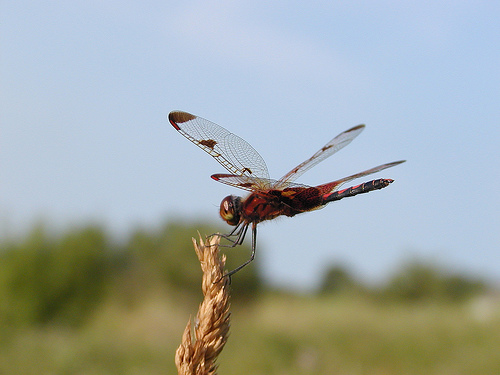
Weird Wednesday: South Arm Nessie

South Arm Nessie

South Arm Nessie, photo by Cvx_Wx

Absolute Michigan has been known to hold Weird Wednesdays on the last Wednesday of every month. Our Michigan Sea Monsters post featured two denizens of the deep courtesy Linda Godfrey’s Weird Michigan, the Sea Monster of the Straits and the Lake Leelanau Monster:

The story of an early 20th Century sea monster sighting was sent to The Shadowlands Web site by a reader whose great-grandfather was the witness. The boy was fishing for perch one day in 1910 in the shallows of Lake Leelanau in Leelanau County. The lake had been dammed in the late 1800’s to provide water power for the local mill and to enable logging. The dam also flooded much surrounding area, turning it into swamps and bogs punctuated by dead, standing trees.

On that particular day, the young great-grandfather, William Gauthier, rowed out to a new fishing spot near the town of Lake Leelanau. Looking for good perch habitat, he paddled up close to a tree that he estimated to stand about five feet tall above the water, with a six-inch trunk. He was in about seven feet of water, and after deciding this would be a good place to stop and cast a line, began tying the boat to the tree.

That’s when young William discovered the tree had eyes. They were staring him dead in the face at about four feet above water level. The boy and serpent exchanged a long gaze, then the creature went, “Bloop” into the water. Gauthier said later that the creature’s head passed one end of the boat while the tail was still at the other end, though it was undulating very quickly through the water. The writer noted that Gauthier always admitted to having been thoroughly frightened by his encounter, and that the event caused him to stay off that lake for many years.

The writer added that his great-grandfather came from a prominent area family and was very well-educated, and that he knew others who would admit privately but not publicly that they, too, had seen the creature. No sightings have been reported in recent times, but who knows how many people have believed they were passing by a rotting old cedar when in fact they had just grazed the Leelanau lake monster?

Could the South Arm of Lake Charlevoix hold similar creatures? Check this out big as a beastie and see more in Ed’s My Neighborhood slideshow.

More weird Michigan on Michigan in Pictures!

Black Bear in Michigan

Bear

Bear, photo by Majestic View Photography

Here’s a few of the many Michigan Black Bear Facts available from the DNR:

What is the status of black bear in Michigan?

Approximately 15,000 – 19,000 black bears (including cubs) roam the hardwood and conifer forests of northern Michigan. About 90 percent of the bear live in the Upper Peninsula, while the remaining ten percent are mainly found in the northern Lower Peninsula. However, it is becoming increasingly common to see bear in the southern half of the Lower Peninsula. During the past twenty-five years, the status of the Michigan black bear has been elevated from pest to prized game species. Today, Michigan’s only bear species is protected by law and managed by the Department of Natural Resources (DNR).

What are the physical characteristics of the black bear?

Most black bear in Michigan have dark black fur. Brown color variations are more common in western states. The size of a bear depends on its age, sex, diet, and season of the year. Adult female bear are generally smaller than adult males. In Michigan, female bear range from 100-250 pounds, while adult males weigh between 150-400 pounds. Adult black bear measure about three feet high when on all four feet and about five feet when standing upright. A bear is considered an “adult” when it is capable of reproducing, which generally occurs at three to four years of age in Michigan. In the wild, bear can live 20 to 30 years.

What is the home range of a black bear?

A bear’s home range is the area that provides sufficient food and cover for the animal to survive. Black bear are solitary animals, but family groups such as a sow and her cubs may be observed. Male black bear live in an area about 100 square miles in size, while females live in smaller areas of 10-20 square miles. Home range size is affected by food availability, the number of other bear in an area, and human development. As more people move to northern Michigan, the amount of undeveloped bear habitat declines.

What is the diet of the black bear?

In one word – everything. Black bear are considered opportunistic feeders, taking advantage of many seasonally available foods. Bear eat succulent, new green vegetation in the spring after they leave their dens. Colonial insects, such as ants and bees, may make up over half of their diet in late spring and early summer. Black bear experience rapid weight gain in years when wild berries, which are high in sugars and other carbohydrates, are available beginning in mid summer. Nuts and acorns, because they are high in fats and protein, are the best fall foods for bear when preparing for their winter’s sleep. If given the chance, black bear will supplement their natural diet with human garbage, pet foods, birdseed, or any foods placed to feed or attract other wildlife.

Read on for more, see the State of Michigan’s Black Bear section and also check Ursus americanus American black bear from the UM Animal Diversity Web for comprehensive information & photos.

View Dan’s photo out on black  and see more in his Animals slideshow.

More animals on Michigan in Pictures.

White-Footed Mouse

ANIMALS

ANIMALS, photo by John E Heintz Jr

The University of Michigan Animal Diversity Web says (in part) that Peromyscus leucopus white-footed mouse:

White-footed mice are found throughout most of the eastern United States. The easternmost part of their range extends from Nova Scotia in the north to Virginia in the south. They occur as far west as Saskatchewan and throughout the plains states, extending through eastern Mexico to southern Mexico and the Yucatan peninsula.

White-footed mice live in a wide variety of habitats but are most abundant in warm, dry forests and brushlands at middle elevations. They are the most abundant small rodent in mixed forests in the eastern United States and in brushy areas bordering agricultural lands. In the southern and western portions of their range they are more restricted in distribution, occurring mainly in wooded areas and semi-desert scrub near waterways. In southern Mexico they occur mainly in agricultural areas. They build nests in places that are warm and dry, such as a hollow tree or vacated bird’s nest. Their home ranges vary from 1/2 to 1 1/2 acres with 4 to 12 mice per acre.

…Most white-footed mice live for one year in the wild. This means that there is an almost complete replacement of all mice in the population from one year to the next. Most mortality occurs in the spring and early summer.

White-footed mice are primarily nocturnal. They are mainly solitary and are territorial, though adjacent home ranges do overlap. White-footed mice climb and swim well. Peromyscus leucopus individuals have keen homing instincts. In experiments in which they were captured and let go 2 miles away, they found their way back to where they were captured. When the young are threatened, the mother carries them to safety one at a time by holding them by the neck with her teeth.

A distinctive behavior of P. leucopus is drumming on a hollow reed or a dry leaf with its fore paws. This produces a prolonged musical buzzing, the meaning of which is unclear.

Read on for more and for pictures. Also (if you’re not the sort who will be disturbed by seeing a video of an indoor mouse) see this video of a mouse drumming on a plastic hose.

Check this out on black and see a series of these little guys in John’s Animal Photography slideshow.

More animals on Michigan in Pictures.
Winter Study: Observing Wolves & Moose on Isle Royale

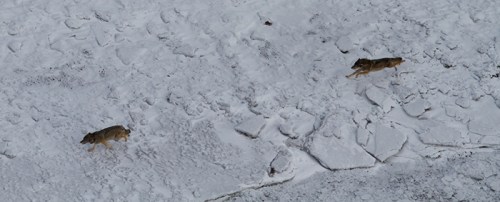
Isabelle being chased by her assailant

Isabelle being chased by her assailant, photo by isleroyalewolf.org

A couple of weeks ago a reader sent me a link isleroyalewolf.org. The website documents the interactions of the island’s wolf & moose population as their decades long dance unfolds on this remote, wilderness island. Their overview explains:

Isle Royale has offered many discoveries… how wolves affect populations of their prey, how population health is affected by inbreeding and genetics, what moose teeth can tell us about long-term trends in air pollution, how ravens give wolves a reason to live in packs, why wolves don’t always eat all the food that they kill, and more. The wolves and moose of Isle Royale also frequently reveal intimate details of their daily life experiences and they have inspired numerous artistic expressions. If we pay attention, they all tell us something important about our relationship with nature. These insights and discoveries are all presented here for you.

Building on the graph above and to develop a deeper understanding, here is more on the history of wolves and moose on Isle Royale. Moose first came to Isle Royale in the early 20th century, and for fifty years, their numbers fluctuated with weather conditions and food abundance. Wolves first arrived in the late 1940s by crossing an ice bridge from Canada. The lives of Isle Royale moose would never be the same.

Every winter since 1958, a team of researchers has spent numerous weeks at Isle Royale observing the lives of these wolves and moose and reporting back. Now they offer a website with photos and detailed reports, a fascinating tale that I encourage you to follow. Today’s photo is from the edition I began with – It’s Complicated. A snapshot:

Isabelle’s signal was surprisingly close. By the time we saw her, she was running for her life, north along the beach of Rainbow Cove. She was being chased by Pip’s two companions. Pip was nowhere in sight. While those two wolves have been eating regularly, Isabelle may not have had a decent meal in weeks, perhaps longer. Isabelle’s half-mile lead was reduced to nothing in just a few minutes.

Definitely read on for photos and a gripping account of these wolves battling and follow the whole 2013 Winter Study as it unfolds (sign up for their email).

More wolves on Michigan in Pictures.

A Michigan groundhog for Groundhog Day

Standing Guard

Standing Guard, photo by James Marvin Phelps

Today (February 2nd) is Groundhog Day, the day halfway between the Winter Solstice and the Spring Equinox. The most famous groundhog in the world, Punxsutawney Phil, didn’t see his shadow this morning. Apparently, Michigan has its own official woodchuck weather forecaster, Woody. She lives at the Howell Nature Center and also didn’t  see her shadow. If you put your trust in celebrity rodents, that means we’re in for an early spring.

Michigan has native groundhogs, also known as woodchucks, whistle-pigs, or land-beavers. The University of Michigan Animal Diversity Web entry for Marmota monax (woodchuck) explains in part that:

Woodchucks are stocky in appearance and often stand up on their hind legs, making them look tall. Their pelage varies greatly in color but ranges from gray to cinnamon to dark brown. Their body is covered with white-tipped guard hairs giving them a grizzled appearance. Their paws vary in color from a typical black to dark brown in most subspecies. However, one subspecies has paws that appear pink. Their short bushy tail is often black to dark brown and is 20 to 25% their total body length. They weigh from 2 to 6 kg, range from 415 to 675 mm in total length, and have tails that range from 100 to 160 mm in length. Although males and females are the same color, males are larger than females. Woodchucks have white teeth, which is uncharacteristic of rodents, and a dental formula of 1/1, 0/0, 2/1, 3/3, for a total of 22 teeth. They have rounded ears that can cover the external auditory canal which prevents dirt from entering the ear canal while burrowing.

…Woodchucks are diurnal, solitary animals … Woodchucks are burrowing mammals and generally construct summer and winter dens. These dens generally have several entrances (including an escape hole) and many chambers and tunnels. Woodchucks usually feed twice daily during the summer, with each feeding session lasting no more than 2 hours. They are often found sunning themselves in the middle of the day during summer.

…Abandoned woodchuck dens are used by a number of different species, including rabbits, skunks, raccoons, opossums, foxes, weasels, ground squirrels, river otters, chipmunks, meadow voles, short-tailed shrews, house mice, pine voles, white-footed mice, lizards, snakes, and arthropods.

You can read more and see photos at ADW and also at Wikipedia.

James took this photo at the Lake Erie Metro Park in August of 2009. See it bigger and see more in his Michigan Groundhog slideshow.

More Michigan animals on Michigan in Pictures.