On the Hunt … Interview with Jim Harrison by Jerry Dennis

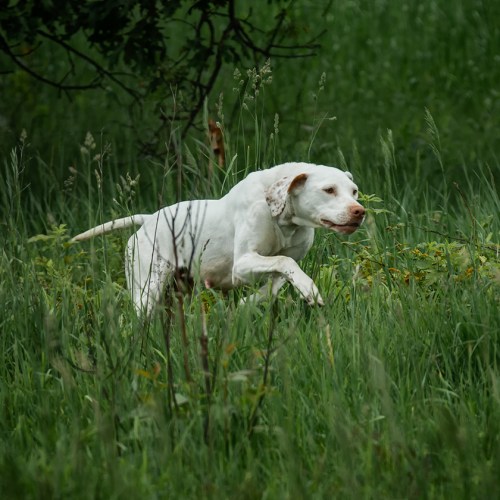
On the Hunt

On the Hunt, photo by PortrayingLife.com

The Cheyenne had a saying, and the Lakota, too: “When your life is tepid and you’re bored just follow your dog and act like your dog all day.” That’s been known to perk you up.
~Author Jim Harrison

One of my favorite Michigan authors, Jerry Dennis,  interviewed Michigan literary icon Jim Harrison in Traverse Magazine. Jerry is a noted outdoor writer, and I think his interview of Harrison is one of the best. A little taste:

JD: You often describe yourself as an “outdoorsman and a man of letters.” Why is being outdoors so important to you?

JH: Very early my dad would take me trout fishing because you know I’d had my eye put out and I needed extra attention. I remember asking him the difference between animals and us and he said, “Nothing. They just live outside and we live inside.” Which struck me very hard at the time, because I could look at animals and say, “I’m one of you.” The real schizophrenia of the nature movement, if you ask me, was to think you could separate yourself from nature. Even Shakespeare says “we are nature, too.” So there’s this sense of schizophrenia to think you’re different or more important than a bird.

JD: In your writing you’ve mentioned the “mythical underpinnings” that connect us with animals. Is that something you can elaborate on?

JH: Oden, that Scandinavian god, always had ravens standing on his shoulders. Myths, of course, are full of our other creatures. I would see bears almost daily in the U.P. They would wander around my cabin, hog my sunflower seeds, and I got to know a couple of them real well. I’d come home from the bar and a bear would be standing by the side of my driveway and I’d open my window and he’d put his chin on my door sill and I’d scratch his ears. They get used to it. But I’d never feed them near the cabin, that’s where you make a mistake. I’d put a fish on a stump about a hundred yards from the cabin.

There’s lots more,  I really encourage you to read it!

View Michael’s English pointer photo bigger and see more in his HuntTestDigital.com slideshow.

More books & authors on Michigan in Pictures.
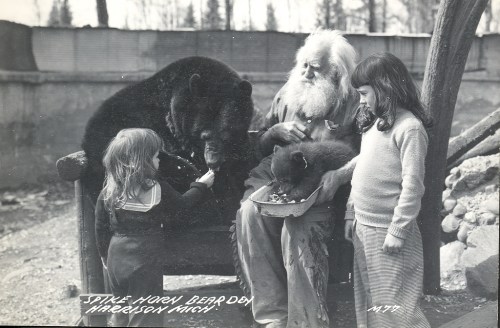
TBT: Spikehorn Meyers and His Bears

Clare Harrison MI Spikehorn Meyers Clare County MI RPPC 1930's-40's M77

Clare Harrison MI Spikehorn Meyers Clare County MI, photo by Don…The UpNorth Memories Guy

Here’s a Throwback Thursday featuring one of Northern Michigan’s most colorful characters:

Harrison’s most colorful character was John “Spikehorn” Meyers, known to thousands of Michigan residents simply as Spikehorn. He was a showman, naturalist, politician, coal miner, tile manufacturer, furniture builder, inventor, realtor, bear hunter, lumberjack, and above all, individualist. The old gentleman had a fertile imagination under his white thatch of hair and full white beard.

According to neighbors, Spikehorn’s interest in the woods and buckskins developed around 1930, when he opened his Bear and Deer Park established on his property at the corner of US-27 and M-61. Rumor has it the park even contained an occasional buffalo.

Spikehorn and his friend, Red Eagle, dressed in buckskins for tourists and treated them to tales of their adventures in the woods. He enjoyed feeding his pets sweets, popcorn, and pop and loved posing with his deer and bears for cameras.

His enemies were the Conservation Officers, as indicated by the sign in front of his business: “Feed Conservation Officers to the Bear.”

Spikehorn also appears in one of the best Michigan history videos, Roaming Through Michigan, a classic newsreel.

View John’s photo big as a bear and see more in his Spikehorn Meyers & Harrison MI slideshow.

Tons more history and more roadside attractions on Michigan in Pictures!

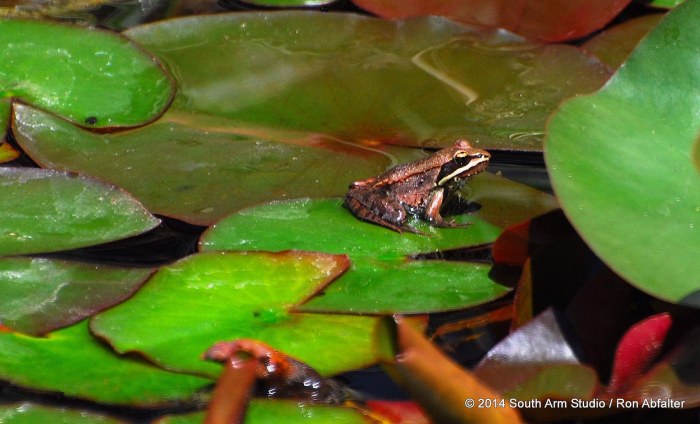
Michigan Frog Files: The Wood Frog (Rana sylvatica)

Michigan Wood Frog

Frog, photo by Ron Abfalter

Word on the pond is that Michigan’s frogs are a little put out by all the attention my readers are paying to Michigan turtles, so here’s a little payback. The DNR’s page on Wood Frog (Rana sylvatica) says:

DESCRIPTION: A brown or tan frog with a dark band (“robber’s mask”) through the eye and a white stripe on the upper lip. Small to medium – 2 to 21/2 inches long.

HABITAT: Woodlands, wooded swamps.

BREEDING: March-April, in woodland ponds and swamps often before ice is completely melted from pond. Egg masses are globular; many females may deposit in one area, often in deepest part of pond. Tadpoles will transform about 2 months later.

VOICE: A duck like “quack,” some describe it as “a lot of chuckling.”

RANGE AND STATUS: Common in moist wooded habitats state-wide.

You can hear the quacking call of the Wood Frog in this video and also learn more about wood frogs from the UM Animal Diversity Web.

View Rob’s photo bigger and see more of his photos from thePalms Supper Club & Dharma Cafe on Flickr.

More Michigan frogs on Michigan in Pictures!

Spend World Turtle Day with Common Map Turtles

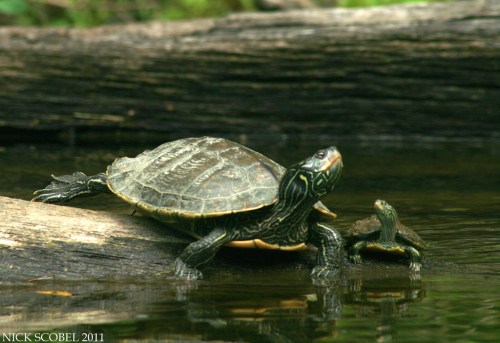
Northern Map Turtles

Northern Map Turtles, photo by Nick Scobel

May 23rd is World Turtle Day and Michigan is home to 10 native turtle species. I’ve now profiled 7 (most with Nick’s awesome photography), and you can get the full list at one of the most popular posts on Michigan in Pictures: Know Your Michigan Turtles.

Graptemys geographica (Common Map Turtle, Northern Map Turtle) from the University of Michigan Animal Diversity web says (in part):

Common map turtles get their name from the markings on the carapace. The light markings resemble waterways on a map or chart. The lines on the carapace are a shade of yellow or orange and are surrounded by dark borders. The rest of the carapace is olive or grayish brown. The markings on the older turtles may be barely visible because of darker pigment. The carapace is broad with moderately low keel. The hind of the carapace is slightly scalloped shaped due to the scutes. The plastron of an adult map turtle tends to be plain yellowish color. The head, neck and limbs are dark olive, brown or black with thin yellow, green or orangish stripes. There is also a oval spot located behind the eye of most specimens. There is sexual dimorphism in size and shape. The females are much larger than the males…

The common map turtle is dormant from November through early April. Most of that time is spent under the water, wedged beneath submerged logs, in the bottom mud of a lake or in a burrow. They have been known to change locations in the middle of the winter. They are avid baskers and they bask in groups. They are diurnal, active both in the day and at night. They are also a very wary animal, at the slightest hint of danger they slip into the water and hide. During courtship the male initiates by tapping his long claws on the front of the female but few details are known.

Common map turtles are omnivores. The feeding always takes place in the water. The adult females, due to their large heads and strong jaws eat larger prey than the males. The females consume snails, clams, and crayfish. The males eat aquatic insects, snails, and smaller crustaceans. Both are also known to eat dead fish and some plant material.

Read on for more and also see the Michigan DNR’s page on Common Map Turtles which includes a distribution map.

View Nick’s photo bigger, see more of his Northern Map Turtle photos or just dive into his huge collection of turtle pics! Nick also runs the Herping Michigan Blog that features all kinds of photo-rich features of Michigan frogs, snakes, salamanders and turtles. Definitely check out his Kayaking for Turtles post to see dozens of turtles from several turtle species that he photographed on one river paddle in Northern Michigan.

American Tortoise Rescue, a nonprofit organization established in 1990 for the protection of all species of tortoise and turtle, is sponsoring its 14th annual World Turtle Day™ on May 23rd. The day was created as an observance to help people celebrate and protect turtles and tortoises and their disappearing habitats around the world. Click the link to learn more about turtles and how you can protect them.

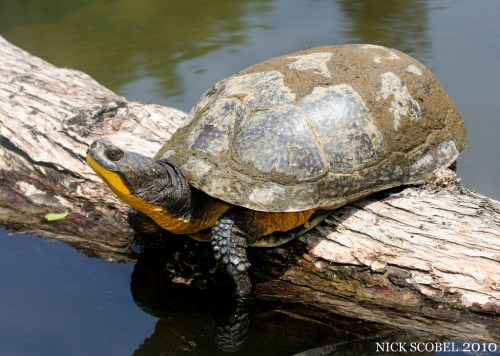
Know Your Michigan Turtles: Blanding’s Turtle

Blanding's Turtle

Blanding’s Turtle, photo by Nick Scobel

One of the most popular posts on Michigan in Pictures is Know Your Michigan Turtles where there’s now 6 of Michigan’s 10 turtle species profiled. For all those folks who come by to hang with our hard-shelled friends, here’s the latest installment in the series! 

The University of Michigan Animal Diversity Web entry for Emydoidea blandingii (Blanding’s Turtle) says that the Great Lakes region is currently a stronghold for this species:

Blanding’s turtles are found in and around shallow weedy ponds, marshes, swamps, and lake inlets and coves most of the year. They prefer slow-moving, shallow water and a muddy bottom with plenty of vegetation.

Blanding’s turtle are medium sized turtles with a carapace length ranging from 15.2 to 27.4 cm. These semi-aquatic turtles have moderately high, domed carapaces. They are elongate and smooth, lacking keels or sculpturing. The carapacial scutes display distinct growth annuli most prominently seen in juveniles. Coloration between individuals is highly variable. The carapace is black or gray with any variation of scattered light yellow or whitish flecks or dots. The light spots and flecks predominate in some individuals while others are almost solid black. The plastron is yellow in color with a dark blotch in the outer corner of each scute, and has a V-shaped notch near the tail.

Blanding’s turtles, like most other turtles, emerge to bask on sunny days. Basking sits include logs, grass clumps, sloping banks, or high perches near the water. Although these turtles are quite tolerant to cold, the summer heat may restrict their activities to early morning and evening or possibly a more nocturnal lifestyle. In the event of their habitat drying up some individuals will opt to migrate to new bodies of water while others simply burrow into the mud and aestivate until conditions improve. Blanding’s turtles generally hibernate from late October until early April, but quite often they can be seen moving slowly below the ice.

Blanding’s turtles are omnivores. Their favorite food items are crustaceans but they also feed on insects, leeches, snails, small fish, frogs, and occasionally some plants. Food is captured with a rapid thrust of this turtle’s long neck, similar to the feeding actions of the snapping turtle (Chelydra). Feeding mostly occurs underwater and food seized on land is generally carried to the water for swallowing. Prey is either swallowed whole or if it is too large it is held by the jaws and shredded into smaller pieces by the front claws.

The Michigan DNR notes that Blanding’s Turtle is protected as a species of special concern in Michigan and also has a map of occurences of Blanding’s Turtle.

View Nick’s photo bigger and see a lot more of his photos of Blanding’s turtles on Flickr including this shot of the turtle’s amazingly long neck. Nick also runs the Herping Michigan Blog, a great resource to see a lot of reptiles and amphibians in the wild!

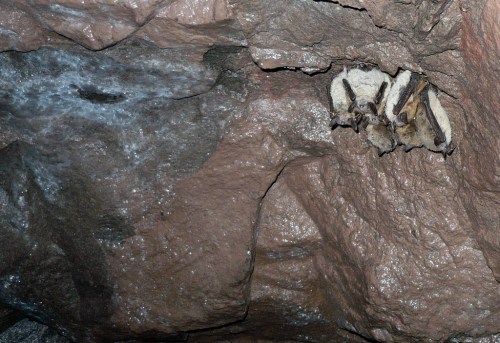
Bad news for Michigan bats: White-nose syndrome found

Bats of Copper Country

Bats of Copper Country, photo by GollyGforce – Living My Worst Nightmare

In “A sad day” for Michigan bats: White-nose syndrome found in 3 counties, Michigan Radio reports:

The Michigan Department of Natural Resources today confirmed the presence of white-nose syndrome in three counties: Alpena, Dickinson and Mackinac.

White-nose syndrome is blamed for the deaths of six million bats in 27 states and five Canadian provinces since 2006. In some places where the fungus outbreak has taken hold, 90% of the bats have died.

“We anticipated that this day would come. It’s not unexpected. But it’s still a sad day,” says Dan O’Brien, a state wildlife veterinarian. “Once this fungus gets into a bat hibernacula it’s going to be there, current evidence suggests, for a long time.”

The fungal disease could have a big impact on Michigan’s economy. Wildlife biologists estimate bats have a roughly $1 billion impact on the state’s agriculture industry by eating harmful insects.

The DNR adds:

“At this point, there is no effective treatment for WNS and no practical way to deliver the treatment to millions of affected bats even if treatment existed. Rehabilitation of bats is prohibited in Michigan because of the potential for the exposure of humans to rabies,” said O’Brien. “The best thing the public can do when they find a dying or dead bat is to leave it alone and keep children, livestock and pets away from it.”

Bat die-offs can be reported through an observation report on the DNR website at www.michigan.gov/wildlife or by calling the DNR at 517-336-3050.

View G’s photo big as a batcave and see more in her In the Wild slideshow.

More animals on Michigan in Pictures.

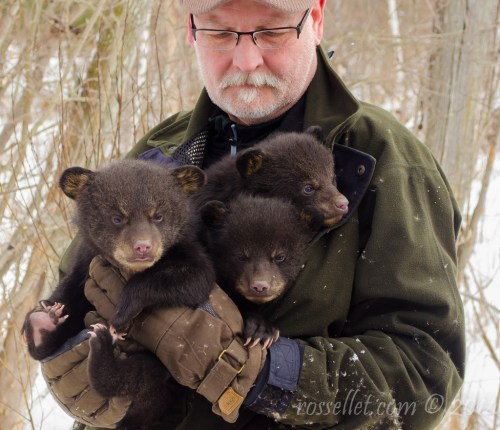
Bear Triplets

Bear Triplets

Bear Triplets, photo by Ross Ellet

I feel like the one on the left says everything I have to say about snow, cold and Winter. Here’s three facts from the DNR’s Michigan Black Bear Facts page – click through for more:

What is the status of black bear in Michigan?

Approximately 15,000 – 19,000 black bears (including cubs) roam the hardwood and conifer forests of northern Michigan. About 90 percent of the bear live in the Upper Peninsula, while the remaining ten percent are mainly found in the northern Lower Peninsula. However, it is becoming increasingly common to see bear in the southern half of the Lower Peninsula. …

When do bear breed?

Breeding takes place in June and July and cubs are born in early January while females are in dens. A litter may consist of one to four cubs, with two or three cubs being most common. An adult female bear usually breeds every other year, but may mate in consecutive years if cubs are lost before mid summer. A female bear will generally breed for the first time at 2’/z years of age in the northern Lower Peninsula, and at 3’/2 years of age in the Upper Peninsula.

What are bear cubs like?

At birth, bear cubs weigh less than one pound, but mother’s rich milk helps them grow quickly. Mother and cubs emerge from the den in spring, with the cubs weighing up to ten pounds. Cubs are under the watchful eyes of their mother throughout the summer and fall seasons. As autumn nears its end, the female once again searches for a suitable den site for herself and her cubs. After emerging from the den the following spring, the adult female will stay with her offspring until she is ready to breed again in June. At that time, she aggressively discourages the companionship of these now yearling bear and they are forced to fend for themselves.

Lots more about American black bears (Ursus americanus) at the UM Animal diversity web. About the photo Ross writes:

Baby black bears being held during a bear den visit in late March 2014. These baby bears are being counted, measured, weighed and analyzed so researchers can understand more about the overall health of the black bear population in Michigan. Researchers are also tracking their movement as some bears shift into southern Michigan.

View his photo big as a bear, see more in hisNature slideshow and view & purchase photos at rossellet.com.

More animals on Michigan in Pictures.

Michigan in Pictures is a blog, folks

Polar Vortex Cabin Fever

Polar Vortex Cabin Fever, photo by lauraherd

A few readers shared Thursday that they’d rather I check my politics at the door and stick to the Michigan photo posting. 6 even unsubscribed, but since 8 more subscribed I guess it’s a wash.

I’ve run a lot of blogs and similar online projects, and I’ve seen what happens when they become places for people to fight about things. That’s not going to happen on Michigan in Pictures, and I want to make a couple of things clear, just so there’s no surprises.

  1. And this is #1 for a reason. I love Michigan. Love love love it. I’ve worked really hard on this site for 8 years for no financial gain, sharing and promoting and discovering Michigan. What I do gain is the satisfaction of learning more and seeing more of my state. My love of Michigan extends to a commitment to the preservation of Michigan’s water and environment, which I believe is critical to our state’s long-term economic health. I can’t and won’t separate this, so you’re going to have to deal with the occasional post about my thoughts on these matters.
  2. And this is really part 2 of #1: I love YOU. You follow Michigan in Pictures because you love Michigan and love learning about the same weird, fun, beautiful things that I do. You also appreciate the talented photographers who share pieces of the glorious whole of the Great Lakes State in the Absolute Michigan pool on Flickr, on Facebook, Twitter and Instagram.  Thank you for your support of my efforts and your support of all the photographers who trust their work to me.
  3. This is my personal blog. I’m glad that so many people enjoy it, and I try go out of my way to confront people. That said, I don’t do Michigan in Pictures for money, I do it for love and my own satisfaction. I find comments along the “Stick to posting pretty pictures of Michigan” insulting and offensive. I’ll be sticking to doing what I do, and if that’s a problem for you, there’s a big wide internet out there so please feel free to unsubscribe now.

Thanks, and have a wonderful weekend.

Laura let me post this photo she took of our cats, Monty & Acorn. It’s a personal favorite. Click to see it bigger on Instagram.

The definition of intensity

The definition of intensity . . .

The definition of intensity…, photo by Dr. Farnsworth

View Dale’s photo from last weekend’s Kalkaska winterfest background big and see more in his winter slideshow.

More winter wallpaper on Michigan in Pictures.

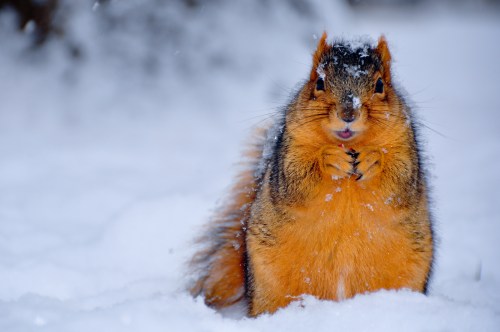
January 21st is National Squirrel Appreciation Day

National Squirrel Appreciation Day

Fox Squirrel, Eastern Fox Squirrel, photo by AndrewH324

Jonathan Schechter of Earth’s Almanac marks Squirrel Appreciation Day, saying:

Squirrel Appreciation Day is here; like them or not. January 21st is the day to look at America’s favorite rodent as something other than pancake-flat road kill, a clever feeder-robber or free entertainment for a frustrated window watching cat. Take time today to appreciate their adaptability and ability to not just survive but thrive in our midst. This slightly nutty ‘holiday’ is saluted by the National Wildlife Federation and was founded in 2001 by Christy Hargrove, a wildlife rehabilitator in North Carolina. Despite the fact that many fail to look both ways before crossing a highway even squirrel haters should salute these creatures that bury nuts; helping to spread trees to areas where the nut did not fall.

In Oakland County the squirrels seen in winter are the evergreen tree loving red squirrels, the rusty orange colored fox squirrel and the gray squirrel, a squirrel of the great American hardwood forests that is sometimes jet black. We are also home to the northern flying squirrel; a nocturnal creature that is more common than many realize! Chipmunks are seldom seen in winter and our 13 lined ground squirrel are under ground snoozing until spring thaw.

Andrew took this photo at the University of Michigan. Due to the high degree of squirrel activity on campus, there’s a Squirrel Club at UM. View Andrew’s photo background bigtacular and see more of this little guy in his Squirrel slideshow.

More squirrels on Michigan in Pictures.