Almost Too Curious: Fawn Facts

Almost Too Curious

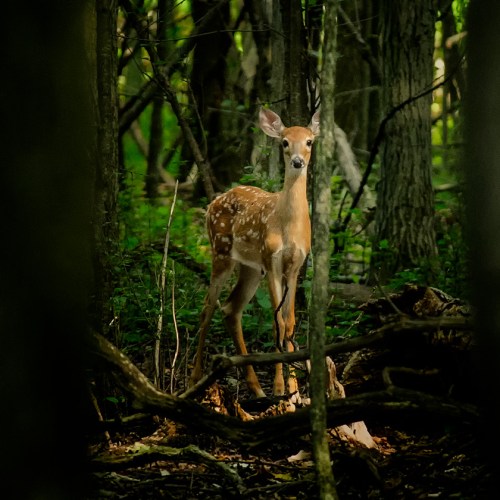
Almost Too Curious, photo by MichaelinA2

In honor of this great shot of a curious Whitetail fawn, here are some fawn facts gathered from the the UM Animal Diversity Web and the Michigan DNR and two hunting sites, The Whitetail Deer and Tinks.

  • The whitetail fawn loses its spots by the end of October of the same year it was born, or within 3 to 4 months after birth.
  • As the spots disappear, the fawn’s coat also changes from its reddish color to a grayish winter coat. The buck fawn’s face grows a bit darker in color but the belly remains white.
  • Deer tend to live in female-led family groups of up to 25 deer and may live to ten years or more.
  • When playing together, fawn games are suggestive of children’s games like tag. Mock fighting, aggressive postures, and scent marking helps fawns refine social behaviors.
  • Young males leave their mother after one year, but young females usually stay with their mother for two years.
  • The area where the fawn is born normally becomes its adult habitat.
  • Male fawns grow pedicles (the attachment point for antlers) that are typically about one inch in length.
  • Fawns that live past the first week have a good chance of surviving to adulthood.

Check it out bigger and see more in Michael’s 2013 Animals slideshow.

More nature on Michigan in Pictures.

Wolves almost gone from Isle Royale

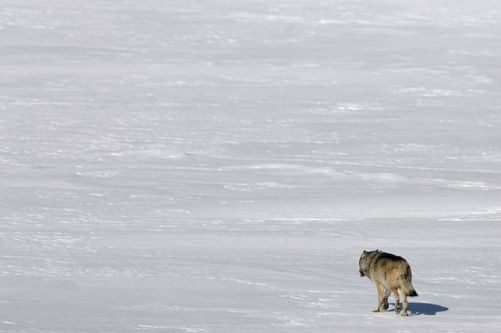
Isle Royale Wolf

The Urge, photo by isleroyalewolf.org

Last weekend the Freep reported that the delicate biosphere that characterized Isle Royale National Park is about to fall apart. The wolf count is down from nine last year to only three, and Michigan Tech ecologist John Vucetich says he wouldn’t be surprised if none remain next winter.

“What’s really important here is not the presence of wolves, per se,” Vucetich said. “But the wolves need to be able to perform their ecological function — predation. Predation has been essentially nil for the past four years now.”

That’s led to a 22% increase in the moose population for each of the past four years, he said, taking the island population from 500 to 1,200 moose. An individual moose consumes up to 40 pounds of vegetation a day.

“One of the most basic lessons we know in ecology, wherever creatures like moose live, you have to have a top predator,” he said. “If you don’t, the herbivore can cause a great deal of harm to the vegetation.”

… Vucetich and his colleague at Michigan Tech, Rolf Peterson, both support a “genetic rescue” of the island’s wolf population — bringing in wolves from elsewhere to bolster island wolves and help facilitate breeding. The U.S. Forest Service is studying the concept, but that process may take years. If the remaining wolf population doesn’t survive, and the Forest Service ultimately approves of the plan, it may mean creating a whole new pack on the island.

I think that this poses very interesting questions about our role in the ecosystems we seek to preserve. Are we to watch what happens and not interfere like a kid watching an ant farm or a Star Fleet team, or do we accept the responsibility of our decision to preserve and seek to maintain the natural balances and populations? As our climate changes, we will no doubt be called to make these decisions more and more frequently as flora and fauna lose the ability to survive in the places we have set aside for them.

This photo was the first in a series of 40 shared last fall in “Thinking Like an Island” from the Wolves & Moose of Isle Royale. They wrote:

THE URGE. Walk 40 miles in two days searching for a lover that may not even exist. Return home to parents and siblings the next day. The life of a dispersing wolf, unsatisfied.

It’s a great series featuring images by George Desort, Rolf Peterson, John Vucetich, and Brian Rajdl along with text by John Vucetich and Michael Paul Nelson. Click to see this photo bigger on Facebook and then use your left arrow to page through them.

Definitely visit isleroyalewolf.org for lots more about the predator/prey balance of one of Michigan’s most fascinating places.

Know your Michigan Turtles: Spiny Soft-shell Turtle

Soft Shell Attracts Seed Pods

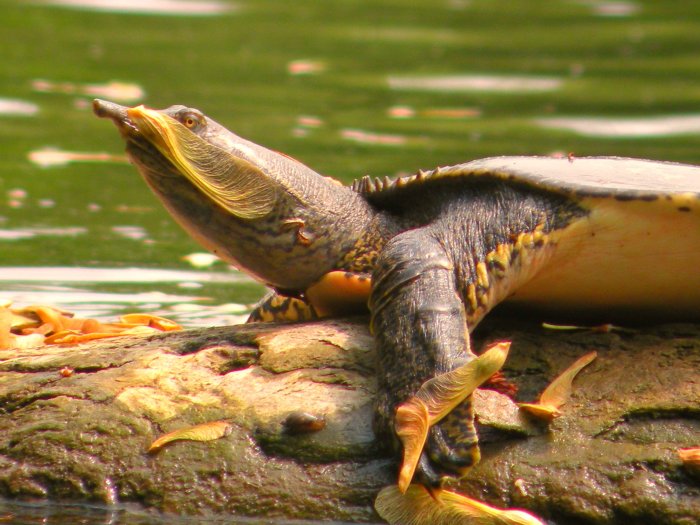
Soft Shell Attracts Seed Pods, photo by David Mayer

One of the most popular posts on Michigan in Pictures is Know Your Michigan Turtles where we now have 8 of Michigan’s 10 turtle species profiled. You can click that link for the list of all of them and read on to learn about the soft shell turtle.

The Spiny Soft-shell Turtle (Apalone spinifera spinifera) entry at the University of Michigan Animal Diversity Web says that:

Apalone spinifera inhabits various freshwater systems such as rivers, lakes, marshes, farm ponds as well as bays of the Great Lakes . Apalone spinifera prefers open habitats with a small amount of vegetation and a sandy or muddy bottom and require sandy raised nesting areas close to water.

…Spiny softshell turtles are diurnal animals, spending most of the day basking in the sun and foraging for food. They can be spotted sunning on logs and river banks. If disturbed, they will quickly retreat into the water and bury themselves in sand, leaving only their heads visible. These turtles are also able to breathe underwater for extended periods through their pharyngeal lining, cloacal lining, and skin. Spiny softshell turtles spend October to April in the water buried underneath substrate in a state of dormancy.

Apalone spinifera preys on on various macroinvertebrates such as aquatic insects, crayfish, and occasionally a fish. They find their food underneath objects, along the floor of the lake, and in vegetation. They also hide in the floor substrate and grab prey as they swim by.

Spiny softshell turtle nests are often destroyed by raccoons, skunks, and foxes. Young softshell turtles are eaten by raccoons, herons, and fish. Adults are killed and eaten only by humans, they have few natural predators. When bothered, spiny softshell turtles will extend their long necks and snap viciously at their attacker, inflicting a painful bite. They are wary and can hide themselves quickly.

Read on for a whole lot more including photos.

David says to be sure to check out the seed pod copter on this turtle’s face! View it background big and see more in his Wildlife slideshow.

Michigan Moose Numbers Declining

Moose Point Face-off

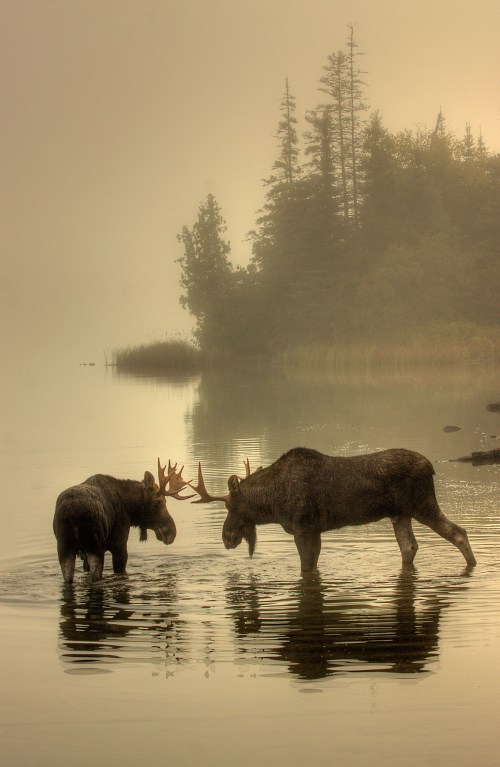
Moose Point Face-off, photo by Carl TerHaar

The Detroit Free Press reported that Michigan moose numbers are down:

The moose population in Michigan’s western Upper Peninsula appears to have dropped over the past two years and experts warn that a warming climate could be cause for concern for the species’ future in the state.

The latest biennial survey by the Department of Natural Resources produced an estimate of 323 moose in their primary Michigan range, which includes Baraga, Iron and Marquette counties. If correct, that would be a decline there of about 28 percent from 2013, when the estimate was 451.

…Even so, surveys since 1997 turned up regular population increases of about 10 percent. Beginning in 2009, the growth rate slowed to about 2 percent.

Now it appears to be dropping.

“It might not happen in our lifetime, or our children’s, but we have to face the possibility that there might not be a wild moose population in Michigan,” Chad Stewart (deer, elk and moose management specialist with the DNR) said.

Scientists are not certain what caused the apparent decline over the past two years, he said. Bitter cold and heavy snow the past two winters is one possible culprit. Also, wolves increasingly may be targeting moose because of falling deer numbers, although Stewart said there’s no hard evidence of that.

But in the long term, a warming climate may be the moose’s biggest enemy. Blood-sucking ticks thrive under such conditions. Thousands can attach themselves to a single moose and weaken the hulking beast.

More at the Freep.

View Carl’s photo big as a moose and see more in his massive Isle Royale National Park slideshow.

More Michigan moose information & photos on Michigan in Pictures

Coywolves: Coyote & Wolf hybrids in Michigan

Coyote on Ice by Jakphoto

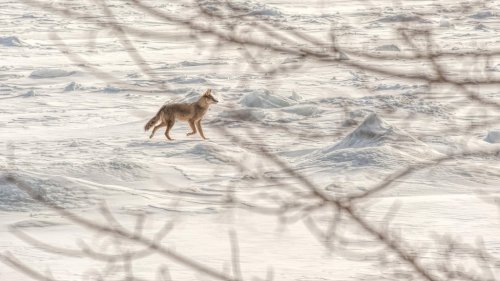
Hunting on Ice, photo by OnceJakPhoto

The Freep has an article about a new animal that is being seen in Michigan titled Michigan’s mysterious, misunderstood coywolves:

…a unique, still relatively unknown and misunderstood hybrid of coyotes known as eastern coyotes or coywolves. They’re mostly coyote, but contain a small percentage of wolf from an unlikely mating of the two species about a century ago. It may sound like an urban legend, but coywolves exist throughout the northeastern U.S. and eastern Canada, and have been confirmed in northeast Lower Michigan through blood-testing and DNA analysis.

Coywolves tend to be a little larger and heavier than their western coyote counterparts, but still well below the size of even the smallest North American wolves. They look like coyotes, though observers often note wolflike characteristics in their faces and fur.

…Coyote expert Stan Gehrt, a professor of wildlife ecology at Ohio State University, rejects the term “coywolf.” He doesn’t even like referring to them as hybrids. It leaves the impression that they are a near 50-50 mix of wolf and coyote, and that just isn’t the case, he said.

“They are eastern coyotes,” Gehrt said. “They aren’t really different from other coyotes, other than they have a little bit of genetic difference. I’ve trapped and tracked hundreds of Midwestern coyotes and a pretty good sample of eastern coyotes in Nova Scotia, and I wouldn’t be able to tell the difference between the two.”

But those, including biologists, who encountered coywolves up close in the Lower Peninsula say they had some wolflike features.

Read on for more including a photo of an actual Michigan coywolf. If you think you’ve seen a coywolf, you can report it online through the DNR or by calling the DNR’s Gaylord office at 989-732-3541, ext. 5901.

If you’re interested in learning more, Meet the Coywolf from PBS’s Nature is a cool profile of this animal that you can watch online for free.

Jim caught this photo of a coyote on the ice of Grand Traverse Bay last week. View it bigger on Flickr and jump into his slideshow for more icy goodness.

More Michigan wildlife on Michigan in Pictures.

Happy Groundhog Day, Michigan!

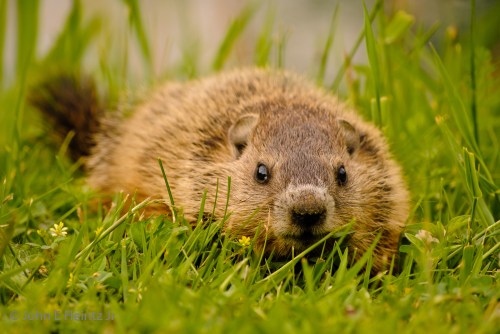
Michigan Groundhog
Young Groundhog, photo by John E Heintz Jr

Happy Groundhog Day everyone! We’re hoping that folks in the southern part of the state are digging out all right!

Michigan has native groundhogs, also known as woodchucks, whistle-pigs, or land-beavers. You can learn all about them from the University of Michigan Animal Diversity Web under Marmota monax (woodchuck) which says (in part):

Woodchucks have numerous common names, including ground hog, and whistle pig. The word “woodchuck” is a misinterpretation of their Native American name “wuchak”, which roughly translates as “the digger”. Groundhog Day occurs when Punxsutawney Phil, a captive woodchuck held in rural Pennsylvania, is awakened from hibernation in order to determine if he will see his shadow. According to the legend, if he sees his shadow there will be 6 additional weeks of winter. If he does not see his shadow, legend predicts an early spring.

The legend of Groundhog Day is likely due to the fact that woodchucks often re-enter hibernation after emerging from their dens prematurely.

We all know about Punxsutawney Phil, but have you heard of Michigan’s Official Groundhog? Her name is Woody, and she lives at the Howell Conference & Nature Center and unfortunately is battling a severe respiratory infection so her alternate Murray will stand in if she’s unable to perform her official duties at 8:15 today.

Woody correctly forecast six more weeks of winter weather on February 2, 2014, much to the chagrin of close to two hundred shivering attendees of that Sunday morning’s Groundhog Day festivities.

Last year’s prognostication, her sixteenth, was made crystal clear by her outright refusal to even leave her home. With temperatures at the Nature Center hovering in the low 20′s and several inches of snow on the ground, the clairvoyant chuck’s behavior was interpreted as just another sign of her wisdom.

Read on for more.

View John’s photo bigger and see lots more backyard wildlife in his ANIMAL PHOTOGRAPHY slideshow.

Biodiversity is not a dirty word

Piping Plover

Untitled, photo by Anna Lysa

Sorry to mess up your holiday week with a bit of advocacy on the behalf of Michigan’s natural environment, but yesterday via Michigan Radio I learned of the very disturbing Senate Bill 78 that’s headed to Governor Snyder for signature or veto. The bill would forbid DNR from preserving biodiversity in forests and parks:

More than 130 scientists and the state’s environmental groups are calling on Gov. Rick Snyder to veto a bill they call anti-science. The bill would forbid the Michigan Department of Natural Resources from protecting native wildlife and plants on the pure merits of protecting nature.

  • The bill would prohibit the Department of Natural Resources from managing state lands for biodiversity.
  • It would prohibit the agency from managing forests for restoration.
  • It would end work to eliminate invasive species.
  • It would strike from the law the finding that most losses of biological diversity are the result of human activity.

Read on for more, and here’s the text of Senate Bill 78. If you’re so inclined, feel free to tell Gov. Rick Snyder what you think. I know that messages to our elected officials really do make a difference.

View Anna Lysa’s photo from July of 2012 at Ludington State Park bigger and see more in her Michigan slideshow.

PS: As I read it, piping plover would not be impacted by this as the species with just 8,000 adults is federally protected. I just picked them because they’re a recognizable species that has benefitted from extensive preservation efforts, some of them in the Sleeping Bear Dunes National Lakeshore in Michigan.

Here’s the piping plover and more of Michigan’s endangered plants and animals on Michigan in Pictures.

Bears, it’s what’s for (Thanksgiving) dinner!

Thinking About the Zoo Visitors?

Thinking About the Zoo Visitors?, photo by Maia C

A very happy Thanksgiving to all of you. I remain very thankful that I have such a great group of photographers and readers for Michigan in Pictures. I love doing this blog, and your support makes it possible!

Maia suggests that this lion is perhaps thinking about zoo visitors, but my personal theory is that he’s thinking about bears, Chicago Bears to be exact! Thankfully, the NFL has given us the opponent who started it all, as the Detroit Lions share the history of the Thanksgiving Day game:

The game was the brainchild of G.A. Richards, the first owner of the Detroit Lions. Richards had purchased the team in 1934 and moved the club from Portsmouth, Ohio to the Motor City. The Lions were the new kids in town and had taken a backseat to the baseball Tigers. Despite the fact the Lions had lost only one game prior to Thanksgiving in 1934, the season’s largest crowd had been just 15,000.

The opponent that day in 1934 was the undefeated, defending World Champion Chicago Bears of George Halas. The game would determine the champion of the Western Division. Richards had convinced the NBC Radio Network to carry the game coast-to-coast (94 stations) and, additionally, an estimated 26,000 fans jammed into the University of Detroit Stadium while thousands more disappointed fans were turned away.

Despite two Ace Gutowsky touchdowns, the Bears won the inaugural game, 19-16, but a classic was born. Since 1934, 69 games have been played with the Lions holding a series record of 33-34-2 (.493). And each game, in its own way, continues to bring back memories of Thanksgiving, not only to Lions’ fans, but to football fans across the nation.

View Maia’s photo big as a lion and see more in her Detroit Zoo Spring/Summer 2008 slideshow.

More Thanksgiving features & photos and more Detroit Lions on Michigan in Pictures.

Cougar Cam Confirmation

Cougar Cam

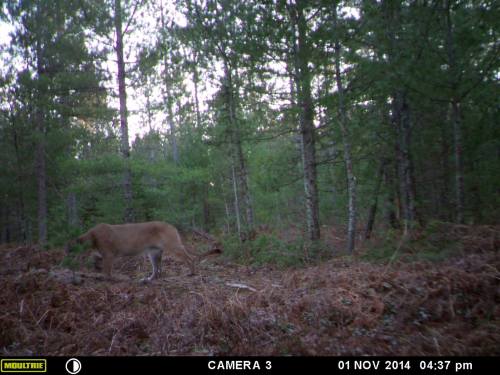
Confirmed Cougar, photo by the Hiawatha Sportsman’s Club

It was just a few years ago that the Michigan DNR vehemently denied the presence of cougars in Michigan, but things have definitely changed. Regarding this photo taken November 1st by an automatic trail cam in the Hiawatha Sportsman’s Club (located near Engadine in the southern Upper Peninsula), the Club writes:

This photo was confirmed by the DNR on November 3rd. The location is the area of S-trail / A-trail, east towards the perimeter of HSC property.

Click to view it big as a cougar and see more photos at the HSC Facebook page including some more trail cam shots and few shared by Denise Conroy of a cougar on someone’s porch near Cedarville!

Follow the whole Michigan Cougar Controversy on Michigan in Pictures.

The Puff Adder aka Eastern Hognose Snake

Eastern Hognose Snake

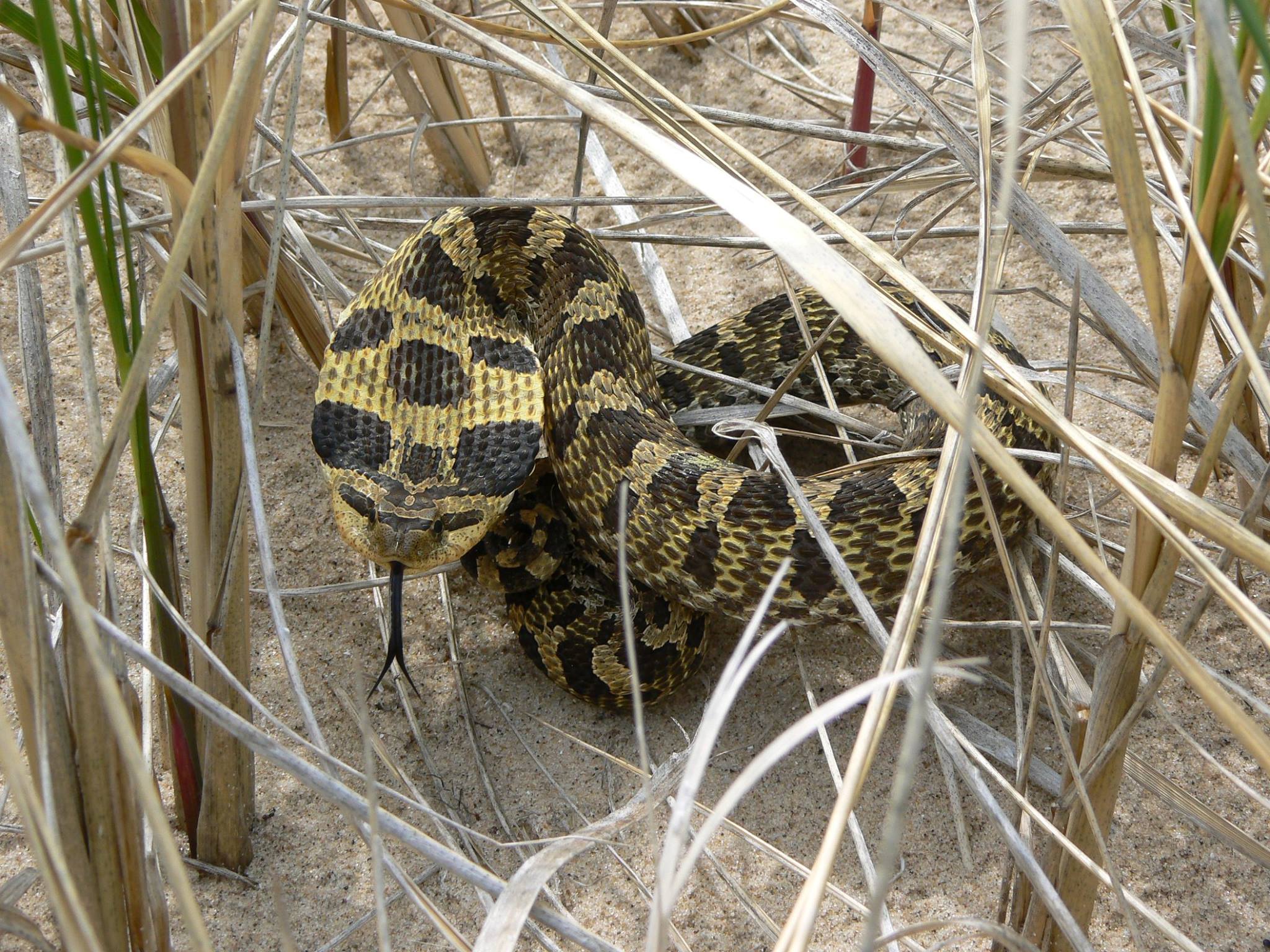
Eastern Hognose Snake by Sleeping Bear Dunes National Lakeshore

Of the approximately 2400 species of snakes in the world, Michigan has just 17. The State of Michigan’s page on the Eastern Hog-nosed Snake (Heterodon platirhinos) says (in part):

Description: A thick-bodied, slow-moving snake with a flattened, upturned “nose.” Color is variable some have dark spots and blotches on a yellow, orange, or brown background, but other specimens are solid black, brown, or olive with little or no visible pattern. Easily identified by defensive behavior (see below). Adult length: 20 to 40 inches.

Habitat and Habits: A snake of open, sandy woodlands – found in the wooded dunes of western Michigan. The upturned snout is used to burrow after toads, a favorite food. When threatened, hognose snakes puff up with air, flatten their necks and bodies, and hiss loudly. (This has led to local names like “puff adder” or “hissing viper.”) If this act is unsuccessful, they will writhe about, excrete a foul smelling musk, and then turn over with mouth agape and lie still, as though dead. Despite this intimidating behavior, Hog-nosed snakes are harmless to humans…

Range and Status: Though recorded from most of the Lower Peninsula and the southern tip of the Upper Peninsula, Hog-nosed Snakes are most common in the western and northern LP. Their numbers have declined in many places, in part due to persecution by humans who mistakenly believe they are dangerous.

View it bigger (if you dare!) on their Facebook and see more great shots of native flora & fauna on the Sleeping Bear Dunes National Lakeshore Facebook!

More Michigan snakes on Michigan in Pictures.

Support Michigan in Pictures with Patreon