Happy World Turtle Day from the Red-eared slider

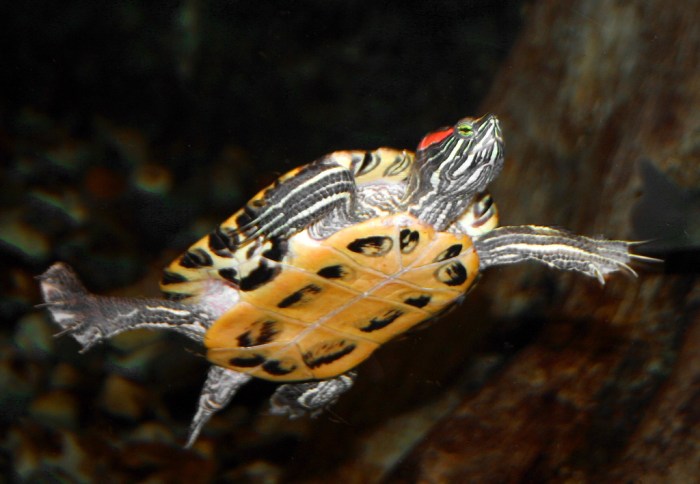
Trachemys scripta Red-eared Slider

Trachemys scripta (Red-eared Slider), photo by Nick Scobel

One of the most popular posts on Michigan in Pictures is Know Your Michigan Turtles, and World Turtle Day (May 23rd) is the perfect day to add another turtle to our list!

Jim Harding’s MSU Critter Field Guide entry for the red-eared slider (Trachemys scripta elegans) says that the turtle is named for the broad red or orange stripe behind the eye, which may extend onto the neck. He continues:

Red-eared sliders prefer still-water habitats (lakes, ponds, sloughs) with abundant aquatic plant growth and numerous basking sites in the form of logs or other emergent objects. These turtles are called “sliders” because they quickly slide from their basking spots into the water when disturbed. They feed on aquatic plants, and animals such as crayfish, snails, insects, tadpoles, and carrion. The young turtles are mostly carnivorous but eat increasing amounts of vegetation as they get older.

…This is a common turtle from northwestern Indiana south to Georgia and west to Texas and Oklahoma. Red-eared sliders are probably not native to Michigan, but breeding populations exist locally in the western and southern Lower Peninsula. Many thousands of baby sliders were once imported into this state for the pet trade, so it is likely that released or escaped specimens are responsible for the established colonies. Isolated specimens may turn up almost anywhere in Michigan.

Read on for more in the MSU Critter Guide.

Nick runs the excellent Herping Michigan Blog where you can find lots more of his excellent photos of Michigan’s reptiles and amphibians along with informative writeups. View his photo bigger and see more in his slideshow.
More Michigan turtles right here!

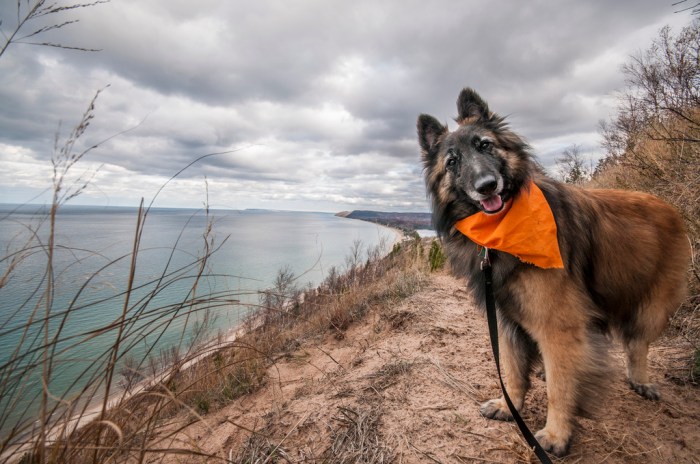
Major Explorer on Empire Bluffs

Major at Empire Bluff

Major Explores Empire Bluff, photo by Mark Miller

Over on Leelanau.com I shared upcoming meetings for folks interested in becoming “Bark Rangers” in the Sleeping Bear Dunes National Lakeshore. Major looked so awesome that I had to share him with all of you too!

Bark Ranger volunteers and their canine companions will serve as ambassadors on National Lakeshore beaches to provide visitors information about the park, highlight pet policies, and pet safety. They will also help to protect the National Lakeshore’s nesting shorebirds.

Dogs can’t come to the meeting, but Bark Rangers will receive training and Bark Ranger gear for their dog if they are volunteering with a dog. You don’t have to own a dog to become a Bark Ranger, and there’s two orientation sessions. The first meeting on Saturday, May 21 at 1 PM and the second on Tuesday, May 24th at 7 PM, and there’s also an option if you’re interested and can’t make it.

Mark is a longtime contributor to Michigan in Pictures. You can view this photo bigger and if you have any doubt that Major has more fun than you, one look at Mark’s slideshow of Major should be enough for your surrender.

More dogs on Michigan in Pictures.

PS: I promise to share some dog-friendly Michigan stuff folks – I know some of you have been asking for it!!

PPS: More about the Empire Bluff Trail from the Sleeping Bear Dunes National Lakeshore.

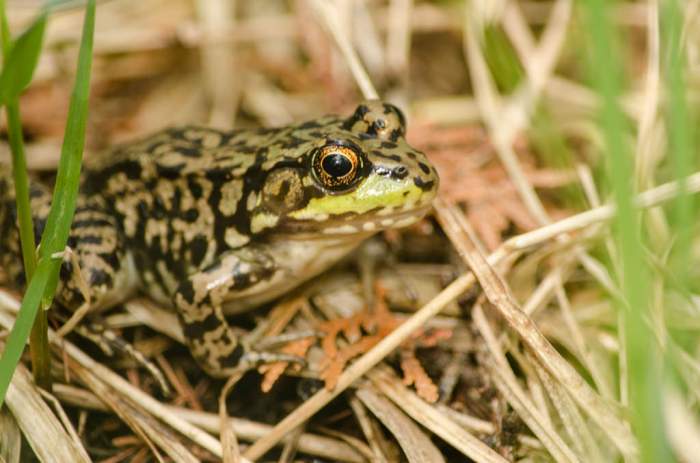
Know Your Michigan Frogs: Mink Frog (Rana septentrionalis)

Michigan Mink Frog

mink frog-0376, photo by tifranta

Saturday was World Frog Day so let’s add another Michigan frog to the list, the Mink Frog (Rana septentrionalis) about which the DNR says:

A blotchy, spotted, greenish or brownish frog. Similar to Green Frog, but has spots or blotches instead of cross bands on the hind legs. Bright green upper lip and creamy to yellowish belly. Produces a musky, mink like odor when handled. Medium – 2 to 3 inches long.

HABITAT: Bogs, ponds, and lake edges. Remains close to permanent water.

BREEDING: June-July. Eggs laid on vegetation in deep water. Tadpoles may require more than one summer to become frogs.

VOICE: Likened to distant hammering; “Kuk, kuk, kuk, kuk, kuk.”

RANGE AND STATUS: Found throughout Upper Peninsula, but generally uncommon.

Click over to the Wisconsin Sea Grant to hear the Mink frog’s call.

View Tiffany’s photo bigger, see more in her slideshow, and follow her at Tiffany Rantanen Photography on Facebook!

More Michigan frogs on Michigan in Pictures.

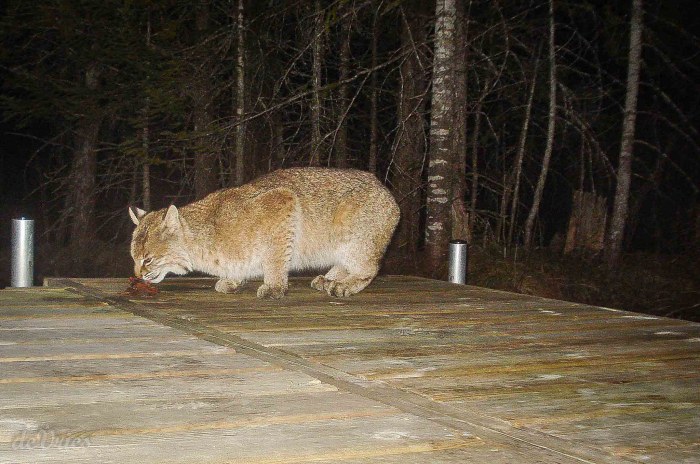
Lynx rufus, Bobcat in Michigan

It’s feeling like Wild Kingdom week at Michigan in Pictures. An update on the eagle nest from yesterday is that one of the eggs is now an eaglet – click to view!!

Bobcat on the Dock

Close Encounter…, photo by Dale DeVries

Dale writes that this close encounter was…

Of the Kitty Cat kind! Around dusk last night I saw the flash from my trail cam go off, so I grabbed binoculars to see what was on the dock. It was so dark I really could not make out what was there, I assumed it to be a raccoon or two. I was quite surprised to see this beautiful Bobcat patrolling the water’s edge!

The UM Animal Diversity Web’s entry for Lynx rufus, the bobcat says (in part):

Bobcats can be found in a variety of habitats, including forests, semi-deserts, mountains, and brushland. They sleep in hidden dens, often in hollow trees, thickets, or rocky crevices.

…Bobcat fur can be various shades of buff and brown, with dark brown or black stripes and spots on some parts of the body. The tip of the tail and the backs of the ears are black. They have short ear tufts, and ruffs of hair on the side of the head, giving the appearance of sideburns.

Like many felids, bobcats are solitary animals. The male and female interact almost exclusively during the mating season. These cats rarely vocalize, although they often yowl and hiss during the mating season. Bobcats are basically terrestrial and nocturnal, although they are good climbers and are often active at dusk as well as during the night.

Bobcats are strictly meat eaters. Stealthy hunters, they stalk their prey, then pounce and (if successful) kill with a bite to the vertebrae of the neck. They hunt rodents, rabbits, small ungulates, large ground birds, and sometimes reptiles. They occasionally eat small domesticated animals and poultry.

Bobcats live up to 12 years in the wild. In captivity, they may live up to 32 years.

Read on for more including photos and bobcat calls and in case you’re trying to figure out what you’re looking at, here’s page on distinguishing Michigan cougars & bobcats and another on the difference between bobcat & lynx (Lynx canadensis) that includes their distinct profiles.

View Dale’s photo background big and see more in his Fern Ridge Pictures slideshow.

More Michigan animals on Michigan in Pictures.

Making Decisions about Wolves on Isle Royale


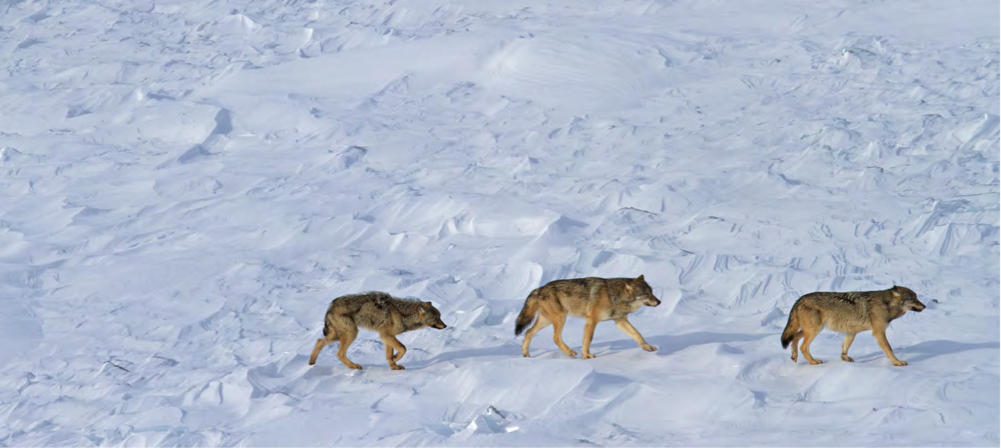
3 Isle Royale wolves 2015

Three Wolves, photo by Vucetich & Peterson

With only a handful of wolves left in Isle Royale National Park, the National Park Service is currently taking public comment on the management of wolves at Isle Royale. They write:

The NPS began this planning process by considering a broad range of potential management actions as part of determining how to manage the moose and wolf populations for at least the next 20 years. However, based on the public comments we received and additional internal deliberations, the NPS has determined that it will revise and narrow the scope of this EIS to focus on the question of whether to bring wolves to Isle Royale National Park in the near term, and if so, how to do so.

Although wolves have not always been part of the Isle Royale ecosystem, they have been present for more than 65 years, and have played a key role in the ecosystem, affecting the moose population and other species during that time. The average wolf population on the island over the past 65 years has been about 22, but there have been as many as 50 wolves on the island and as few as three. Over the past five years the population has declined steeply, which has given rise to the need to determine whether the NPS should bring additional wolves to the island. There were three wolves documented on the island as of March 2015 and only two wolves have been confirmed as of February 2016. At this time, natural recovery of the population is unlikely.

The potential absence of wolves raises concerns about possible effects to Isle Royale’s current ecosystem, including effects to both the moose population and Isle Royale’s forest/vegetation communities. The revised purpose of the plan, therefore, is to determine whether and how to bring wolves to Isle Royale National Park to function as the apex predator in the near term within a changing and dynamic island ecosystem.

The photo above from the 2014-2015 Annual Report from the Vucetich & Peterson Ecological Studies of Wolves on Isle Royale shows three wolves observed at winter study 2015. More on their website at isleroyalewolf.org and definitely follow Wolves and Moose of Isle Royale on Facebook for updates!

More wolves on Michigan in Pictures.

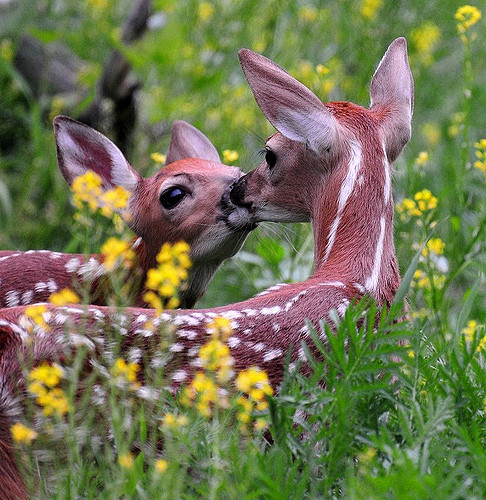
A big smooch for Spring!

Spring Smooches

Kisses…, photo by Julie

All signs are pointing to Spring arriving in Michigan!

View Julie’s photo bigger and see more in her Wildlife slideshow.

Must be a Monday

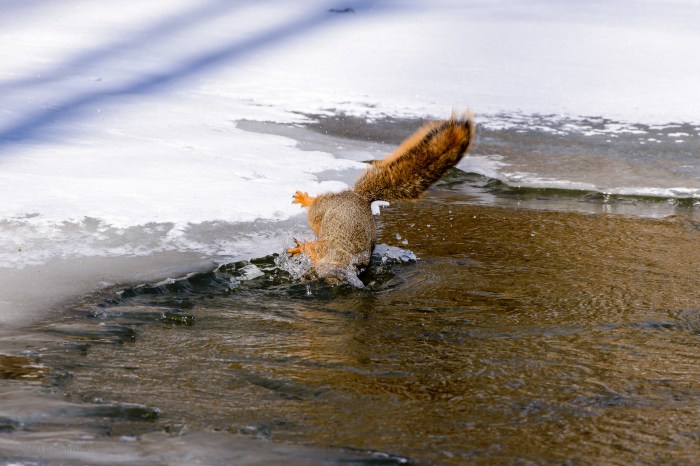
Fox Squirrel Falls in the River

FOX SQUIRREL, photo by John E Heintz Jr

“If one place is as good as any other, it’s high time we decided. Otherwise when we get there, we won’t know we’ve arrived.”
~Dr. Doolittle

I swear that John Heintz is a direct descendent of Dr. Doolittle – gets the best nature photos! View his photo bigger and definitely watch his slideshow for the whole story.

More from the animal kingdom and more funny photos on Michigan in Pictures.

Groundhog Warning!

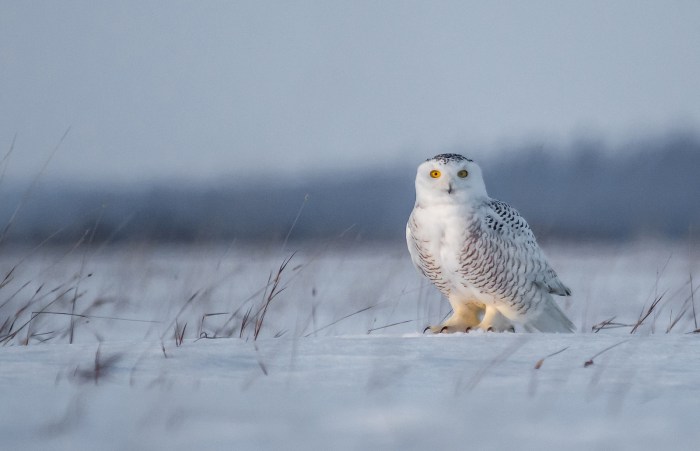
Snowy Owl

Snowy Owl, photo by Kevin Povenz

Any Michigan groundhogs out there probably better just stay inside and check to see what Woody the Woodchuck from the Howell Nature Center predicts. Word is already in from Punxsutawney Phil that we’re in for an early Spring!

You can learn all about Michigan groundhogs/woodchucks and Woody, Michigan’s official groundhog and snowy owls on Michigan in Pictures. One thing about snowy owls that you may not know is that due to their remote existence, they typically don’t have the same fear of humans that other owls exhibit.

Kevin took this gorgeous photo on Saturday near Sault Ste Marie and writes:

Yes I was laying down on my belly in the snow to get this shot. Not the sharpest of shots as there were weeds between me and this snowy and was hard to focus. Should of used manual focus, but I loved the moment. He just kept looking at me probably thinking “what the…?”

View his photo bigger and see more in his Birds of Prey slideshow.

January 20, 1985: The Michigan Moose Lift

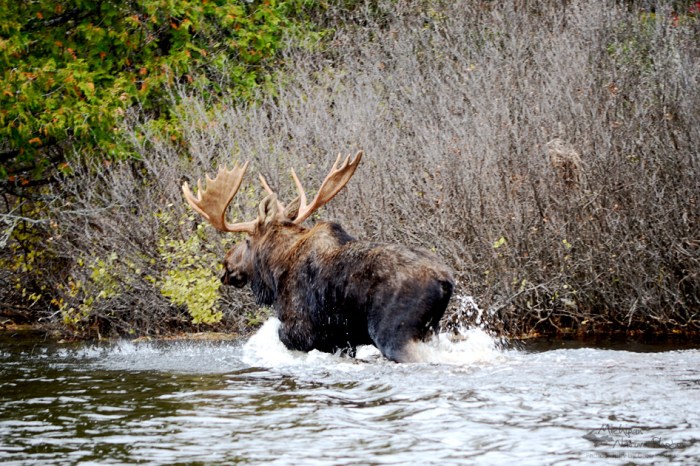
Upper Peninsula of Michigan moose

Upper Peninsula of Michigan moose, photo by Greg Kretovic

Every so often, something I have featured on Michigan in Pictures will vanish from the internet, leaving whatever I shared as the only remaining source. Such is the case with one of my favorite modern Michigan stories, The Michigan Moose Lift of January 20, 1985. Click that link to read about this historic operation that relocated 59 moose from the Algonquin Provincial Park in Ontario and led to the re-establishment of moose in Michigan’s Upper Peninsula – somewhere north of 400 at last estimate*.

Here’s a very cool video from the DNR that does a great job of telling the story. Enjoy!

Greg took this photo of a large bull moose exploring the shoreline of an inland lake in Baraga County in October of 2012. View his photo bigger, see more in his slideshow, and definitely follow him at Michigan Nature Photos on Facebook.

* From the Detroit Free Press article on the latest biennial survey of Michigan’s moose population:

The latest biennial survey by the Department of Natural Resources produced an estimate of 323 moose in their primary Michigan range, which includes Baraga, Iron and Marquette counties. If correct, that would be a decline there of about 28 percent from 2013, when the estimate was 451.

Chad Stewart, a deer, elk and moose management specialist with the DNR, said the population could have held steady since the 2013 count but that the findings, including a decrease in the number of calves spotted with adult females, suggest a decline is the likelier scenario.

It is “quite possible that we’re looking at a considerable drop in numbers,” Stewart said Monday.

A smaller moose herd wanders the eastern U.P. Biologists have long estimated their number at around 100.

MotorCity Horseman

Durell Robinson MotorCity Horsemen

Durell Montgomery of the Motorcity Horsemen, photo courtesy Apiary Projects

Here’s a cool benefit for MotorCity Horsemen at Two James Spirits of Detroit that my friend Andrea Maio of Detroit-based media production company Apiary shared:

Come celebrate the grit, determination and integrity that is #thespiritofdetroit with the December 13, 2015 premiere of our Johnny Smoking Gun Whiskey video featuring Durell Montgomery of MotorCity Horsemen with an original score by Flint Eastwood. Sponsored by Two James Spirits and Johnny Noodle King and produced by Woodbridge based boutique media production company Apiary, in collaboration with Territory Post Production and Assemble sound, the video highlights the story of Durell Montgomery, the dynamic young founder and owner of Motorcity Horsemen; a self identified cowboy who rides his horses along city streets and aims to start a riding center within the city limits of Detroit.

Click for more about MotorCity Horsemen.

The photo is a screen grab from the opening of the video. As promise, here is the video and here’s a link to Motor City Horsemen’s Go Fund Me campaign!