Campus Martius, 1914

Campus Martius, 1914

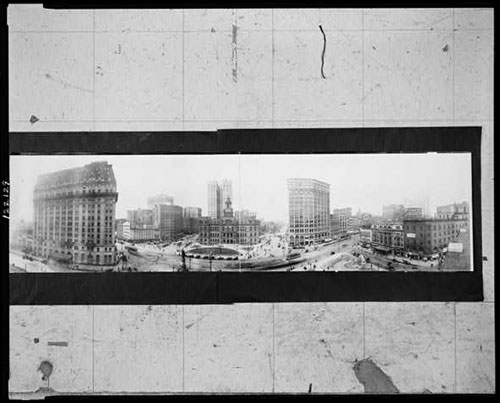
The Library of Congress has this amazing panorama of Detroit's Campus Martius taken in 1914. You can click the photo above for a large panorama and get details on the photograph here (and a link to a 12 MB tiff of the panorama)!!

From the Campus Martius Park web site:

In 1788, Campus Martius served as a drill ground for militia training. Campus Martius means "military ground" and was named after the Campus Martius at Marietta, Ohio, a 180-foot stockade.

After the fire of 1805, Judge Woodward was appointed to oversee the plan to lay out the streets, squares and lots with the assistance of the best surveyors from Canada. They placed their instruments and astronomical devices on the summit of a huge stone. He viewed the planets and meteors in order to determine "true North". Today we still call this point the "Point of Origin" which is located in center of Campus Martius at the junction of Woodward and Monroe. It is from this point that the City of Detroit's Coordinate system was created.

UrbanTiki explains that when it's not hosting the Motown Winter Blast, Campus Martius's hydraulic concert stage allows it to host concerts (photo by ifmuth) and serve as an ice rink (photo by mainegal). SNWEB.org has a great shot of the Point of Origin. (sorry to get all link-happy on you there)

Speaking of link-happy, here's a look by Michigan in Pictures at the Michigan Soldiers & Sailors Monument  which is located in Campus Martius

An Entirely Different Human Shield

moleshield.jpg

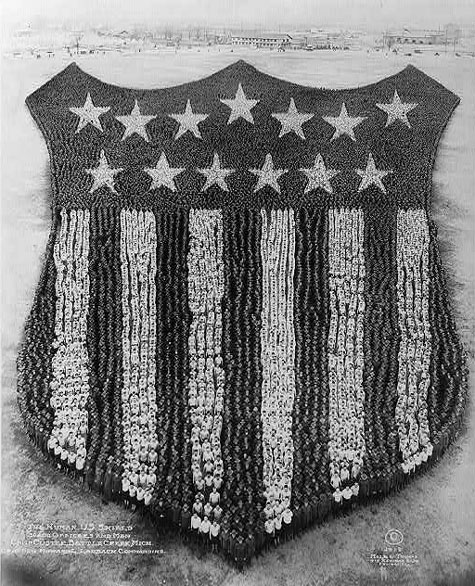
Apparently, we’ll end the week on a military theme. This morning, I stumbled upon a page with some amazing examples of “patriotic photographs in true perspective” produced by Mole & Thomas, a Chicago photography studio. The one above was taken at Camp Custer in Battle Creek, Michigan.

Now if you’re anything like me, you won’t mind a bit more detail on the above photo provided by the George Glazer Gallery of NYC:

Aerial photograph of 30,000 military officers and men at Camp Custer, Battle Creek, Michigan, forming an emblem based on the shield that is part of the design of the great seal of the United States, with 13 stars and 13 vertical stripes. The shield is in front of the bald eagle in the seal design, which was officially adopted by the U.S. Government in 1787. This photograph was taken by Mole & Thomas, a Chicago firm famous for such patriotic bird’s-eye group shots at military bases after World War I. The Library of Congress has eight such photos in their collection, including this one.

Arthur S. Mole was a British-born commercial photographer who worked in Zion, Illinois. During and shortly after World War I, Mole traveled with his partner John D. Thomas from one military camp to another, posing thousands of soldiers to form gigantic patriotic symbols that they photographed from above. The formations depicted such images as the Liberty Bell, the Statue of Liberty, the Marine Corps emblem and a portrait of President Woodrow Wilson. The Wilson portrait, for example, was formed using 21,000 officers and men at Camp Sherman in Ohio and stretched over 700 feet. His “Human Liberty Bell” was composed from over 25,000 soldiers, arranged with Mole’s characteristic attention to detail to even depict the crack in the bell. Mole and Thomas spent a week or more preparing for these immense works, which were taken from a 70- or 80-foot tower with an 11- by- 14-inch view camera. When the demand for these photographs dropped in the 1920s, Mole returned to his photography business in Zion. Photographs by Mole and Thomas are in the collections of the Chicago Historical Society, the Museum of Modern Art and the Library of Congress.

The Glazer Gallery sold this print, but they may have others.

Image Courtesy Library of Congress.