Mighty Michigan Maples vs Acid Rain

mighty maple

mighty maple, photo by aimeeern.

“Though a tree grows so high, the falling leaves return to the root.”
– Malay proverb

A couple of weeks ago we reported on the threat to Michigan Eastern Black Walnut trees from Thousand Cankers Disease, but apparently they’re not the only significant Michigan tree in peril. Now the Wall Street Journal is reporting that scientists are warning that acid rain will damage Great Lakes maples in the coming decades:

Sugar maple abundance already has dropped in parts of the northeastern U.S. and southeastern Canada over the past 40 years, primarily because of high acid levels in soils. The upper Great Lakes have mostly escaped the damage because the area’s soils are rich in calcium, which provides a buffer against acid.

But in an article published this month in the Journal of Applied Ecology, scientists said they had discovered another way that acid rain harms sugar maple seedlings in upper Great Lakes forests.

It causes excessive nitrogen buildups that prevent dead maple leaves from decaying after falling to the ground, hampering growth of new trees, said Donald Zak, a professor of ecology and evolutionary biology at the University of Michigan.

“The thickening of the forest floor has become a physical barrier for seedlings to reach mineral soil or to emerge from the extra litter,” Zak said. “What we’ve uncovered is a totally different and indirect mechanism by which atmospheric nitrogen deposition can negatively impact sugar maples.”

If you’re into plant biology, you might enjoy Simulated N deposition negatively impacts sugar maple regeneration in a northern hardwood ecosystem from the Journal of Applied Ecology. If you’re into fall color or maple syrup, you might enjoy encouraging your elected representatives to take action to protect the future of these glorious trees.

Check this out big as a maple tree and in Amy’s autumn slideshow.

More beautiful maples can be found in our fall wallpaper archives.

The Light at Point Aux Bec Scies

 Pt. Betsie Lighthouse

Pt. Betsie Lighthouse , photo by GLASman1.

Point Betsie Light is one of the most photographed lighthouses in the world. The Friends of Point Betsie website notes that the point was originally known by the French as “Point Aux Bec Scies,” meaning “sawed beak point” and that it was was built in 1858 at a cost of $5000. If you want to get a taste of life at a lighthouse, you can rent the Assistant Keeper’s apartment in the summertime.

Check it out bigger and in Mark’s slideshow.

Much more about Point Betsie Lighthouse on Michigan in Pictures!

Petit Portal and the geology of Pictured Rocks

DSC00824_tonemapped

DSC00824_tonemapped, photo by ansonredford.

While Petit Portal – also called Petit Arch and Arch Rock by some – is often confused with the partially caved in Grand Portal, it’s a smaller and as yet intact formation. You can read about some of these from the Pictured Rocks National Lakeshore website. The two arches (and many cave structures) are formed by the powerful action of Lake Superior waves on the soft sandstone that underlies the harder layers above.

You can read more about the geology of Pictured Rocks from Oh Ranger! (a cool site I just found today) and also this PDF on geology from the Lakeshore. If you want to see them up close, the boat tours from Munising are worth every penny.

Donald took this 5 years ago. Check it out background bigtacular and in his stunning Pictured Rocks Nat’l Lakeshore slideshow which includes some jaw-dropping shots of Chapel Rock and even a look from inside Petit Portal.

Much more on the Pictured Rocks on Michigan in Pictures.

Coming Home

Iraqi child won't let go of Mich. Guardsman

Iraqi child won’t let go of Mich. Guardsman, photo by The National Guard.

The Iraq War began on March 20, 2003 and was formally ended yesterday, December 15, 2011. At 8 years, 9 months it was longer than Vietnam, longer than World War II. This Detroit Free Press article on the costs of the war in Iraq says they include 4,487 dead and 32,226 wounded Americans and over 100,000 Iraqi dead. Michigan’s contribution was at least 159 dead and 1,000 wounded, according to Pentagon records. Military Times has the number at 216, and you can see the list of Michiganders who gave their lives in the Iraq War.

Retired Marine and Iraq vet Steve Maddox says that veteran’s challenges are just beginning and cannot be answered by yellow ribbons or catchy sloganeering. In addition to combat injuries and frightening suicide rates he writes:

I see post-Iraq War challenges that are as big, if not bigger than those we faced as a nation for the past eight years. Iraq and Afghanistan veterans face higher unemployment rates than their contemporaries. In Michigan, with an overall unemployment rate hovering around 10%, Iraq and Afghanistan veterans’ unemployment rate is over 29%, by far the highest in the country.

One of the articles I read noted that we’re not leaving Iraq in very good shape. The Iraqi Hope Foundation was founded by Michigan Tech alum and Iraq veteran Major Don Makay. The foundation seeks to honor the sacrifices of veterans by building stability and prosperity of Iraq through investment in small and mid-level businesses. Read more about it right here.

About this photo, the National Guard says:

U.S. Army Sgt. Thomas Loyd, assigned to Foxtrot Company, 425th Infantry (Long Range Surveillance), Michigan National Guard, based in Selfridge, Mich., holds hands with an Iraqi child in Sununi, Iraq, Oct. 29, 2009. Loyd was standing outside the mayor’s office while a meeting was taking place when the child attached himself to Loyd and would not let go. (U.S. Navy photo by Mass Communication Specialist Carmichael Yepez/Released)

See it background big and see a few more in their Michigan slideshow.

Charles W. Howard Santa Claus School in Midland

Santa Chair

Santa Chair, photo by LadyDragonflyCC -See through my eyes!.

“He errs who thinks Santa enters through the chimney. Santa enters through the heart.”
– Charles W. Howard

The Charles W. Howard Santa Claus School in Midland was established in 1937 and is the longest continuously running Santa Claus School in the world. The school is a nonprofit and seeks to uphold the traditions and history of Santa Claus and to help its students improve their presentations of Santa Claus. A nice feature on the school in the LA Times explains that:

Howard, the school founder, was a Santa with an impressive resume that included being St. Nick for Macy’s. He opened the school in 1937 after coming across too many other Santas with frayed beards, shoddy suits and limited knowledge of reindeer. (current director Tom) Valent took over the school in 1986 and retains most of Howard’s original curriculum, along with modern additions such as contract issues and how to endure the rigors of being a mall Santa (get a flu shot and negotiate regular bathroom breaks).

…Valent’s cheerful demeanor belies the seriousness with which he approaches his mission of ensuring that Santa Claus embodies perfection, from fresh breath and clean whiskers to impeccable morals. He’s not here to get these Santas jobs — the school has no placement services. He’s here to make sure that whether they play Santa in malls or parades, or in hospitals, homeless shelters or private parties, they do it flawlessly.

“It’s a privilege to be Santa Claus,” said Valent, who has been Santa Claus himself for 35 years, from Greenland to Midland. “You’re taking on a character that stands for all good things.”

Be sure to check out their photo gallery on Facebook, and if you’re interested, the 2012 Santa School takes place October 18th – 20th and is taking reservations now.

Speaking of Santa, yesterday on Absolute Michigan we had an in-depth feature on including charities in your holiday gift plans that might give you chance to share some of that Santa spirit.

Check this out on black and in Christine’s My Favs slideshow.

Loop and Swirl – Superior Falls (Wisconsin/Upper Michigan Border)

Loop and Swirl - Superior Falls (Wisconsin/Upper Michigan Border)

Loop and Swirl – Superior Falls (Wisconsin/Upper Michigan Border), photo by Aaron C. Jors.

On Saturday we dove into Mittengate – the lighthearted battle between Michigan & Wisconsin over the Badger State’s use of the mitten in tourism promotion.

To help keep the cheese-loving hordes at bay, we’re lucky to have the Montreal River and Superior Falls! GoWaterfalling’s page on Superior Falls explains:

Superior Falls is located on the Montreal River just a few hundred yards from Lake Superior. The Montreal River forms part of the border between Michigan and Wisconsin so the falls is technically in both states, but it is most easily visited from the Michigan side. I do not know if it can be visited from the Wisconsin side.

This is an impressive waterfall consisting of several drops and some very dramatic gorge walls. Unfortunately there is a dam a short distance above the falls and most of the water is diverted for power generation. The power company is required to maintain at least 20 cubic feet of water per second flowing over the falls. Early spring is the best time to see the falls…

The fence is a bit frustrating and often blocks your view, but it also will save you from a long, long fall into the gorge. The overlook is at the top of the gorge wall pictured below.

They also note that Northern States Power operates the Superior Falls Hydro plant in the area – you can see more photos of the falls and of the small power plant at the unofficial Superior Falls homepage.

Check this photo out bigger and in Aaron’s Waterfalls sideshow. He also has a great photo of Tannery Falls on Michigan in Pictures and there’s tons more Michigan waterfalls in our Waterfall category!

Christmas Moon, Snow Moon, Cold Moon, Oak Moon, December Moon

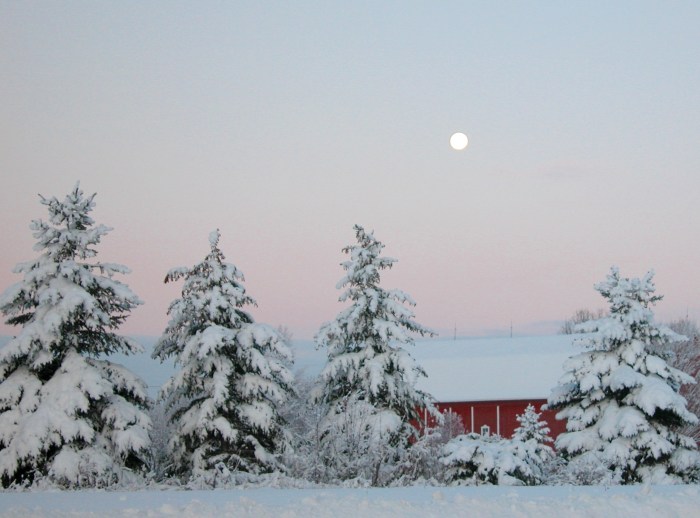
Crisp Morning in December

Crisp Morning in December, photo by CaptPiper.

The moon is officially full at 9:36 AM tomorrow morning, so tonight is the fullest moon you will get for a December night. Full Moon Names in the Farmer’s Almanac says that December’s full moon was known as the Cold Moon or the Long Nights Moon by the Algonquin.

The Full Cold Moon; or the Full Long Nights Moon – December During this month the winter cold fastens its grip, and nights are at their longest and darkest. It is also sometimes called the Moon before Yule.

The term Long Night Moon is a doubly appropriate name because the midwinter night is indeed long, and because the Moon is above the horizon for a long time. The midwinter full Moon has a high trajectory across the sky because it is opposite a low Sun.

A few other names from Wikipedia’s full moon entry and elsewhere are the Bitter Moon (Chinese), Christmas Moon (Colonial America), Snow Moon (Cherokee), and Oak Moon (England).

Check this out background bigtacular and in Julie’s Michigan Barns slideshow.

More winter wallpaper from Michigan in Pictures.

Remembering Michigan’s legendary architect Albert Kahn

Albert Kahn's legacy

Albert Kahn’s legacy, photo by .brianday.

“Architecture is 90 percent business and 10 percent art.”
~Albert Kahn

Legendary Detroit architect Albert Kahn died on December 8, 1942. The Albert Kahn entry at Wikipedia begins:

Kahn was born on March 21, 1869 in Rhaunen, Rhineland-Palatinate, Germany. Kahn came to Detroit in 1880 at the age of 11. His father Joseph was trained as a rabbi. His mother Rosalie had a talent for the visual arts and music. As a teenager, he got a job at the architectural firm of Mason and Rice. Kahn won a year’s scholarship to study abroad in Europe, where he toured with another young architecture student, Henry Bacon, who would later design the Lincoln Memorial in Washington, D.C.

The architectural firm Albert Kahn Associates was founded in 1895. He developed a new style of construction where reinforced concrete replaced wood in factory walls, roofs, and supports. This gave better fire protection and allowed large volumes of unobstructed interior. Packard Motor Car Company’s factory built in 1907 was the first development of this principle.
The success of the Packard plant interested Henry Ford in Kahn’s designs. Kahn designed Ford Motor Company’s Highland Park plant, begun in 1909, where Ford consolidated production of the Ford Model T and perfected the assembly line. On Bob-Lo Island, Henry Ford had a dance hall designed and built by Albert Kahn, which was billed as the second largest in the world in a 1903 account…

Ten Albert Kahn designed buildings are recognized with Michigan historical markers:

    • Battle Creek Post Office
    • The Dearborn Inn
    • Detroit Arsenal Tank Plant in Warren, Michigan
    • Edsel and Eleanor Ford House in Grosse Pointe Shores, Michigan
    • Fisher Building
    • Delta Upsilon Fraternity, 1331 Hill St., Ann Arbor
    • Packard Motor Car Company factory
    • The Detroit News
    • The Detroit Free Press
    • Willow Run

Get the complete list of his firm’s buildings (including the Russell Industrial Center) at Wikipedia. The company that Kahn founded in 1895 is still in the business. There’s an interesting biography of Albert Kahn from Ford that notes that a Detroit sculptor recognized Albert’s artistic talent and allowed him to attend his art school free. However, after discovering that Kahn was color blind, the artist encouraged him to become an architect and secured him a job as an office boy.

Check this photo out bigger and see more in Brian’s Detroit Flavor slideshow. Coincidentally enough, Brian just let me know that this photo is being hung in a gallery today along with 10 other prints from Brian (and another 10 from two other michpics regulars,  Jon DeBoer and Jeff Gaydash) at Studio Couture gallery, 1433 Woodward Avenue. Opening night for the exhibition will be this Saturday from 6pm-9pm. Details right here!

More Michigan architects & architecture from Michigan in Pictures.

Hasselblad: White Fish Falls

White Fish Falls

White Fish Falls, photo by Sean Depuydt.

I think these are the lower falls on the Laughing Whitefish River in the U.P. Read more about Laughing Whitefish Falls from Michigan in Pictures.

Check this out on black and in Sean’s gorgeous Hasselblad slideshow.

More black & white photography on Michigan in Pictures.

A long shot in Vehicle City

A long shot

A long shot, photo by flintstoner.

Editor’s note: Midway through writing this post, I realized that I had blogged about the Vehicle City arches four years ago. I figured that if I had forgotten, most of you probably would have forgotten too or never seen it, so here you go.

Last week Governor Rick Snyder appointed Michael Brown as Emergency Manager for Flint. You can read all about that (including some interviews) on Absolute Michigan.

When I was looking at photos for that feature, this one with all the arches on Saginaw street caught my eye so I decided to learn a little more about them. Flinn’s Journal (which is a really cool site by the way that has a dynamic Facebook page) has a column on the Flint Arches that explains:

On November 29, 2003, a part of downtown Flint’s past officially returned to become part of Flint’s present and future when the replicated Flint Vehicle City arches were dedicated and lit for the first time. The arches are reminders of Flint’s glorious past as “The Vehicle City” as the city faces an uncertain future.

The vehicles which were made in Flint when the original arches were built were horse-drawn carriages. The leading maker of horse-drawn carriages in Flint was the Durant-Dort Carriage Company which was co-founded by William C. Durant and J. Dallas Dort and was in business from 1886 to 1917. Both men would also start companies which made horseless carriages. Dort founded the Dort Motor Car Company which was in business from 1915 to 1923. Dort Highway was named in his honor. Durant took over the then-small Buick Motor Company in 1904 and made it the leading motorcar company in 1908, the year that Durant founded Buick’s parent company General Motors Corporation. The first arches were erected in 1899 and built by Genesee Iron Works.

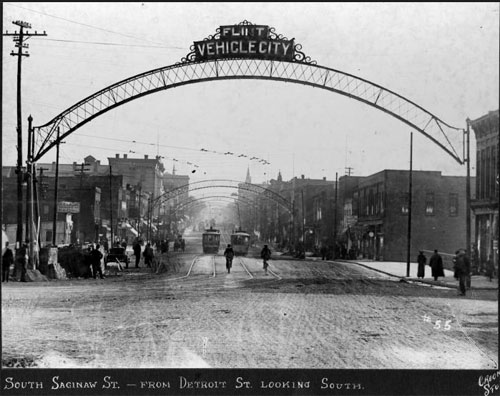
The arches were each fitted with 50 light bulbs which were illuminated at night. The arches replaced gas lighting. To celebrate Flint’s Golden Jubilee in 1905, an additional arch was erected near the point where Saginaw Street and Detroit Street (now M.L. King Ave.) split off north of the bridge over the Flint River. This arch was topped off by an illuminated sign saying “FLINT VEHICLE CITY”. For the Christmas holiday season, the regular light bulbs were replaced by multicolored light bulbs.

Click above to read more and see some photos. The arches were fabricated by Bristol Steel of Davison Michigan – check their site for photos and video of the installation. You can see some cool old photos at the Flint Vehicle City Arches site too.

Check this out background bigtacular and in flintstoner’s Flickriver.

Below is a photo by Arthur Crooks from the excellent Making of Modern Michigan gallery showing the Vehicle City Arch erected in 1905 as part of the City’s 50th anniversary. The caption of the photo says “South Saginaw St from Detroit Street looking South” while the description says it’s on Saginaw Street looking north. Can anyone clarify this?