
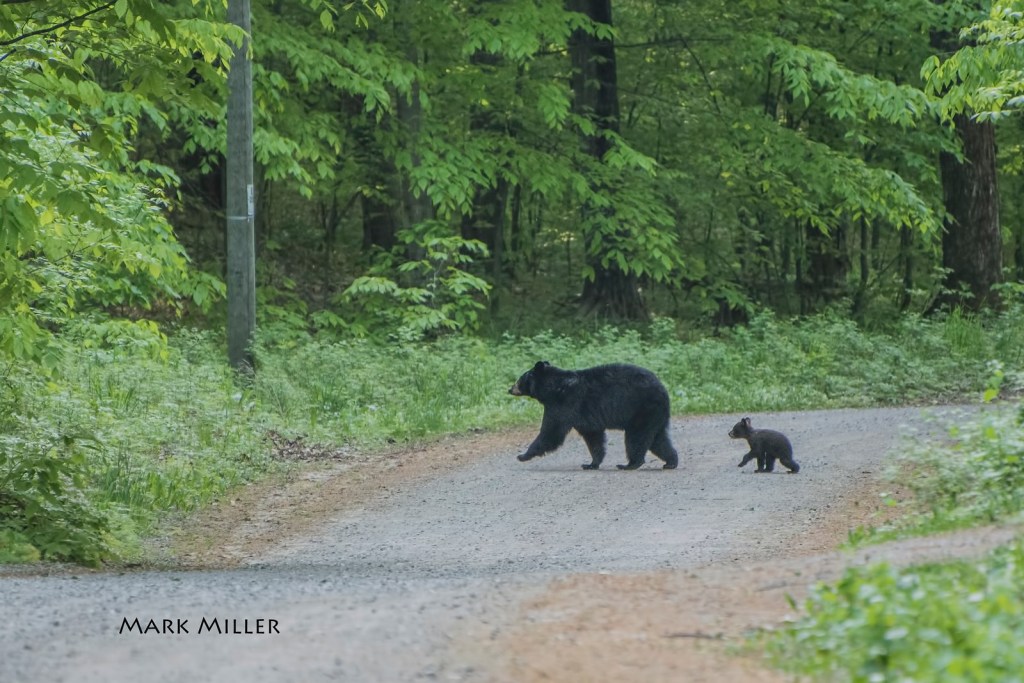
Saturday Morning Stroll by Mark Miller
We interrupt our mostly Michigan content to bring you important news about Alaska’s Fat Bear Week online competition! Some of the largest brown bears on the planet make their home at Brooks River in Katmai National Park, and in addition to being adorably chonky, the fattest bears are best prepared for winter hibernation.
While Michigan doesn’t have brown bears, our native black bear population is also out there in the woods right now, actively searching for the raw materials to pack on the pounds. The Michigan DNR says that about about 13,000 American black bears live in Michigan. Most of them (around 11,000) live in the Upper Peninsula with around 1,700 in the northern Lower Peninsula. Their Living with Black Bears guide says that the black bear is the only species of bear with an average lifespan of 10 years in the wild. Male black bears live in an area about 100 square miles or more in size, while females live in smaller areas about 10 to 20 square miles. They are solitary animals, a sow (female bear who has birthed at least one cub) and her cubs may be seen together.
Black bears can have various color phases including black (most common in Michigan), brown and cinnamon. In Michigan, adult female black bears range from 100 to 250 pounds while adult males can weigh up to 400 pounds. Adult black bears measure about three feet high on all fours & five feet tall when standing upright.
Black bears are omnivorous & will travel great distances to find food, opportunistically feeding on both plants and animal including tender vegetation, nuts, berries, and insects. Black bears are generally fearful of humans and will leave if they are aware of your presence, but human foods, garbage, pet foods, & birdseed can definitely draw them to your door! In the rare circumstance that a bear doesn’t turn and leave, try to scare it off by yelling while leaving a clear, unobstructed escape route for the bear. If the bear stands its ground, makes threatening sounds or bluff charges, you are too close. Take slow steps backward while continuing to talk to the bear in a stern tone. In the rare event of an attack, fight back with a backpack. DO NOT run or play dead.
Mark captured these black bears out for a Saturday morning stroll near Empire back in June of 2015. You can see more in his In In My Backyard gallery on Flickr.

 Michigan in Pictures
The bear and cub are so cute! I follow a wildlife photographer in British Columbia and he has a lot of bears and bear cubs too through the years. I like Mark’s bears and I looked at his “My Backyard Gallery” – wow. They are all beautiful photos and the close-ups of the Ruby-throated Hummingbird with the sparkling plumage, but my favorite has to be the birds with the icicles, one clinging with its feet to an icicle. There were other beautiful birds as well, the always-cut Titmouse for example.
LikeLiked by 1 person
Mark has gotten some great pictures over the years but those are really special. Totally jealous of his life in Empire with those awesome dogs!! <3
LikeLiked by 1 person
I liked Mark’s dog pics too.
LikeLiked by 1 person
Those black bear triplets are adorable – I didn’t see them until after I wrote my other comment. I was laughing on “X” when the National Park Service said how they weighed the bears with a bathroom scale, then clarified it. :)
LikeLiked by 2 people