
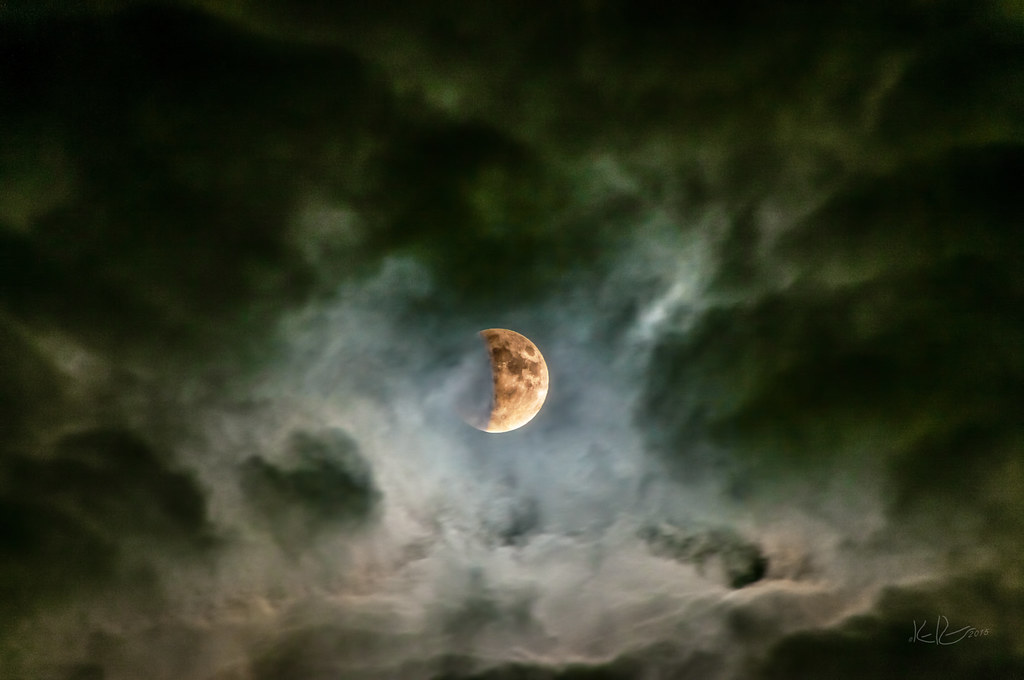
Super Moon Total Lunar Eclipse by Kenneth Raymond
Bridge Michigan shares that the supermoon tomorrow night (September 17) could be (literally) overshadowed by another astronomical event, a partial lunar eclipse:
Full moons are likely every month, but supermoons, which occur when the moon is closest to Earth, are rarer. Only 25% of all full moons are supermoons, according to NASA. The next ones are Oct. 17 and Nov. 15. But the September supermoon will be brighter and red because of the partial lunar eclipse, which is when the Earth passes between the sun and the moon, and casts its shadow on the moon.
“Supermoon is a popular science term for when full moons occur close to the perigee of the moon’s orbit about Earth,” said Seth Jacobson, natural science professor at Michigan State University.
“Lunar eclipses occur at full moons when the sun, Earth and moon are all in the same plane and in that order. In this case, the moon will simultaneously be closer and in almost the exact same plane, so we get a partial lunar eclipse and a supermoon at the same time. The chance of both occurring during the same full moon cycle is about 5% or once every one-and-a-half years,” Jacobson said.
The partial eclipse is predicted at 10:44.
I’ve featured this sweet shot Kenneth took this during the total lunar eclipse of Steptember 27, 2015 before & I will probably do so again! See more in his Night Sky gallery on Flickr and view & purchase his work on his website.

 Michigan in Pictures