
EDIT: WOW!! Check out the video that Tudor did at Forty Mile Point, The Grand Hotel and Fort Mackinac!
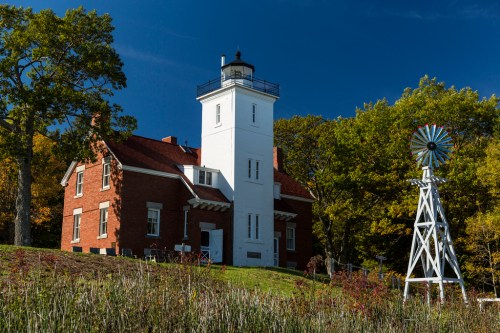
2013_10_11-WTA-5DM3-4448, photo by Tudor ApMadoc
Wikipedia’s U.S. Lighthouses entry says that the United States has had approximately a thousand lights as well as light towers, range lights, and pier head lights. With the second longest coastline in the U.S. and a history of vibrant trade across the Great Lakes, it makes sense that Michigan has the most lights of any state with over 150 past and present lights (166 by their count and as many as 247 by some). While the current number varies depending on who you talk to, 115 seems to be the accepted number.
Terry Pepper’s Seeing the Light is a fabulous guide to the lighthouses of the Great Lakes and definitely a resource to review before you visit a Michigan lighthouse. The Forty Mile Point Light entry in explains:
While the Presque Isle Peninsula had been lighted since 1840, and the entrance to the Cheboygan River fifty miles to the north had been lighted since 1851, the New Presque Isle Light’s range of visibility of 19 miles and the Cheboygan Light’s visible range of 13 miles left an unlighted 18 mile intervening stretch of coastline along which mariners were forced to navigate blind. In it’s annual report for fiscal 1890, the Board recommended that $25,000 be appropriated for the construction of a new light and fog signal at Forty Mile Point near Hammond’s Bay, at the approximate mid point between the two lights.
(the project languished for nearly 60 years until…)
Eleventh District Engineer Major Milton B. Adams selected and surveyed the site for the new Light. With an offer of $200 for the property accepted by the owner, Adams approved the plans and specifications for the station in February 1896. Contracts for the ironwork for the lantern, gallery, boilers and fog whistles were awarded soon thereafter, and with receipt of the materials at the Detroit depot, were loaded aboard the lighthouse tender AMARANTH and delivered to the site on July 5, 1896. Work at the site began with the construction of a wood-framed building, which would be used by the work crew as a temporary dwelling during construction, and converted into a barn for the keeper’s horses on the completion of the work.
Adams’ plan for the main lighthouse structure was a virtual duplicate of that simultaneously under construction at Big Bay Point on Lake Superior. Consisting of a duplex dwelling with a tower incorporated into the center of one side-wall, the structure stood 35 feet by 57 feet in plan. Erected on a 20″ thick cut limestone foundation, the brick walls featured double walls with an air space between to provide insulation. The integrated tower stood twelve feet in plan, and fifty-two feet in height. The apartments on each side of the dwelling were exact mirrored duplicates and were set-up to afford complete privacy. Each apartment featured its own main entry, cellar, kitchen, parlor, tower entry door and stairway to the bedrooms on the second floor. Indicative of Adam’s thoughtfulness in designing the structure, each of the stairways incorporated a skylight in its ceiling through which the lantern could be observed, thereby allowing both keeper and his assistant to verify the correct operation of the light from within the warmth of their apartment without having to leave the building or climb to the top of the tower itself to see the light. The brick tower was capped by a square gallery with iron safety railing, and a prefabricated octagonal cast iron lantern erected at its center.
Read on for more at Seeing the Light and also check out this shot of the construction crew posing in front of the lighthouse in 1896. Forty Mile Point Light is now a museum, click here to visit their website for more including directions.
Check this photo out bigger, have a look at this panoramic shot of the light and see more in Tudor’s 2013-10 Fall Trip slideshow.
Many more Michigan lighthouses on Michigan in Pictures.
 Michigan in Pictures