
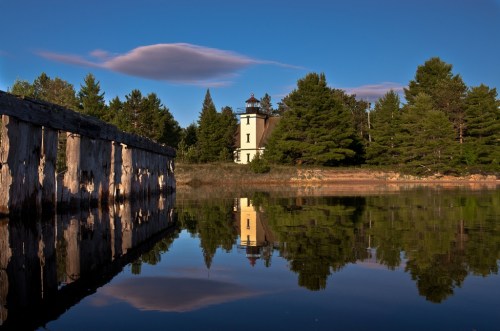
Bete Grise Lighthouse, photo by Steve Nowakowski
Terry Pepper’s Seeing the Light page for the Medota Channel Light says that in response to increasing industrialization around Lac LaBelle, a cut was created from the Lake Superior into Lac LaBelle to allow access to the big ships that plied the Great Lakes.
As a result, the construction of the Mendota Light was first considered by the US Congress in 1867, when an appropriation of $14,000 for the construction of a light station was approved on March 2, with the terms of the contract called for construction of the structure to begin in 1869, with final completion no later than November 1870.
Later that year, it was realized that declining industrial development in the area would no longer support the planned deepening of the cut into Lac Labelle, and it was deemed that the light would serve no purpose. Decommission was ordered, and instructions to dismantle the structure were issued to the crew of the steamer “Haze,” with all equipment to be returned to USLHS headquarters in St. Joseph for eventual reuse. (The lens and mechanics were later reused in the Marquette Breakwater light.)
Thus, the Mendota light station was decommissioned before it saw real service, and the structure sat idle and blinded for the following twenty two years.
In the following years, Great Lakes shipping increased dramatically, and many ships rounding the Keweenaw began using Bete Grise Bay as a shelter during rough seas. In 1892 it was determined that a reactivation of the Mendota light, along with relocation closer to the bay would make bay entry a far safer proposition for such ships seeking shelter. Authorization for reactivation was issued on February 15, 1893, and $7,500 was appropriated to cover the expenses.
Read on for more about this light.
Check Steve’s photo out background bigtacular and see more in his Bete Grise Lighthouse slideshow.
There’s lots more lighthouses on Michigan in Pictures and you might also want to check out the vantage from Bare Bluff on Bete Gris Bay!
 Michigan in Pictures