
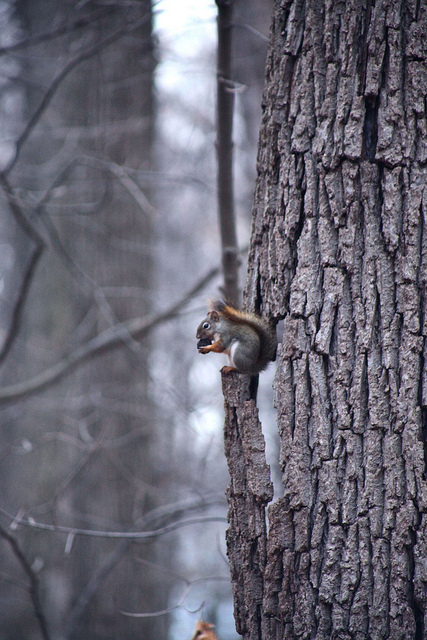
pine squirrel in winter coat, photo by jb goodwater
The University of Michigan Museum of Zoology Animal Diversity Web is a massive online database of animal natural history, distribution, classification and conservation biology. Their entry for Tamiasciurus hudsonicus red squirrel says (in part) that:
Red squirrels occupy northern boreal coniferous forests abundant with conifer seeds, fungi, and interlocking canopies … Populations of red squirrels occur in different habit conditions due to the vastness of their range. They occur in both temperate and polar environments and are considered to be primarily arboreal. They can be found in a mixed variety of forests including coniferous, deciduous, and mixed forests and they are also able to thrive in suburban and urban settings, as long as cool, coniferous forests with dense, interlocking canopies and abundant fungal resources are present.
Red squirrels differ from other tree squirrels by their deep reddish color, territorial behavior, and their smaller body size. They are less than 30% the size of grey squirrels (Sciurus carolinensis). While size and pelage color can vary geographically, they generally have a reddish back and white underside that is demarcated by dark lateral lines, which are especially visible in summer. A white eye ring is present year-round and tufted ears are during the winter.
Read on for a whole lot more including photos, lifespan (5 years average), how they communicate and mark their territory, and what they eat (and what eats them).
Check this photo out background bigtacular and see more in Joshua’s slideshow.
More squirrels on Michigan in Pictures.
 Michigan in Pictures