
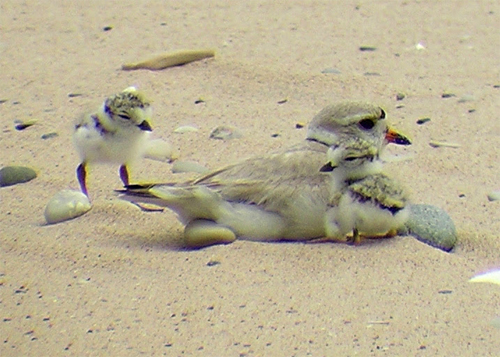
Adult Piping Plover caring for her chicks, photo courtesy National Park Service
The Sleeping Bear Dunes National Lakeshore page on piping plovers begins:
The Piping Plover (Charadrius melodus) is an endangered shorebird. They are sand-colored on the back and white below. During the breeding season adults have a black forehead band between the eyes and a single black band around the neck. (Its larger relative the Killdeer is commonly seen at parks, playgrounds, and golf courses, and has two dark bands around the neck.) Piping Plovers nest only on beaches and prefer beaches with cobble. There are three small populations: one in the Great Plains, one on the Atlantic Coast, and the one here in the Great Lakes. They winter together on the Gulf Coast but travel to the separate areas during the breeding season. It is a special opportunity to be able observe Piping Plovers since there are only between 50 and 60 nesting pairs in the entire Great Lakes area and less than 5000 individuals worldwide.
You can read more about piping plovers at All About Birds where they also have some photos, a plover call and a video. You can also check out a video of a piping plover feeding from the other side of the state on Saginaw Bay.
The Sleeping Bear Dunes National Lakeshore reports that four pairs of this federally endangered shorebird have made the Glen Haven beach their home for the summer. It’s an easily accessible location that provides visitors an excellent opportunity to view a rare bird in its natural habitat. While the entire shoreline will be open for walking, certain areas of the beach will be temporarily closed to all entry.
More photos of piping plovers from Alice van Zoeren and the Sleeping Bear Dunes National Lakeshore.
 Michigan in Pictures
2 thoughts on “Piping Plover (Charadrius melodus)”